Results by title
754 books match the query 'Native American Studies' and 6 start with y
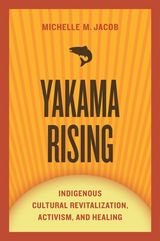
Yakama Rising
Indigenous Cultural Revitalization, Activism, and HealingMichelle M. Jacob
University of Arizona Press, 2013
The Yakama Nation of present-day Washington State has responded to more than a century of historical trauma with a resurgence of grassroots activism and cultural revitalization. This pathbreaking ethnography shifts the conversation from one of victimhood to one of ongoing resistance and resilience as a means of healing the soul wounds of settler colonialism. Yakama Rising: Indigenous Cultural Revitalization, Activism, and Healing argues that Indigenous communities themselves have the answers to the persistent social problems they face. This book contributes to discourses of Indigenous social change by articulating a Yakama decolonizing praxis that advances the premise that grassroots activism and cultural revitalization are powerful examples of decolonization.
Michelle M. Jacob employs ethnographic case studies to demonstrate the tension between reclaiming traditional cultural practices and adapting to change. Through interviewees’ narratives, she carefully tacks back and forth between the atrocities of colonization and the remarkable actions of individuals committed to sustaining Yakama heritage. Focusing on three domains of Indigenous revitalization—dance, language, and foods—Jacob carefully elucidates the philosophy underlying and unifying each domain while also illustrating the importance of these practices for Indigenous self-determination, healing, and survival.
In the impassioned voice of a member of the Yakama Nation, Jacob presents a volume that is at once intimate and specific to her home community and that also advances theories of Indigenous decolonization, feminism, and cultural revitalization. Jacob’s theoretical and methodological contributions make this work valuable to a range of students, academics, tribal community members, and professionals, and an essential read for anyone interested in the ways that grassroots activism can transform individual lives, communities, and society.
[more]
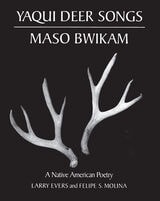
Yaqui Deer Songs/Maso Bwikam
A Native American PoetryLarry Evers and Felipe S. Molina
University of Arizona Press, 1987
Winner of the American Folklore Society’s Chicago Folklore Prize
Yaqui regard song as a kind of lingua franca of the intelligent universe. It is through song that experience with other living things is made intelligible and accessible to the human community. Deer songs often take the form of dialogues in which the deer and others in the wilderness world speak with one another or with the deer singers themselves. It is in this way, according to one deer singer, that “the wilderness world listens to itself even today.”
In this book authentic ceremonial songs, transcribed in both Yaqui and English, are the center of a fascinating discussion of the Deer Song tradition in Yaqui culture. Yaqui Deer Songs/Maso Bwikam thus enables non-Yaquis to hear these dialogues with the wilderness world for the first time.
[more]
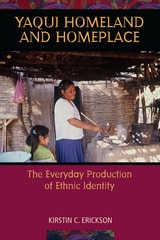
Yaqui Homeland and Homeplace
The Everyday Production of Ethnic IdentityKirstin C. Erickson
University of Arizona Press, 2008
In this illuminating book, anthropologist Kirstin Erickson explains how members of the Yaqui tribe, an indigenous group in northern Mexico, construct, negotiate, and continually reimagine their ethnic identity. She examines two interconnected dimensions of the Yaqui ethnic imagination: the simultaneous processes of place making and identification, and the inseparability of ethnicity from female-identified spaces, roles, and practices.
Yaquis live in a portion of their ancestral homeland in Sonora, about 250 miles south of the Arizona border. A long history of displacement and ethnic struggle continues to shape the Yaqui sense of self, as Erickson discovered during the sixteen months that she lived in Potam, one of the eight historic Yaqui pueblos. She found that themes of identity frequently arise in the stories that Yaquis tell and that geography and location—space and place—figure prominently in their narratives.
Revisiting Edward Spicer’s groundbreaking anthropological study of the Yaquis of Potam pueblo undertaken more than sixty years ago, Erickson pays particular attention to the “cultural work” performed by Yaqui women today. She shows that by reaffirming their gendered identities and creating and occupying female-gendered spaces such as kitchens, household altars, and domestic ceremonial spaces, women constitute Yaqui ethnicity in ways that are as significant as actions taken by males in tribal leadership and public ceremony.
This absorbing study contributes new empirical knowledge about a Native American community as it adds to the growing anthropology of space/place and gender. By inviting readers into the homes and patios where Yaqui women discuss their lives, it offers a highly personalized account of how they construct—and reconstruct—their identity.
[more]

Yaqui Myths and Legends
Ruth Warner Giddings
University of Arizona Press, 1968
Sixty-one tales narrated by Yaquis reflect this people's sense of the sacred and material value of their territory.
[more]
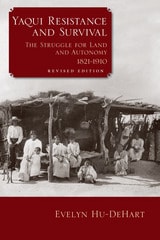
Yaqui Resistance and Survival
The Struggle for Land and Autonomy, 1821–1910Evelyn Hu-DeHart
University of Wisconsin Press, 2016
Evelyn Hu-DeHart brings into focus the Yaqui in the nineteenth century, as the newly independent Mexico lurched through immense economic and governmental transformations, wars, insurgencies, and changing political alliances. This history includes Yaqui efforts to establish a native republic independent of Mexico, their resistance against government efforts to reduce their communal land to individual holdings, the value of their labor to mining and agricultural companies in northwest Mexico, their several revolts and guerrilla actions, the massive deportation of Yaquis from Sonora to Yucatán, the flight of some Yaquis across the U.S. border to Arizona, and their role in the 1910 Mexican Revolution.
In this revised edition of her groundbreaking work, Hu-DeHart reviews and reflects on the growth in scholarship about the Yaqui, including advances in theoretical frameworks and methodologies on borderlands, transnationalism, diaspora, and collective memory that are especially relevant to their history.
In this revised edition of her groundbreaking work, Hu-DeHart reviews and reflects on the growth in scholarship about the Yaqui, including advances in theoretical frameworks and methodologies on borderlands, transnationalism, diaspora, and collective memory that are especially relevant to their history.
[more]
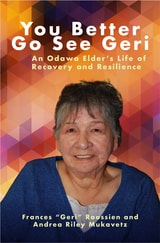
You Better Go See Geri
An Odawa Elder’s Life of Recovery and ResilienceFrances “Geri” Roossien
Oregon State University Press, 2021
Born into an Odawa family in Michigan in 1932, Frances “Geri” Roossien lived a life that was both ordinary and instructive. As a child, she attended Holy Childhood Boarding School; as an adult, she coped with her trauma through substance abuse; and in recovery she became a respected elder who developed tribally centered programs for addiction and family health, including the first Native American Recovery Group.
While a graduate student, Andrea Riley Mukavetz was invited into Geri’s home to listen to her stories and assist in compiling and publishing a memoir. Geri wanted her stories to serve as a resource, form of support, and affirmation that Indigenous people can be proud of who they are and overcome trauma. Geri hoped to be a model to current and future generations, and she believed strongly that more Indigenous people should become substance abuse counselors and work with their communities in tribally specific ways.
Geri died in 2019, but Riley Mukavetz carried on the work. This book presents Geri’s stories, lightly edited and organized for clarity, with an introduction by Riley Mukavetz that centers Geri’s life and the process of oral history in historical and theoretical context.
[more]