Results by title
637 books match the query 'Political activity' and 6 start with y
Yes Gawd!
How Faith Shapes LGBT Identity and Politics in the United StatesCravens III, Royal G.
Temple University Press, 2024
Cravens also demonstrates the mobilizing power of faith for LGBT people by contrasting the effects of participation in faith and secular communities on political activism. He explores how factors such as coming out, race, and LGBT-affirming churches influence political attitudes and behavior and explains how the development of LGBT politico-religious activism provides opportunities for LGBT people to organize politically.
Ultimately, Cravens provides a cohesive account of how religion acts as a catalyst for and facilitator in the political development of LGBT people in the United States. In the process, he shows that there is room for both religion in LGBT communities and LGBT people in religious communities.

Young Activists and the Public Library
Facilitating DemocracyVirginia A. Walter
American Library Association, 2020
Young America
Land, Labor, and the Republican CommunityMark A. Lause
University of Illinois Press, 2005
Rooting the movement in contemporary economic structures and social ideology, Young America examines this urban and working-class "agrarianism," demonstrating how the political preoccupations of this movement transformed socialism by drawing its adherents from communitarian preoccupations into political action. The alliance of the NRA's land reformers and radical abolitionists led unprecedented numbers to petition Congress and established the foundations of what became the new Republican Party, promising "Free Soil, Free Labor, Free Men."
Younger Than That Now
The Politics of Age in the 1960sHolly V. Scott
University of Massachusetts Press, 2016
Retrospectives of the 1960s routinely include the face of youth rebellion: long-haired students occupying campus buildings, young men burning draft cards, hippies dancing at Woodstock. In Younger Than That Now, Holly V. Scott explores how the idea of “youth” served as a tactic in the political and social activism of these years. In the early part of that decade, young white activists began to learn from the civil rights movement's defiance of racism. They examined their own lives and concluded that campus rules and the draft were repression as well. As a group, they were ripe for revolution, and their age gave them a unique perspective for understanding and protesting against injustice. In short, young people began to use their youth as a political strategy.
Some in the New Left were dubious of this strategy and asked how it might damage long-term progress. Young feminists and people of color were particularly quick to question the idea that age alone was enough to sustain a movement. And the media often presented young people as impulsive and naive, undermining their political legitimacy. In tracing how “youth” took on multiple meanings as the 1960s progressed, Scott demonstrates the power of this idea to both promote and hinder social change.
Youth Power in Precarious Times
Reimagining Civic ParticipationMelissa Brough
Duke University Press, 2020
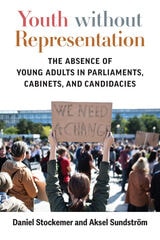
Youth without Representation
The Absence of Young Adults in Parliaments, Cabinets, and CandidaciesDaniel Stockemer and Aksel Sundström
University of Michigan Press, 2022
Officeholders in contemporary parliaments and cabinets are more likely than not to be male, wealthy, middle-aged or older, and from the dominant ethnicity, whereas young adults have an insufficient presence in political office. Young adults—those aged 35 years or under—comprise a mere ten percent of all parliamentarians globally, and three percent of all cabinet members. Compared to their presence in the world’s population, this age group faces an underrepresentation of one to three in parliament and one to ten in cabinet. In this book, Stockemer and Sundström provide a holistic account of youths’ marginalization in legislatures, cabinets, and candidacies for office through a comparative lens. They argue that youths’ underrepresentation in political office constitutes a democratic deficit and provide ample evidence for why they think that youth must be present in politics at much higher rates. They further embed this book within what they label a vicious cycle of political alienation, which involves the declining political sophistication of the young, their waning electoral participation, and their insufficient of representation in office. Empirically, the authors combine a global focus with in-depth studies, discussing the country-level, party-level, and individual-level factors that bar young adults’ entry to positions of political power. This is the first comprehensive book on youth representation and it has relevance for those broadly interested in issues of representation, democracy, inequality, and comparative politics.