Results by title
4127 books match the query 'Science' and 6 start with y
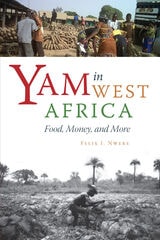
Yam in West Africa
Food, Money, and MoreFelix I. Nweke
Michigan State University Press, 2015
Yam production is concentrated in West Africa, which is responsible for more than 90 percent of the 50 million tons produced annually around the globe. Though the crop can attract high prices, too often its producers live in penury. Regional issues drive up labor costs of food crops because of dependence on obsolete technology. In addition, certain agronomic practices that are peculiar to yam production remain unchanged, and pests and diseases still ravage the crop. Yam in West Africa investigates solutions to these problems with the aim of expanding yam production, increasing sales, helping farmers, and bringing more of this staple food to those who need it. The future of the yam is bright; this book aims to make it more so.
Yardstick Nation
The Metric System in AmericaHector Vera
Vanderbilt University Press, 2025
Honorable Mention, Robert K. Merton Book Award, American Sociological Association’s Science, Knowledge, and Technology (SKAT) Section, 2026
Why is there no metric system in the United States? Why is it that a country known for its openness to the future, its scientific innovations, and its preference for practicality has not adopted the most practical, scientific, and innovative system of measurement? Yardstick Nation answers these questions by analyzing the political, economic, and international factors that determined the trajectory of the United States as a nation self-excluded from one of the most successful global technical languages.
Using a historical-comparative approach and qualitative analysis of archival material, the book examines the trajectories of American scientists, engineers, politicians, and industrialists from 1787 to 1982, to detail what they wanted to attain and to explain what was actually possible to achieve given the political and economic conditions in which they lived. Yardstick Nation argues that in order to understand the unbreached distance between the United States and the metric system, we must consider the interaction between three structural elements: historical timing, state infrastructural power, and international economic integration.
Author Hector Vera’s systematic look at when and why countries have adopted the metric system shows that its introduction is never casual. In the countries that voluntarily embraced the metric system, this was the result of either deep internal political transformations or momentous changes in the international economy. When the adoption of the metric system is politically driven, it comes as the result of a social revolution, independence war, national unification, or the draft of a new constitution. When it is propelled by economic factors, metrication is part of the efforts of economically stagnant countries to integrate into international markets.
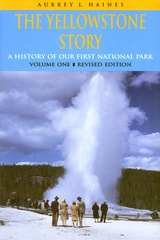
Yellowstone Story, Revised Edition, Volume I
A History of Our First National ParkAubrey L. Haines
University Press of Colorado, 1996
The Yellowstone Park Act
Approved March 1, 1872
Be it enacted by the Senate and House of Representatives of the United States of America in Congress assembled, That the tract of land in the Territories of Montana and Wyoming, lying near the headwaters of the Yellowstone river . . . is hereby reserved and withdrawn from settlement, occupancy, or sale under the laws of the United States, and dedicated and set apart as a public park or pleasuring-ground for the benefit and enjoyment of the people.
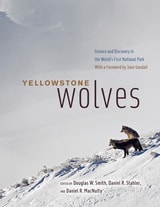
Yellowstone Wolves
Science and Discovery in the World's First National ParkEdited by Douglas W. Smith, Daniel R. Stahler, and Daniel R. MacNulty
University of Chicago Press, 2020
Here, for the first time in a single book, is the incredible story of the wolves’ return to Yellowstone National Park as told by the very people responsible for their reintroduction, study, and management. Anchored in what we have learned from Yellowstone, highlighting the unique blend of research techniques that have given us this knowledge, and addressing the major issues that wolves still face today, this book is as wide-ranging and awe-inspiring as the Yellowstone restoration effort itself. We learn about individual wolves, population dynamics, wolf-prey relationships, genetics, disease, management and policy, newly studied behaviors and interactions with other species, and the rippling ecosystem effects wolves have had on Yellowstone’s wild and rare landscape. Perhaps most importantly of all, the book also offers solutions to ongoing controversies and debates.
Featuring a foreword by Jane Goodall, beautiful images, a companion online documentary by celebrated filmmaker Bob Landis, and contributions from more than seventy wolf and wildlife conservation luminaries from Yellowstone and around the world, Yellowstone Wolves is a gripping, accessible celebration of the extraordinary Yellowstone Wolf Project—and of the park through which these majestic and important creatures once again roam.
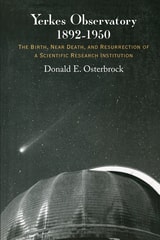
Yerkes Observatory, 1892-1950
The Birth, Near Death, and Resurrection of a Scientific Research InstitutionDonald E. Osterbrock
University of Chicago Press, 1996

You Know My Method
Science of the DetectiveJ.K. Van Dover
University of Wisconsin Press, 1994
The four principal writers covered are Edgar Allan Poe, Sir Arthur Conan Doyle, R. Austin Freeman, and Arthur B. Reeve. Another dozen more writers are treated somewhat more briefly: Gaboriau, Pinkerton, Green, Morrison, Futrelle, and Leroux, among others.