Results by title
4038 books match the query 'Social aspects' and 11 start with y
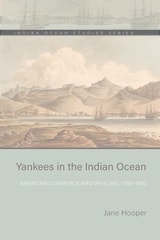
Yankees in the Indian Ocean
American Commerce and Whaling, 1786–1860Jane Hooper
Ohio University Press, 2022
The history of US imperialism remains incomplete without this consideration of long-overlooked nineteenth-century American commercial and whaling ventures in the Indian Ocean.
Yankees in the Indian Ocean shows how nineteenth-century American merchant and whaler activity in the Indian Ocean shaped the imperial future of the United States, influenced the region’s commerce, encouraged illegal slaving, and contributed to environmental degradation. For a brief time, Americans outnumbered other Western visitors to Mauritius, Madagascar, Zanzibar, and the East African littoral. In a relentless search for commodities and provisions, American whaleships landed at islands throughout the ocean and stripped them of resources. Yet Americans failed to develop a permanent foothold in the region and operated instead from a position of weakness relative to other major colonizing powers, thus discouraging the development of American imperial holdings there.
The history of American concerns in the Indian Ocean world remains largely unwritten. Scholars who focus on the region have mostly ignored American involvement, despite arguments for the ocean’s importance in powering global connections during the late eighteenth and early nineteenth centuries. Historians of the United States likewise have failed to examine the western Indian Ocean because of a preoccupation with US interests in Asia and the Pacific. Failing to understand the scale of American trade in the Indian Ocean has led to a fixation on European commercial strength to the exclusion of other maritime networks. Instead, this book reveals how the people of Madagascar and East Africa helped the United States briefly dominate commerce and whaling.
This book investigates how and why Americans were drawn to the western Indian Ocean years before the United States established a formal overseas empire in the late nineteenth century. Ship logs, sailor journals, and travel narratives reveal how American men transformed foreign land- and seascapes into knowable spaces that confirmed American conceptions of people and natural resources; these sources also provide insight into the complex social and ecological worlds of the Indian Ocean during this critical time.
Yesterday's Future
The Twentieth Century BeginsMichael E. Stevens
Wisconsin Historical Society Press, 1999

Yorùbá Bàtá Goes Global
Artists, Culture Brokers, and FansDebra L. Klein
University of Chicago Press, 2007
Yorùbá Bàtá Goes Global describes the dramatic changes and reinventions of traditional bàtá performance in recent years, showing how they are continually recreated, performed, and sold. Klein delves into the lives of Yorùbá musicians, focusing on their strategic collaborations with artists, culture brokers, researchers, and entrepreneurs worldwide. And she explores how reinvigorated performing ensembles are beginning to parlay success on the world stage into increased power and status within Nigeria. Klein’s study of the interwoven roles of innovation and tradition will interest scholars of African, global, and cultural studies, anthropology, and ethnomusicology alike.
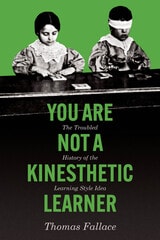
You Are Not a Kinesthetic Learner
The Troubled History of the Learning Style IdeaThomas Fallace
University of Chicago Press, 2025
The widely embraced notion that we all process information in one of three distinct modes—visual, auditory, or kinesthetic—has informed educational practices for decades. In recent years, however, numerous studies have questioned the effectiveness of aligning instruction with the alleged learning styles of individual students. So, why is it still commonplace in the literature on beneficial teaching at all levels of education?
In You Are Not a Kinesthetic Learner: The Troubled History of a Dangerous Idea, historian Thomas Fallace traces the origins, evolution, and history of the learning style idea, demonstrating its relationship to a legacy of unequal education for children of color. Fallace argues that the research supporting the learning style idea was problematic from its inception in the 1910s and that it was used to label and justify a diminished curriculum for many Black and Latine students, whose cultural differences were perceived as weaknesses. In recent years, numerous empirical studies have not found the approach to be effective. This fascinating history clearly shows the danger of sorting and labeling students with permanent style identities and makes a strong case for removing learning styles as the basis for any educators’ instructional toolkit.
The first book-length history of learning styles, You Are Not a Kinesthetic Learner encourages us all to consider the research, be open to future developments and updates, and question even our most intuitive assumptions.
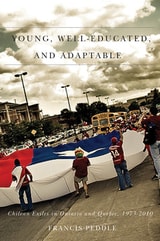
Young, Well-Educated, and Adaptable
Chilean Exiles in Ontario and Quebec, 1973-2010Francis Peddie
University of Manitoba Press, 2014
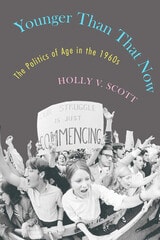
Younger Than That Now
The Politics of Age in the 1960sHolly V. Scott
University of Massachusetts Press, 2016
Retrospectives of the 1960s routinely include the face of youth rebellion: long-haired students occupying campus buildings, young men burning draft cards, hippies dancing at Woodstock. In Younger Than That Now, Holly V. Scott explores how the idea of “youth” served as a tactic in the political and social activism of these years. In the early part of that decade, young white activists began to learn from the civil rights movement's defiance of racism. They examined their own lives and concluded that campus rules and the draft were repression as well. As a group, they were ripe for revolution, and their age gave them a unique perspective for understanding and protesting against injustice. In short, young people began to use their youth as a political strategy.
Some in the New Left were dubious of this strategy and asked how it might damage long-term progress. Young feminists and people of color were particularly quick to question the idea that age alone was enough to sustain a movement. And the media often presented young people as impulsive and naive, undermining their political legitimacy. In tracing how “youth” took on multiple meanings as the 1960s progressed, Scott demonstrates the power of this idea to both promote and hinder social change.
Youth Media Matters
Participatory Cultures and Literacies in EducationKorina M. Jocson
University of Minnesota Press, 2018
In an information age of youth social movements, Youth Media Matters examines how young people are using new media technologies to tell stories about themselves and their social worlds. They do so through joint efforts in a range of educational settings and media environments, including high school classrooms, youth media organizations, and social media sites. Korina M. Jocson draws on various theories to show how educators can harness the power of youth media to provide new opportunities for meaningful learning and “do-it-together production.” Describing the impact that youth media can have on the broader culture, Jocson demonstrates how it supports expansive literacy practices and promotes civic engagement, particularly among historically marginalized youth.
In Youth Media Matters, Jocson offers a connective analysis of content area classrooms, career and technical education, literary and media arts organizations, community television stations, and colleges and universities. She provides examples of youth media work—including videos, television broadcasts, websites, and blogs—produced in the San Francisco Bay Area, Los Angeles, New York, and St. Louis. At a time when educators are increasingly attentive to participatory cultures yet constrained by top-down pedagogical requirements, Jocson highlights the knowledge production and transformative potential of youth media with import both in and out of the classroom.
Youth Power in Precarious Times
Reimagining Civic ParticipationMelissa Brough
Duke University Press, 2020
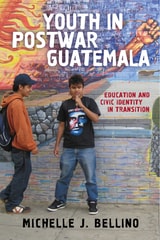
Youth in Postwar Guatemala
Education and Civic Identity in TransitionMichelle J. Bellino
Rutgers University Press, 2017
In the aftermath of armed conflict, how do new generations of young people learn about peace, justice, and democracy? Michelle J. Bellino describes how, following Guatemala’s civil war, adolescents at four schools in urban and rural communities learn about their country’s history of authoritarianism and develop civic identities within a fragile postwar democracy.
Through rich ethnographic accounts, Youth in Postwar Guatemala, traces youth experiences in schools, homes, and communities, to examine how knowledge and attitudes toward historical injustice traverse public and private spaces, as well as generations. Bellino documents the ways that young people critically examine injustice while shaping an evolving sense of themselves as civic actors. In a country still marked by the legacies of war and division, young people navigate between the perilous work of critiquing the flawed democracy they inherited, and safely waiting for the one they were promised...
Youth without Representation
The Absence of Young Adults in Parliaments, Cabinets, and CandidaciesDaniel Stockemer and Aksel Sundström
University of Michigan Press, 2022
Officeholders in contemporary parliaments and cabinets are more likely than not to be male, wealthy, middle-aged or older, and from the dominant ethnicity, whereas young adults have an insufficient presence in political office. Young adults—those aged 35 years or under—comprise a mere ten percent of all parliamentarians globally, and three percent of all cabinet members. Compared to their presence in the world’s population, this age group faces an underrepresentation of one to three in parliament and one to ten in cabinet. In this book, Stockemer and Sundström provide a holistic account of youths’ marginalization in legislatures, cabinets, and candidacies for office through a comparative lens. They argue that youths’ underrepresentation in political office constitutes a democratic deficit and provide ample evidence for why they think that youth must be present in politics at much higher rates. They further embed this book within what they label a vicious cycle of political alienation, which involves the declining political sophistication of the young, their waning electoral participation, and their insufficient of representation in office. Empirically, the authors combine a global focus with in-depth studies, discussing the country-level, party-level, and individual-level factors that bar young adults’ entry to positions of political power. This is the first comprehensive book on youth representation and it has relevance for those broadly interested in issues of representation, democracy, inequality, and comparative politics.

Yucatan in an Era of Globalization
Edited by Eric N. Baklanoff and Edward Moseley
University of Alabama Press, 2008