Results by title
1296 books match the query 'Women authors' and 8 start with y
Yes, There Will Be Singing
Marilyn Krysl
University of Michigan Press, 2014
Yes, There Will Be Singing brings together Marilyn Krysl’s essays on the origins of language and poetry, poetic form, the poetry of witness, and poetry’s collaboration with the healing arts. Beginning with pieces on her own origins as a poet, she branches into poetry’s profound spiritual and political possibilities, drawing on rich examples from poets such as Anna Akhmatova, W.S. Merwin, and Vénus Khoury-Ghata. Krysl concludes with a selection of stories of her nursing and humanitarian work, powerfully connecting poetic expression with a generous and compassionate worldview.
[more]
You Darling Thing
Monica Ferrell
Four Way Books, 2018
Guided by a poem assembled from “compliments” paid by a suitor to his girlfriend (which echo the endearments Anna Karenina’s Count Vronsky directs toward his racehorse, before she collapses under his weight and is shot), You Darling Thing investigates bridehood and the concept of the vow through the voices of a variety of brides, ex-brides, courtesans, and wives. The book is ultimately less about marriage than about potentiality and promise, an engagement with what seems possible before it stops being possible—anticipation at the outset of a hunt, embryos that stay unborn, youthful predictions for a life before it’s lived, and delight in the expressive possibilities afforded by language and art.
[more]
You Don’t Have to Go to Mars for Love
Yona Harvey
Four Way Books, 2020
The poems of award-winning poet Yona Harvey’s much anticipated You Don’t Have to Go to Mars for Love follow an unnamed protagonist on her multidimensional, Afro-futuristic journey. Her story stretches the boundaries normally constraining a black, female body like hers. Half-superhero, half-secret-identity, she encounters side-slipping, speculative realities testing her in poems that appear like the panels of a comic book. Music directs readers through large and small emotional arcs, constantly retroubled by lyric experimentation. Harvey layers her poems with a chorus of women’s voices. Her artful use of refrain emphasizes the protagonist’s meaning making and doubling back: “Who am I to say? The eye is often mistaken. Or is it the mind? Always eager to interpret.” Our hero is captured, escapes, scuba dives, goes interstellar, and she emerges on the other end of her journey renewed, invoking the gods: “taunt the sharks. & when the glaciers get to melting, / all God’s River’s we shall haunt.”
[more]

You Haven't Asked About My Wedding or What I Wore
Poems of Courtship on the American FrontierJana Harris
University of Alaska Press, 2014
“Nowhere / on these parchment leaves do I find / myself, my likeness, my name, / not a whisper—Cynthia—not one / breath of me.”
For thirty years poet Jana Harris researched the diaries and letters of North American pioneer women. While the names and experiences of the authors varied, Harris found one story often connected them: their most powerful memories were of courtships and weddings. They dreamed of having a fine wedding while they spent their lives hauling water, scrubbing floors, and hoping for admirers. Many married men they hardly knew.
Based on primary research of nineteenth-century frontier women, Harris uses her compelling poetry to resurrect a forgotten history. She captures the hope, anxiety, anger, and despair of these women through a variety of characters and poetic strategies, while archival photographs give faces to the names and details to the settings. Harris’s meticulous research and stirring words give these pioneer women a renewed voice that proves the timelessness of the hopes and fears of love and marriage.
[more]
You Will Hear Thunder
Anna Akhmatova
Ohio University Press, 2017
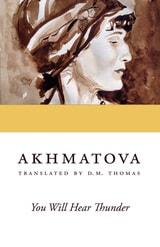
Anna Akhmatova lived through pre-revolution Russia, Bolshevism, and Stalinism. Throughout it all, she maintained an elegant, muscular style that could grab a reader by the throat at a moment’s notice. Defined by tragedy and beauty in equal measure, her poems take on romantic frustration and the pull of the sensory, and find power in the mundane. Above all, she believed that a Russian poet could only produce poetry in Russia. You Will Hear Thunder spans Akhmatova’s very early career into the early 1960s. These poems were written through her bohemian prerevolution days, her many marriages, the terror and privation of life under Stalin, and her later years, during which she saw her work once again recognized by the Soviet state. Intricately observed and unwavering in their emotional immediacy, these strikingly modern poems represent one of the twentieth century’s most powerful voices.
[more]
You Will Hear Thunder
Anna Akhmatova
Ohio University Press, 2017
Anna Akhmatova lived through pre-revolution Russia, Bolshevism, and Stalinism. Throughout it all, she maintained an elegant, muscular style that could grab a reader by the throat at a moment’s notice. Defined by tragedy and beauty in equal measure, her poems take on romantic frustration and the pull of the sensory, and find power in the mundane. Above all, she believed that a Russian poet could only produce poetry in Russia. You Will Hear Thunder spans Akhmatova’s very early career into the early 1960s. These poems were written through her bohemian prerevolution days, her many marriages, the terror and privation of life under Stalin, and her later years, during which she saw her work once again recognized by the Soviet state. Intricately observed and unwavering in their emotional immediacy, these strikingly modern poems represent one of the twentieth century’s most powerful voices.
[more]
Your Madness, Not Mine
Stories of CameroonMakuchi
Ohio University Press, 1999
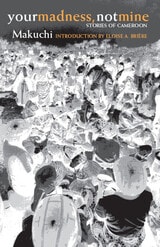
Women’s writing in Cameroon has so far been dominated by Francophone writers. The short stories in this collection represent the yearnings and vision of an Anglophone woman, who writes both as a Cameroonian and as a woman whose life has been shaped by the minority status her people occupy within the nation-state. The stories in Your Madness, Not Mine are about postcolonial Cameroon, but especially about Cameroonian women, who probe their day-to-day experiences of survival and empowerment as they deal with gender oppression: from patriarchal expectations to the malaise of maldevelopment, unemployment, and the attraction of the West for young Cameroonians. Makuchi has given us powerful portraits of the people of postcolonial Africa in the so-called global village who too often go unseen and unheard.
[more]
Yours, Purple Gallinule
Ewa Chrusciel
Omnidawn, 2022
Lyrical satire that imagines mental illnesses as various bird species.
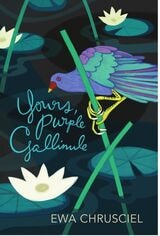
Ewa Chrusciel’s fourth book in English, Yours, Purple Gallinule, playfully explores health and illness as they are culturally constructed. Using research into clinical understandings of mental afflictions and their treatments through history, Chrusciel maps various diagnostics onto an array of bird species. A lyrical satire, the book is a reflection on a society that tends to over-diagnose, misdiagnose, and over-medicate. These poems pose questions about what it means to be unique and to accept pain and suffering as a fact of life.
On the pages of Yours, Purple Gallinule, we encounter birds, a poet, and a psychiatrist. The psychiatrist undergoes a series of conversions as she realizes that the point is not to classify thoughtlessly, but to “make music instead”—to dwell in astonishment. Birds evade the anthropomorphizing intentions of the human protagonists as the psychiatrist and the poet eventually become one. The anthropomorphizing goes in reverse, and the human being becomes more avian. Like the dove in the biblical Noah’s ark story, the bird proclaims a new covenant, with a twig in its beak and a message: “We are all mad; some more than others, but no one is spared the affliction. And the madder we are, the more sacred.”
[more]