Results by title
1441 books match the query 'World' and 4 start with y
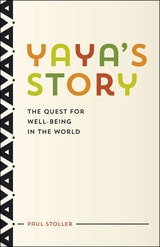
Yaya's Story
The Quest for Well-Being in the WorldPaul Stoller
University of Chicago Press, 2014
Harouna and Stoller would meet in Harlem, at a bustling African market where Harouna built a life as an African art trader and Stoller was conducting research. Moving from Belayara in Niger to Silver Spring, Maryland, and from the Peace Corps to fieldwork to New York, Stoller recounts their separate lives and how the threat posed by cancer brought them a new, profound, and shared sense of meaning. Combining memoir, ethnography, and philosophy through a series of interconnected narratives, he tells a story of remarkable friendship and the quest for well-being. It’s a story of difference and unity, of illness and health, a lyrical reflection on human resiliency and the shoulders we lean on.
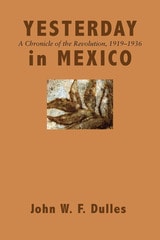
Yesterday in Mexico
A Chronicle of the Revolution, 1919–1936By John W. F. Dulles
University of Texas Press, 1961
Early in a sixteen-year sojourn in Mexico as an engineer for an American mining company, John W. F. Dulles became fascinated by the story of Mexico’s emergence as a modern nation, and was imbued with the urge to tell that story as it had not yet been told—by letting events speak for themselves, without any interpretations or appraisal.
The resultant book offers an interesting paradox: it is “chronicle” in the medieval sense—a straightforward record of events in chronological order, recounted with no effort at evaluation or interpretation; yet in one aspect it is a highly personal narrative, since much of its significant new material came to Dulles as a result of personal interviews with principals of the Revolution. From them he obtained firsthand versions of events and other reminiscences, and he has distilled these accounts into a work of history characterized by thorough research and objective narration.
These fascinating interviews were no more important, however, than were the author’s many hours of laborious search in libraries for accounts of the events from Carranza’s last year to Calles’ final retirement from the Mexican scene. The author read scores of impassioned versions of what transpired during these fateful years, accounts written from every point of view, virtually all of them unpublished in English and many of them documents which had never been published in any language.
Combining this material with the personal reminiscences, Dulles has provided a narrative rich in its new detail, dispassionate in its presentation of facts, dramatic in its description of the clash of armies and the turbulence of rough-and-tumble politics, and absorbing in its panoramic view of a people’s struggle.
In it come to life the colorful men of the Revolution —Obregón, De la Huerta, Carranza, Villa, Pani, Carillo Puerto, Morones, Calles, Portes Gil, Vasconcelos, Ortiz Rubio, Garrido Canabal, Rodríguez, Cárdenas. (Dulles’ narrative of their public actions is illumined occasionally by humorous anecdotes and by intimate glimpses.) From it emerges also, as the main character, Mexico herself, struggling for self-discipline, for economic stability, for justice among her citizens, for international recognition, for democracy.
This account will be prized for its encyclopedic collection of facts and for its important clarification of many notable events, among them the assassination of Carranza, the De La Huerta revolt, the assassination of Obregón, the trial of Toral, the resignation of President Ortiz Rubio, and the break between Cárdenas and Calles. More than sixty photographs supplement the text.

You Can Crush the Flowers
A Visual Memoir of the Egyptian RevolutionBahia Shehab
Gingko, 2021
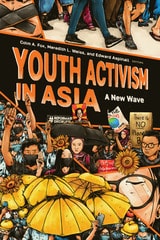
Youth Activism in Asia
A New WaveEdited by Colm A. Fox, Meredith L. Weiss, Edward Aspinall
University of Michigan Press, 2026
Over the last decade, a youth revolt has swept through Asia. Massive, regime-rocking protests have grabbed global attention as students and other young people have confronted security forces on the streets, taking great risks to condemn authoritarian rule, promote democracy, and to push forward new agendas of personal freedom and gender equality. Behind the scenes, young people have experimented with novel and diverse modes of political and social activism, often using new tools of online communication and cultural expression, forging new kinds of coalitions, and exploring nonconfrontational and subterranean networking.
Youth Activism in Asia focuses equally on the episodes of spectacular protest and on varieties of less visible engagement, examining the diversity, origins, and impact of contemporary youth activism in Asia. With fifteen case studies, the volume highlights shared patterns among demands, tactical repertoires, and activist networks, and examines what differentiates protest movements across countries and over time. Drawing on original fieldwork and, in many cases, their own experience, the authors address Brunei, China, Hong Kong, Indonesia, Malaysia, Myanmar, the Philippines, Singapore, Taiwan, Thailand, Timor-Leste, and transnational activism. Conceiving of “activism” broadly as any action intended to bring about social and political change, the volume makes theoretical contributions to our understanding of the relationship between protest and democratic backsliding, engagement with new communication technologies, and this generation’s distinctive intersectional politics. Youth Activism in Asia showcases the creativity, energy, boldness, and diversity of a new generation of Asian political activists.