Results by title
4531 books match the query 'Cultural & Ethnic Studies' and 7 start with z
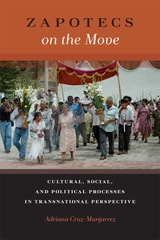
Zapotecs on the Move
Cultural, Social, and Political Processes in Transnational PerspectiveCruz-Manjarrez, Adriana
Rutgers University Press, 2013
Based on multi-site fieldwork conducted over a five-year period, Adriana Cruz-Manjarrez analyzes how and why Yalálag Zapotec identity and culture have been reconfigured in the United States, using such cultural practices as music, dance, and religious rituals as a lens to bring this dynamic process into focus. By illustrating the sociocultural, economic, and political practices that link immigrants in Los Angeles to those left behind, the book documents how transnational migration has reflected, shaped, and transformed these practices in both their place of origin and immigration.
Zion in the Valley, Volume I
The Jewish Community of St. Louis, Volume I, 1807-1907Walter Ehrlich
University of Missouri Press, 1997
St. Louis contains one of the largest Jewish communities in the interior of the United States. Yet, despite the important contributions of St. Louis Jews to the city's cultural and economic growth and to national and international Jewry, no history of their accomplishments has heretofore been written.
In this masterful book, Walter Ehrlich shows how the St. Louis Jewish community grew in two separate yet intricately related milieux. One was the internal socioreligious community, which centered on relations of Jews with fellow Jews. The other was the broader secular environment, in which Jews individually and collectively interacted with the non-Jewish population, assuming significant roles in the political, economic, social, and religious developments of one of the country's most important urban centers.
Employing many previously unused primary materials--especially congregational archives, organizational and business records, contemporary newspapers, and vivid personal memoirs--Ehrlich presents a fascinating description of how individuals and groups contributed to the growth and development of a major American urban area. He clarifies significant aspects of social and economic structure, mobility, and philanthropy within the Jewish community and integrates them within the broader framework of American society. In the process, Ehrlich provides a unique perspective on St. Louis history, as well as on American urban, ethnic, and immigration history.
Zion in the Valley is an invaluable contribution to the field of Jewish studies. It will appeal to scholars and students of Jewish, urban, and ethnic history, as well as to members of the broader St. Louis community.
Zion in the Valley, Volume II
The Jewish Community of St. Louis, Volume II, The Twentieth CenturyWalter Ehrlich
University of Missouri Press, 2002
Zones of Encuentro
Language and Identities in Northern New MexicoLillian Gorman
The Ohio State University Press, 2024
Winner, 2025 New Mexico Book Awards, Multicultural Category
Finalist, New Mexico Book Awards, BIPOC Author or Subject Category and First Book Category
Working at the intersection of Latina/o/x cultural studies, sociocultural linguistics, and Chicana feminist studies, Lillian Gorman’s Zones of Encuentro takes an in-depth look at the cultural and linguistic interactions between two distinct Latina/o/x communities in the region: Nuevomexicanos (Hispanic people who trace their presence in the region to colonial times and whose families have historically spoken Traditional New Mexican Spanish, or TNMS) and first-generation Mexicano immigrants (who tend to speak Mexican Spanish). Gorman examines the everyday lived language experiences and ethnolinguistic identities of Mexicanos and Nuevomexicanos together, specifically through the case of mixed Mexicano-Nuevomexicano families. Through an interdisciplinary critical reading of ethnographic data, pláticas (informal conversations that gather family and community knowledge), interviews, articles, and historical memoirs, Gorman analyzes language ideologies, identity formations, and language practices by exploring complex spaces of encounter within Mexicano-Nuevomexicano families. Zones of Encuentro complicates homogeneous notions of language and identity and contemplates what a shared cultural and linguistic homeplace looks like for Mexicanos and Nuevomexicanos in northern New Mexico.
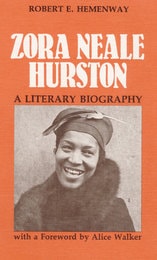
Zora Neale Hurston
A Literary BiographyRobert E. Hemenway. Foreword by Alice Walker
University of Illinois Press, 1977
The life and work of the iconic author and intellectual
Zora Neale Hurston transformed each hour of her life into something bubbling, exuberant, and brimming with joy. Robert Hemenway’s biography is a towering portrait of the novelist, folklorist, and anthropologist. Drawing on archival documents and interviews with people who knew her, Hemenway explores Hurston’s art and work, from her extraordinary novels and autobiography to a popular treatment of black folkways that revealed her deep commitment to the black folk tradition. He also provides a sensitive look at her two marriages; her relationships with Mrs. R. Osgood Mason, Franz Boas, and Langston Hughes; her time as a member of the black literati of the 1920s and 1930s; and the penniless final years leading to her death.
Sophisticated and original, Zora Neale Hurston tells the compelling story of a woman who reveled in a fully lived life dedicated to a lasting art and the preservation of a vital cultural heritage.
Zora Neale Hurston
And A History Of Southern LifeTiffany Ruby Patterson
Temple University Press, 2005
Zora Neale Hurston
Collected PlaysJean Lee Cole and Charles Mitchell
Rutgers University Press, 2008
Though she died penniless and forgotten, Zora Neale Hurston is now recognized as a major figure in African American literature. Best known for her 1937 novel Their Eyes Were Watching God, she also published numerous short stories and essays, three other novels, and two books on black folklore.
Even avid readers of Hurston’s prose, however, may be surprised to know that she was also a serious and ambitious playwright throughout her career. Although several of her plays were produced during her lifetime—and some to public acclaim—they have languished in obscurity for years. Even now, most critics and historians gloss over these texts, treating them as supplementary material for understanding her novels. Yet, Hurston’s dramatic works stand on their own merits and independently of her fiction.
Now, eleven of these forgotten dramatic writings are being published together for the first time in this carefully edited and annotated volume. Filled with lively characters, vibrant images of rural and city life, biblical and folk tales, voodoo, and, most importantly, the blues, readers will discover a “real Negro theater” that embraces all the richness of black life.