Results by title
808 books match the query 'Drama' and 5 start with z

Zapolska's Women
Three Plays: Malka Szwarcenkopf, The Man, and Miss MaliczewskaGabriela Zapolska
Intellect Books, 2009
Gabriela Zapolska (1857–1921) was one of the foremost modernist Polish playwrights. Zapolska’s Women features three of her performance texts that focus on the economic and social pressures faced by women in partitioned Poland at the end of the eighteenth century. In addition to the plays, Zapolska’s Women provides a detailed biography of Zapolska, relating her life story to the themes of each play; an analysis of her significance within Polish and European literary and theatrical traditions; and background on the social and historical conditions within Poland during the time the plays were written and originally performed. This informative collection of groundbreaking plays will introduce an English-speaking audience to Zapolska’s important work.
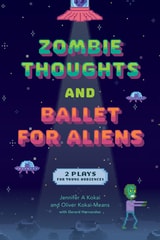
Zombie Thoughts and Ballet for Aliens
Two Plays for Young AudiencesJennifer A. Kokai and Oliver Kokai-Means with Gerard Hernandez
Vanderbilt University Press, 2025
Ballet for Aliens was co‑written with both Oliver Kokai‑Means and new playwright, a then-twelve‑year‑old Gerard Hernandez, about Gerard’s experience as a youth with Crohn’s disease. Gerard was a ballet dancer through his childhood, though his health often made this difficult, and the piece required formal ballet movement, so the production was co-created with highly regarded dance company Ballet West’s Peter Christie, their education director. A portion of this play was presented to the Utah Legislature in 2022 to argue for the importance of funding the arts in elementary schools.
Zombie Thoughts and Ballet for Aliens have gone on to be produced across the United States and internationally by school groups, universities, and professional tours of varying theatre sizes. This volume offers both plays and an introduction by Kokai and the youth playwrights, which contextualizes efforts for theatrical interventions in youth mental health.
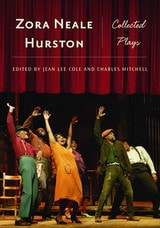
Zora Neale Hurston
Collected PlaysJean Lee Cole and Charles Mitchell
Rutgers University Press, 2008
Though she died penniless and forgotten, Zora Neale Hurston is now recognized as a major figure in African American literature. Best known for her 1937 novel Their Eyes Were Watching God, she also published numerous short stories and essays, three other novels, and two books on black folklore.
Even avid readers of Hurston’s prose, however, may be surprised to know that she was also a serious and ambitious playwright throughout her career. Although several of her plays were produced during her lifetime—and some to public acclaim—they have languished in obscurity for years. Even now, most critics and historians gloss over these texts, treating them as supplementary material for understanding her novels. Yet, Hurston’s dramatic works stand on their own merits and independently of her fiction.
Now, eleven of these forgotten dramatic writings are being published together for the first time in this carefully edited and annotated volume. Filled with lively characters, vibrant images of rural and city life, biblical and folk tales, voodoo, and, most importantly, the blues, readers will discover a “real Negro theater” that embraces all the richness of black life.

Zurich Transit
Max Frisch
Seagull Books, 2010
This screenplay by Swiss playwright and novelist Max Frisch was developed from an episode in his 1964 novel Gantenbein, or A Wilderness of Mirrors. At the center of both works is Theo Ehrismann, a man who cannot seem to change his life no matter how many times he resolves to do so. Chance comes to Theo one day upon returning from a trip abroad—he arrives home to read his own obituary in the paper. He shows up just on time for his own funeral and observes the attending mourners, and yet he is not able to reveal himself to them, and especially not to his wife. “How does one say that he is alive,” wonders Theo.
Life, as Frisch said, “is the sum of events that happen by chance, and it always could as well have turned out differently; there is not a single action or omission that does not allow for variables in the future.” Zurich Transit presents Frisch at the height of his dramatic powers and exemplifies his ardent believe in a dramaturgy of coincidence rather than causality.
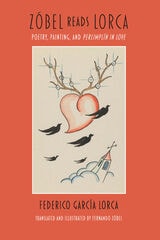
Zóbel Reads Lorca
Poetry, Painting, and Perlimplín In LoveFederico García Lorca
Swan Isle Press, 2022
Painting, poetry, and music come together in Zóbel Reads Lorca, as Fernando Zóbel, a Harvard student who would become one of Spain’s most famous painters, translates and illustrates Federico García Lorca’s haunting play about the wounds of love.
The premiere of Amor de Don Perlimplín con Belisa en su jardín, an “erotic allelujia” which Lorca once called his most cherished play, was shut down in 1928 by Spanish government censors who confiscated the manuscript and locked it away in the pornography section of a state archive. Lorca rewrote the work in New York, and an amateur theater group brought it to the Spanish stage a few years later. Since his death, the play has also been transformed into ballet and opera.
Zóbel Reads Lorca presents Zóbel’s previously unpublished translation and features contextual essays from several scholars. Art historian Felipe Pereda studies Lorca in the context of Zóbel’s development as a painter, Luis Fernández Cifuentes describes the precarious and much-debated state of the humanities in Zóbel’s Harvard and throughout the United States in the 1940s, and Christopher Maurer delves into musical and visual aspects of the play’s American productions.