Results by title
8113 books match the query 'Literary Criticism' and 7 start with z
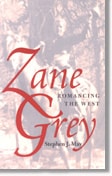
Zane Grey
Romancing The WestStephen J. May
Ohio University Press, 1997
One of the century’s most enduring American writers, Zane Grey left a legacy to our national consciousness that far outstrips the literary contribution of his often predictable plots and recurring themes. How did Grey capture the attention of millions of readers and promote the Western fantasy that continues to occupy many of the world’s leisure hours? This study assesses the Zane Grey phenomenon by examining Grey’s romantic novels in the context of his life and era.
Grey, whose roots were in Zanesville, Ohio, was the son of a dentist and practiced dentistry himself in his early adulthood. He threw over that life for one of adventure, traveling throughout the world in search of excitement, a course that ultimately led him to become one of America’s most popular authors. But he also was dogged by depression and inertia that affected his ability and will to work.
In Zane Grey: Romancing the West, author Stephen J. May traces the career of Grey by analyzing the development of his novels and popularity and the degree to which that shaped his world.
The book also investigates Grey’s personal life—from his fling with Hollywood to his passion for deep-sea fishing—illuminating the literature that shaped America’s vision of itself through one of its most enduring and cherished myths.
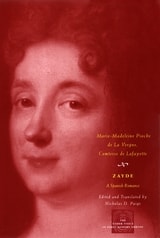
Zayde
A Spanish RomanceMarie-Madeleine Pioche de La Vergne, Comtesse de Lafayette
University of Chicago Press, 2006
Zayde unfolds during the long medieval struggle between Christians and Muslims for control of the Iberian Peninsula; Madame de Lafayette (1634-93) takes the reader on a Mediterranean tour typical of classical and seventeenth-century romances—from Catalonia to Cyprus and back again—with battles, prophecies, and shipwrecks dotting the crisscrossed paths of the book’s noble lovers. But where romance was long and episodic, Zayde possesses a magisterial architecture of suspense. Chaste and faithful heroines and heroes are replaced here by characters who are consumed by jealousy and unable to love happily. And, unlike in traditional romance, the reader is no longer simply expected to admire deeds of bravery and virtue, but instead is caught up in intense first-person testimony on the psychology of desire.
Unavailable in English for more than two centuries, Zayde reemerges here in Nicholas Paige’s accessible and vibrant translation as a worthy representative of a once popular genre and will be welcomed by readers of French literature and students of the European novelistic tradition.

Zen, Poetry, the Art of Lucien Stryk
Susan Porterfield
Ohio University Press, 1993
Lucien Stryk has been a presence in American letters for almost fifty years. Those who know his poetry well will find this collection particularly gratifying. Like journeying again to places visited long ago, Stryk’s writing is both familiar and wonderfully fresh.
For those just becoming acquainted with Stryk’s work, Zen, Poetry, the Art of Lucien Stryk makes an excellent introduction. It includes his early essay, “The American Scene Versus the International Scene,” written shortly after his service in the Pacific during World War II, and “Digging In,” his first published poem, as well as some of his best-known pieces on Zen and Zen poetry. Among the latter are “Beginnings, Ends,” “Poetry and Zen,” “I Fear Nothing: A Note on the Zen Poetry of Death,” and his introduction to the great haiku poets, Issa and Basho. Selections of his most recent work include “The Red Rug: An Introduction to Poetry,” and an imagined conversation among all four leading haiku poets called “Meeting at Hagi-no-Tera.”
Porterfield’s informative collection includes essays about Stryk’s work as well as his own prose and poetry. As the volume makes clear, writing poetry is for Lucien Stryk a sacred act. It is both escape and communion, inseparable from life’s daily activities.
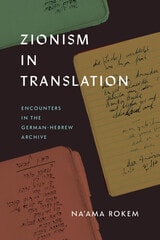
Zionism in Translation
Encounters in the German-Hebrew ArchiveNa'ama Rokem
University of Chicago Press, 2026
Examining a network of correspondences and encounters that cross between German and Hebrew, Zionism in Translation argues that the space between the languages enabled ambivalent conversations about the foundation of the State of Israel.
Zionism in Translation concerns exchanges—primarily of letters but also drafts, reviews, and other ephemera—sent to or from Jerusalem in the decades after 1948. All were written in German and Hebrew by a fascinating range of literary figures, including Hannah Arendt, Gershom Scholem, Yehuda Amichai, Ludwig Strauss, Erich Auerbach, Walter Benjamin, Leah Goldberg, Peter Szondi, Paul Celan, and Tuvia Ruebner. Na’ama Rokem illuminates the complexities that emerge as the two languages mix in this extraordinary epistolary network.
The writers that Rokem studies here contend with the genocidal violence that brought the rich historical relation between German and Hebrew to a seeming end. They also grapple, in different ways, with the new reality in Israel/Palestine in the wake of the founding of the State of Israel and the Palestinian Nakba. The bilingual conversation that crosses over between German and Hebrew in these letters thus centers around the question of Jewish fate in the twentieth century and is immersed in negotiations about Jewish nationalism, the Zionist movement, and the possibilities of Jewish poetry. In the space between German and Hebrew, Rokem argues, the protagonists of her story voice ambivalences and hesitancies not found elsewhere.
Zionism in Translation joins a growing body of scholarship that uncovers the complex modes of belonging and resistance that unfold around the Zionist movement in the twentieth century. It will interest all readers concerned with modern Jewish intellectual, cultural, and literary history, the history of Zionism, and writers such as Arendt or Celan.
Zombie Cinema
Olney, Ian
Rutgers University Press, 2017
Zombie Cinema is a lively and accessible introduction to this massively popular genre. Presenting a historical overview of zombie appearances in cinema and on television, Ian Olney also considers why, more than any other horror movie monster, zombies have captured the imagination of twenty-first-century audiences.
Surveying the landmarks of zombie film and TV, from White Zombie to The Walking Dead, the book also offers unique insight into why zombies have gone global, spreading well beyond the borders of American and European cinema to turn up in films from countries as far-flung as Cuba, India, Japan, New Zealand, and Nigeria. Both fun and thought-provoking, Zombie Cinema will give readers a new perspective on our ravenous hunger for the living dead.
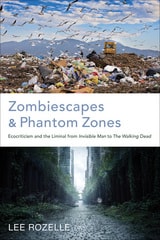
Zombiescapes and Phantom Zones
Ecocriticism and the Liminal from "Invisible Man" to "The Walking Dead"Lee Rozelle
University of Alabama Press, 2016
A Critical Journey Through Zombie Worlds and Ecological Thought.
In Zombiescapes and Phantom Zones: Ecocriticism and the Liminal from “Invisible Man” to “The Walking Dead,” Lee Rozelle chronicles the weirdest, ugliest, and most mixed-up characters to appear on the literary scene since World War II—creatures intimately linked to damaged habitats that rise from the muck, not to destroy or rule the world, but to save it. The book asks what happens to these landscapes after the madness, havoc, and destruction. What monsters and magic surface then?
Rozelle argues that zombiescapes and phantom zones depicted in the book become catalysts for environmental reanimation and sources of hope. Liminality offers exciting and useful new ways to conceptualize places that have historically proven troublesome, unwieldy, or hard to define. Zombiescapes can reduce the effects of pollution, promote environmental justice, lessen economic disparity, and localize food production. The grotesques that ooze and crawl from these passages challenge readers to consider new ways to re-inhabit broken lands at a time when energy efficiency, fracking, climate change, the Pacific trade agreement, local food production, and sustainability shape the intellectual landscape.
Rozelle focuses on literary works from 1950 to 2015—the zombiescapes and monsterscapes of post–World War II literature—that portray in troubling and often devastating ways the “brownfields” that have been divested of much of their biodiversity and ecological viability. However, he also highlights how these literary works suggest a new life and new potential for such environments. With an unlikely focus on places of ruination and an application of interdisciplinary, transnational approaches to a range of fields and texts, Rozelle advances the notion that places of distortion might become a nexus where revelation and advocacy are possible again.
Zombiescapes and Phantom Zones has much to offer to various fields of scholarship, including literary studies, ecocriticism, and environmental studies. Research, academic, and undergraduate audiences will be captivated by Rozelle’s lively prose and unique anthropological, ecocritical, and literary analyses.
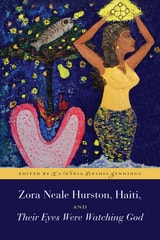
Zora Neale Hurston, Haiti, and Their Eyes Were Watching God
La Vinia Delois Jennings
Northwestern University Press, 2013
Zora Neale Hurston wrote her most famous novel, Their Eyes Were Watching God, while in Haiti on a trip funded by a Guggenheim fellowship to research the region’s transatlantic folk and religious culture; this work grounded what would become her ethnography Tell My Horse: Voodoo and Life in Haiti and Jamaica. The essays in Zora Neale Hurston, Haiti, and “Their Eyes Were Watching God” persuasively demonstrate that Hurston’s study of Haitian Voudoun informed the characterization, plotting, symbolism, and theme of her novel. Much in the way that Voudoun and its North American derivative Voodoo are syncretic religions, Hurston’s fiction enacts a syncretic, performative practice of reference, freely drawing upon Greco-Roman, Judeo-Christian, and Haitian Voudoun mythologies for its political, aesthetic, and philosophical underpinnings. Zora Neale Hurston, Haiti, and “Their Eyes Were Watching God” connects Hurston’s work more firmly to the cultural and religious flows of the African diaspora and to the literary practice by twentieth-century American writers of subscripting in their fictional texts symbols and beliefs drawn from West and Central African religions.