Results by title
110 books match the query 'New Mexico' and 3 start with z
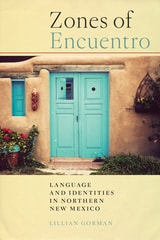
Zones of Encuentro
Language and Identities in Northern New MexicoLillian Gorman
The Ohio State University Press, 2024
Winner, 2025 New Mexico Book Awards, Multicultural Category
Finalist, New Mexico Book Awards, BIPOC Author or Subject Category and First Book Category
Working at the intersection of Latina/o/x cultural studies, sociocultural linguistics, and Chicana feminist studies, Lillian Gorman’s Zones of Encuentro takes an in-depth look at the cultural and linguistic interactions between two distinct Latina/o/x communities in the region: Nuevomexicanos (Hispanic people who trace their presence in the region to colonial times and whose families have historically spoken Traditional New Mexican Spanish, or TNMS) and first-generation Mexicano immigrants (who tend to speak Mexican Spanish). Gorman examines the everyday lived language experiences and ethnolinguistic identities of Mexicanos and Nuevomexicanos together, specifically through the case of mixed Mexicano-Nuevomexicano families. Through an interdisciplinary critical reading of ethnographic data, pláticas (informal conversations that gather family and community knowledge), interviews, articles, and historical memoirs, Gorman analyzes language ideologies, identity formations, and language practices by exploring complex spaces of encounter within Mexicano-Nuevomexicano families. Zones of Encuentro complicates homogeneous notions of language and identity and contemplates what a shared cultural and linguistic homeplace looks like for Mexicanos and Nuevomexicanos in northern New Mexico.
Zooarchaeology of Six Prehistoric Sites in the Sierra Blanca Region, New Mexico
Jonathan C. Driver
University of Michigan Press, 1985
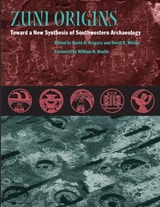
Zuni Origins
Toward a New Synthesis of Southwestern ArchaeologyEdited by David A. Gregory and David R. Wilcox; Foreword by William H. Doelle
University of Arizona Press, 2007
The Zuni are a Southwestern people whose origins have long intrigued anthropologists. This volume presents fresh approaches to that question from both anthropological and traditional perspectives, exploring the origins of the tribe and the influences that have affected their way of life. Utilizing macro-regional approaches, it brings together many decades of research in the Zuni and Mogollon areas, incorporating archaeological evidence, environmental data, and linguistic analyses to propose new links among early Southwestern peoples.
The findings reported here postulate the differentiation of the Zuni language at least 7,000 to 8,000 years ago, following the initial peopling of the hemisphere, and both formulate and test the hypothesis that many Mogollon populations were Zunian speakers. Some of the contributions situate Zuni within the developmental context of Southwestern societies from Paleoindian to Mogollon. Others test the Mogollon-Zuni hypothesis by searching for contrasts between these and neighboring peoples and tracing these contrasts through macro-regional analyses of environments, sites, pottery, basketry, and rock art. Several studies of late prehistoric and protohistoric settlement systems in the Zuni area then express more cautious views on the Mogollon connection and present insights from Zuni traditional history and cultural geography. Two internationally known scholars then critique the essays, and the editors present a new research design for pursuing the question of Zuni origins.
By taking stock and synthesizing what is currently known about the origins of the Zuni language and the development of modern Zuni culture, Zuni Origins is the only volume to address this subject with such a breadth of data and interpretations. It will prove invaluable to archaeologists working throughout the North American Southwest as well as to others struggling with issues of ethnicity, migration, incipient agriculture, and linguistic origins.