Results by title
3785 books match the query 'Poetry' and 8 start with z
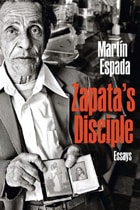
Zapata's Disciple
EssaysMartín Espada
Northwestern University Press, 2016
The ferocious acumen with which the award-winning poet Martín Espada attacks issues of social injustice in Zapata’s Disciple makes it no surprise that the book has been the subject of bans in both Arizona and Texas, targeted for its presence in the Mexican American Studies curriculum of Tucson’s schools and for its potential to incite a riot among Texas prison populations. This new edition of Zapata’s Disciple, which won the 1999 Independent Publisher Book Award for Essay / Creative Nonfiction, opens with an introduction in which the author chronicles this history of censorship and continues his lifelong fight for freedom of expression. A dozen of Espada’s poems, tender and wry as they are powerful, interweave with essays that address the denigration of the Spanish language by American cultural arbiters, castigate Nike for the exploitation of its workers, reflect upon National Public Radio’s censorship of Espada’s poem about Mumia Abu- Jamal, and more. Zapata’s Disciple is a potent assault on the continued marginalization of Latinos and other poor and working-class citizens in American society, and the collection breathes with a revolutionary zeal that is as relevant now as when it was first published.

Zen, Poetry, the Art of Lucien Stryk
Susan Porterfield
Ohio University Press, 1993
Lucien Stryk has been a presence in American letters for almost fifty years. Those who know his poetry well will find this collection particularly gratifying. Like journeying again to places visited long ago, Stryk’s writing is both familiar and wonderfully fresh.
For those just becoming acquainted with Stryk’s work, Zen, Poetry, the Art of Lucien Stryk makes an excellent introduction. It includes his early essay, “The American Scene Versus the International Scene,” written shortly after his service in the Pacific during World War II, and “Digging In,” his first published poem, as well as some of his best-known pieces on Zen and Zen poetry. Among the latter are “Beginnings, Ends,” “Poetry and Zen,” “I Fear Nothing: A Note on the Zen Poetry of Death,” and his introduction to the great haiku poets, Issa and Basho. Selections of his most recent work include “The Red Rug: An Introduction to Poetry,” and an imagined conversation among all four leading haiku poets called “Meeting at Hagi-no-Tera.”
Porterfield’s informative collection includes essays about Stryk’s work as well as his own prose and poetry. As the volume makes clear, writing poetry is for Lucien Stryk a sacred act. It is both escape and communion, inseparable from life’s daily activities.
Zeppo's First Wife
New and Selected PoemsGail Mazur
University of Chicago Press, 2005
. . . Sad, so sad-compared to what?
To your earlier more oblivious state?
It never was oblivious enough-
always those presentiments of sadness
prickling the limbic. Now a voice says, Get outside
yourself, go walk on the flats. The tide's gone out—
but your little metal detector will detect little metallic coins
of enormous sadness in the teeming wet sand,
and then, the tide will come back, erasing, cleansing!
And you, standing there in the salty scouring air-
will you still be enormously sad,
While the other world, outside your tiny purview, struck
by iron, reels? World of intentional iron, pure savage
organized iron of the world, it hasn't the time
that you have for your puny enormous sadness.
Widely acclaimed for expanding the stylistic boundaries of both the narrative and meditative lyric, Gail Mazur’s poetry crackles with verbal invention as she confronts the inevitable upheavals of a lived life. Zeppo’s First Wife, which includes excerpts from Mazur’s four previous books, as well as twenty-two new poems, is epitomized by the worldly longing of the title poem, with its searching poignancy and comic bravura. Mazur’s explorations of “this fallen world, this loony world” are deeply moving acts of empathy by a singular moral sensibility—evident from the earliest poem included here, the much-anthologized “Baseball,” a stunning bird’s-eye view of human foibles and passions. Clear-eyed, full of paradoxical griefs and appetites, her poems brave the most urgent subjects—from the fraught luscious Eden of the ballpark, to the fragility of our closest human ties, to the implications for America in a world where power and war are cataclysmic for the strong as well as the weak.
Ziggurat
Peter Balakian
University of Chicago Press, 2010
Zion
TJ Jarrett
Southern Illinois University Press, 2014
Zion, the latest collection of poems by TJ Jarrett, is the poignant study of the resonating effects of the civil rights movement on one family. Jarrett lovingly explores the minutiae of mortality and race across three generations of “Dark Girls” who have come together one summer to grieve and to remember as one of them passes to the farther shore—a place beyond retribution, where there is only forgiveness.
The Mississippi of Jarrett’s collection is alive with fireflies and locusts and murders of crows; yet for some, it is a wasteland of unanswered prayers, burning evenings, and the shades of dead or disappeared loved ones. There, the dark nights of the soul weigh long and heavy, and “every heart has its solstice, and its ache is unrelenting.”
Yet much as every solstice has an equinox, every time to kill has a time to forgive. Throughout the volume, the author imagines opportunities for compassion on multiple levels, from sweeping pardons to the most intimate of mercies. Jarrett’s faceless narrator confesses the past through conversation and exploration with notorious Mississippi governor Theodore Bilbo: two minds, two hearts, two races at last face to face.
At once brutal and achingly tender, Jarrett’s volume itself is a vibrant and musical body, singing to all its parts.
Zoo
PoemsAlice Friman
University of Arkansas Press, 1999
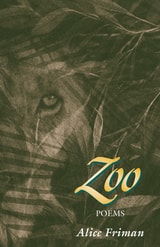
Alice Friman writes her poems with a razor-like intensity. Her metaphors slice through comfortable conventions of nature, family, love, and history. Vultures flock to carrion and “[s]pread / their wings into a tablecloth of frenzy.” A male lion takes a dead leopard’s head “in his jaws, argues it like a cat with a mole.” With equal skill, Friman can also light up quieter moments. A neglected ceiling threatens to crash down “in a blizzard of broken sidewalks,” and in the middle of family tension sits the daughter “curled in the living room chair, the eye / of the storm drowning herself in a book.”
Whether she confronts the ghosts of family, the bewildering violence of nature, or the phantoms of love in the here and now, Friman tears away the gauzy veils with her diamondhard imagination. She never takes her eyes off the subjects, always aware that the beasts are watching, too. Line by line, she takes this frightening, beautiful zoo and offers it up to us in poems that contain but do not strangle the life out of it. The bars of her lines and stanzas bend and tense while animals roar inside. Zoo testifies to the ability of language to make the familiar new in the hands of a skilled maker.
Zorba's Daughter
poemsElisabeth Murawski
Utah State University Press, 2010
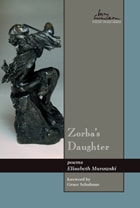
In Zorba's Daughter, the 14th volume in the Swenson Poetry Award series, Elisabeth Murawski speaks from a vital and unique sensibility, finding in ordinary images an opening to the passion of human courage in the face of deep existential pain and ambivalence. These poems awaken our joy as well as guilt, our hope as well as grief. They often evoke a sorrowful music, like the voice of mourning, but even in pointing to "the black holes of heaven," Murawski turns our gaze upward.
Zorba's Daughter was selected for the Swenson Award by the distinguished poet Grace Schulman. An icon of the literary scene, Schulman is acclaimed for her searching, highly original, lyric poetry, as well as for her teaching and her influential tenure as the poetry editor at The Nation, (1971-2006). Harold Bloom calls her "one of the permanent poets of her generation." Richard Howard says, "she is a torch."
Zóbel Reads Lorca
Poetry, Painting, and Perlimplín In LoveFederico García Lorca
Swan Isle Press, 2022
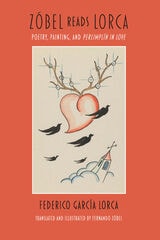
Painting, poetry, and music come together in Zóbel Reads Lorca, as Fernando Zóbel, a Harvard student who would become one of Spain’s most famous painters, translates and illustrates Federico García Lorca’s haunting play about the wounds of love.
The premiere of Amor de Don Perlimplín con Belisa en su jardín, an “erotic allelujia” which Lorca once called his most cherished play, was shut down in 1928 by Spanish government censors who confiscated the manuscript and locked it away in the pornography section of a state archive. Lorca rewrote the work in New York, and an amateur theater group brought it to the Spanish stage a few years later. Since his death, the play has also been transformed into ballet and opera.
Zóbel Reads Lorca presents Zóbel’s previously unpublished translation and features contextual essays from several scholars. Art historian Felipe Pereda studies Lorca in the context of Zóbel’s development as a painter, Luis Fernández Cifuentes describes the precarious and much-debated state of the humanities in Zóbel’s Harvard and throughout the United States in the 1940s, and Christopher Maurer delves into musical and visual aspects of the play’s American productions.