Results by title
8812 books match the query 'Political Science' and 7 start with z

Zanzibar under Colonial Rule
Abdul Sheriff
Ohio University Press, 1991
Zanzibar stands at the center of the Indian Ocean system’s involvement in the history of Eastern Africa. This book follows on from the period covered in Abdul Sheriff’s acclaimed Slaves, Spices and Ivory in Zanzibar.
The first part of the book shows the transition of Zanzibar from the commercial economy of the nineteenth century to the colonial economy of the twentieth century.
The authors begin with the abolition of the slave trade in 1873 that started the process of transformation. They show the transition from slavery to colonial “free” labor, the creation of the capitalist economy, and the resulting social contradictions. They take the history up to formal independence in 1963 with a postscript on the 1964 insurrection.
In the second part the authors analyze social classes. The landlords and the merchants were dominant in the commercial empire of the nineteenth century and had difficulties in adjusting to the colonial condition. At the same time the development of capitalist farmers and a fully proletarianized working class was hindered.
The conservative administration could not resolve the contradictions of colonial capitalism, and the formation of a united nationalist movement was hampered. This period culminated in the insurrection of 1964, but the revolution could not be consummated without mature revolutionary classes.

Zapata's Disciple
EssaysMartín Espada
Northwestern University Press, 2016
The ferocious acumen with which the award-winning poet Martín Espada attacks issues of social injustice in Zapata’s Disciple makes it no surprise that the book has been the subject of bans in both Arizona and Texas, targeted for its presence in the Mexican American Studies curriculum of Tucson’s schools and for its potential to incite a riot among Texas prison populations. This new edition of Zapata’s Disciple, which won the 1999 Independent Publisher Book Award for Essay / Creative Nonfiction, opens with an introduction in which the author chronicles this history of censorship and continues his lifelong fight for freedom of expression. A dozen of Espada’s poems, tender and wry as they are powerful, interweave with essays that address the denigration of the Spanish language by American cultural arbiters, castigate Nike for the exploitation of its workers, reflect upon National Public Radio’s censorship of Espada’s poem about Mumia Abu- Jamal, and more. Zapata’s Disciple is a potent assault on the continued marginalization of Latinos and other poor and working-class citizens in American society, and the collection breathes with a revolutionary zeal that is as relevant now as when it was first published.

Zapatista!
Reinventing Revolution in MexicoEdited by John Holloway and Eloina Pelaez
Pluto Press, 1998
Zapatistas
The Chiapas Revolt and What It Means For Radical PoliticsMihalis Mentinis
Pluto Press, 2006
The Zapatista Army for National Liberation burst onto the world stage on 1 January 1994. Zapatista commander Subcomandante Marcos announced a revolution, and declared war on the Mexican government and global capitalism. Since then, the Zapatistas have inspired thousands of activists across the world. They have attracted much attention from political theorists and analysts. Despite this, there is little consensus about the real nature and efficacy of the movement.
Zapatistas provides a bold new approach to understanding the insurrection. Mentinis spent nine months visiting the Zapatista autonomous zone, and the result is this unique exploration of the indigenous political theory emerging within the movement. Combining this with an analysis of the integrity of the Zaptista project, Mentinis draws on the concept of the 'event' from Badiou, ideas from Situationism, the 'project of autonomy' of Cornelius Castoriadis and the 'constituent power' of Antonio Negri, to present a rigourous account of the movement and the impact it has had on radical political theory.
Zionism and its Discontents
A Century of Radical Dissent in Israel/PalestineRan Greenstein
Pluto Press, 2014
Mainstream nationalist narratives and political movements have dominated the Israeli-Palestinian situation for too long. In this much-needed book, Ran Greenstein challenges this hegemony by focusing on four different, but at the same time connected, attempts which stood up to Zionist dominance and the settlement project before and after 1948.
Greenstein begins by addressing the role of the Palestinian Communist Party, and then the bi-nationalist movement, before moving on to the period after 1948 when Palestinian attempts to challenge their unjust conditions of marginalisation became more frequent. Finally, he confronts the radical anti-Zionist Matzpen group, which operated from the early 1960s–80s.
In addition to analyses of the shifting positions of these movements, Greenstein examines perspectives regarding a set of conceptual issues: colonialism and settlement, race/ethnicity and class, and questions of identity, rights and power, and how, such as in the case of South Africa, these relations should be seen as global.
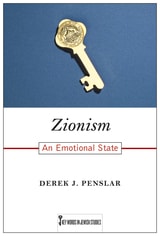
Zionism
An Emotional StateDerek J. Penslar
Rutgers University Press, 2023
Finalist for the National Jewish Book Award for Modern Jewish Thought and Experience.
Emotion lies at the heart of all national movements, and Zionism is no exception. For those who identify as Zionist, the word connotes liberation and redemption, uniqueness and vulnerability. Yet for many, Zionism is a source of distaste if not disgust, and those who reject it are no less passionate than those who embrace it. The power of such emotions helps explain why a word originally associated with territorial aspiration has survived so many years after the establishment of the Israeli state.
Zionism: An Emotional State expertly demonstrates how the energy propelling the Zionist project originates from bundles of feeling whose elements have varied in volume, intensity, and durability across space and time. Beginning with an original typology of Zionism and a new take on its relationship to colonialism, Penslar then examines the emotions that have shaped Zionist sensibilities and practices over the course of the movement’s history. The resulting portrait of Zionism reconfigures how we understand Jewish identity amidst continuing debates on the role of nationalism in the modern world.

Zion’s Last Frontier
LDS Ranchers, Federal Regulators, and the Clash of the New West in Capitol Reef Country, UtahThomas E. Sheridan
University of Arizona Press, 2026
Zion’s Last Frontier is a historical ethnography that documents the uniquely Latter-Day Saints (Mormon) ranching community around Capitol Reef National Park in south-central Utah over the last 150 years.
From the arrival of the first LDS pioneers in the 1870s to fifth- and sixth-generation descendants of those pioneers today, anthropologist Thomas E. Sheridan documents their ongoing struggles with the federal and state agencies that control 96 percent of the land they ranch. Changing policies and management philosophies profoundly impact the ranchers’ livelihoods and ways of life. Sheridan argues that the ranchers should qualify as Traditionally Associated People. Only one allotment on the Park remains, but the Park still allows ranchers to drive their cattle on horseback along the few canyons that cut through the Waterpocket Fold as they move their herds from their traditional summer grazing lands to their winter grazing lands.
Pushing beyond binary arguments, Sheridan offers an empathetic look at the lived experiences of rural communities often mischaracterized in debates over public lands and environmentalism. Tensions have been aggravated by a massive increase in the number of tourists that swarm the area in the warmer months and a steady increase in the number of seasonal residents who build second homes there.
Zion’s Last Frontier provides an in-depth look at the clash of cultures between the agrarian Old West and the New West of tourism and second-homers that is playing itself out across so many parts of the rural West today.