Results by title
1668 books match the query 'Popular culture' and 3 start with z

Ziegfeld Girl
Image and Icon in Culture and CinemaLinda Mizejewski
Duke University Press, 1999
In the first decades of the twentieth century, Broadway teemed with showgirls, but only the Ziegfeld Girl has survived in American popular culture—as a figure of legend, nostalgia, and camp. Featured in Florenz Ziegfeld Jr.’s renowned revues, which ran on Broadway from 1907 to 1931, the Ziegfeld Girl has appeared in her trademark feather headdresses, parading and posing, occasionally singing and dancing, in numerous musicals and musical films paying direct or indirect homage to the intrepid producer and his glorious Girl. Linda Mizejewski analyzes the Ziegfeld Girl as a cultural icon and argues that during a time when American national identity was in flux, Ziegfeld Girls were both products and representations of a white, upscale, heterosexual national ideal.
Mizejewski traces the Ziegfeld Girl’s connections to turn-of-the-century celebrity culture, black Broadway, the fashion industry, and the changing sexual and gender identities evident in mainstream entertainment during the Ziegfeld years. In addition, she emphasizes how crises of immigration and integration made the identity and whiteness of the American Girl an urgent issue on Broadway’s revue stages during that era. Although her focus is on the showgirl as a “type,” the analysis is intermingled with discussions of figures like Anna Held, Fanny Brice, and Bessie McCoy, the Yama Yama girl, as well as Ziegfeld himself. Finally, Mizejewski discusses the classic American films that have most vividly kept this showgirl alive in both popular and camp culture, including The Great Ziegfeld, Ziegfeld Girl, and the Busby Berkeley musicals that cloned Ziegfeld’s showgirls for decades.
Ziegfeld Girl will appeal to scholars and students in American studies, popular culture, theater and performance studies, film history, gender studies, gay and lesbian studies, and social history.
[more]
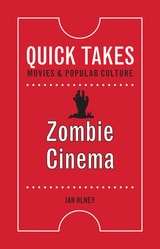
Zombie Cinema
Olney, Ian
Rutgers University Press, 2017
It’s official: the zombie apocalypse is here. The living dead have been lurking in popular culture since the 1930s, but they have never been as ubiquitous or as widely-embraced as they are today.
Zombie Cinema is a lively and accessible introduction to this massively popular genre. Presenting a historical overview of zombie appearances in cinema and on television, Ian Olney also considers why, more than any other horror movie monster, zombies have captured the imagination of twenty-first-century audiences.
Surveying the landmarks of zombie film and TV, from White Zombie to The Walking Dead, the book also offers unique insight into why zombies have gone global, spreading well beyond the borders of American and European cinema to turn up in films from countries as far-flung as Cuba, India, Japan, New Zealand, and Nigeria. Both fun and thought-provoking, Zombie Cinema will give readers a new perspective on our ravenous hunger for the living dead.
[more]
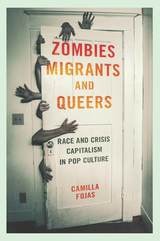
Zombies, Migrants, and Queers
Race and Crisis Capitalism in Pop CultureCamilla Fojas
University of Illinois Press, 2017
The alarm and anxiety unleashed by the Great Recession found fascinating expression across popular culture. Harried survivors negotiated societal collapse in The Walking Dead. Middle-class whites crossed the literal and metaphorical Mexican border on Breaking Bad or coped with a lack of freedom among the marginalized on Orange Is the New Black. Camilla Fojas uses representations of people of color, the incarcerated, and trans/queers--vulnerable populations all--to work through the contradictions created by the economic crisis and its freefalling aftermath. Television, film, advertising, and media coverage of the crisis created a distinct kind of story about capitalism and the violence that supports it. Fojas shows how these pop culture moments reshaped social dynamics and people's economic sensibilities and connects the ways pop culture reflected economic devastation. She also examines how these artifacts illuminated parts of society usually kept off-screen or on the margins even as they defaulted to stories of white protagonists.
[more]