Results by title
22279 books match the query 'Social Science' and 28 start with z

Zanzibar under Colonial Rule
Abdul Sheriff
Ohio University Press, 1991
Zanzibar stands at the center of the Indian Ocean system’s involvement in the history of Eastern Africa. This book follows on from the period covered in Abdul Sheriff’s acclaimed Slaves, Spices and Ivory in Zanzibar.
The first part of the book shows the transition of Zanzibar from the commercial economy of the nineteenth century to the colonial economy of the twentieth century.
The authors begin with the abolition of the slave trade in 1873 that started the process of transformation. They show the transition from slavery to colonial “free” labor, the creation of the capitalist economy, and the resulting social contradictions. They take the history up to formal independence in 1963 with a postscript on the 1964 insurrection.
In the second part the authors analyze social classes. The landlords and the merchants were dominant in the commercial empire of the nineteenth century and had difficulties in adjusting to the colonial condition. At the same time the development of capitalist farmers and a fully proletarianized working class was hindered.
The conservative administration could not resolve the contradictions of colonial capitalism, and the formation of a united nationalist movement was hampered. This period culminated in the insurrection of 1964, but the revolution could not be consummated without mature revolutionary classes.
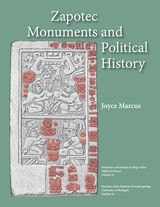
Zapotec Monuments and Political History
Joyce Marcus
University of Michigan Press, 2020
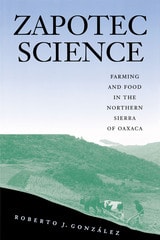
Zapotec Science
Farming and Food in the Northern Sierra of OaxacaBy Roberto J. González
University of Texas Press, 2001
2003 — Julian Steward Award – Anthropology & Environment Section, American Anthropological Association
2002 — A CHOICE Outstanding Academic Book
How Zapotec agricultural and dietary theories and practices constitute a valid local science.
Zapotec farmers in the northern sierra of Oaxaca, Mexico, are highly successful in providing their families with abundant, nutritious food in an ecologically sustainable fashion, although the premises that guide their agricultural practices would be considered erroneous by the standards of most agronomists and botanists in the United States and Europe. In this book, Roberto González convincingly argues that in fact Zapotec agricultural and dietary theories and practices constitute a valid local science, which has had a reciprocally beneficial relationship with European and United States farming and food systems since the sixteenth century.
González bases his analysis upon direct participant observation in the farms and fields of a Zapotec village. By using the ethnographic fieldwork approach, he is able to describe and analyze the rich meanings that campesino families attach to their crops, lands, and animals. González also reviews the history of maize, sugarcane, and coffee cultivation in the Zapotec region to show how campesino farmers have intelligently and scientifically adapted their farming practices to local conditions over the course of centuries. By setting his ethnographic study of the Talea de Castro community within a historical world systems perspective, he also skillfully weighs the local impact of national and global currents ranging from Spanish colonialism to the 1910 Mexican Revolution to NAFTA. At the same time, he shows how, at the turn of the twenty-first century, the sustainable practices of "traditional" subsistence agriculture are beginning to replace the failed, unsustainable techniques of modern industrial farming in some parts of the United States and Europe.
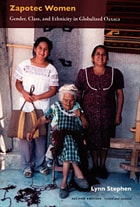
Zapotec Women
Gender, Class, and Ethnicity in Globalized OaxacaLynn Stephen
Duke University Press, 2005
Stephen presents new information about the weaving cooperatives women have formed over the last two decades in an attempt to gain political and cultural rights within their community and standing as independent artisans within the global market. She also addresses the place of Zapotec weaving within Mexican folk art and the significance of increased migration out of Teotitlán. The women weavers and merchants collaborated with Stephen on the research for this book, and their perspectives are key to her analysis of how gender relations have changed within rituals, weaving production and marketing, local politics, and family life. Drawing on the experiences of women in Teotitlán, Stephen considers the prospects for the political, economic, and cultural participation of other indigenous women in Mexico under the policies of economic neoliberalism which have prevailed since the 1990s.
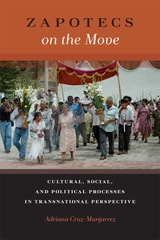
Zapotecs on the Move
Cultural, Social, and Political Processes in Transnational PerspectiveCruz-Manjarrez, Adriana
Rutgers University Press, 2013
Based on multi-site fieldwork conducted over a five-year period, Adriana Cruz-Manjarrez analyzes how and why Yalálag Zapotec identity and culture have been reconfigured in the United States, using such cultural practices as music, dance, and religious rituals as a lens to bring this dynamic process into focus. By illustrating the sociocultural, economic, and political practices that link immigrants in Los Angeles to those left behind, the book documents how transnational migration has reflected, shaped, and transformed these practices in both their place of origin and immigration.

Zeroing In on the Year 2000
The Final EditionEdited by George E. Marcus
University of Chicago Press, 2000
The book begins with a fascinating, at times poignant, look back at the inception and progress of the series, in which the contributors reflect on how the shifting contexts for the production and reception of the series has been a reliable barometer of the profound ways in which traditional forms of knowledge about society are changing. Then, appropriate to the end of the century and of the series, the focus turns to pieces that deal with social phenomena that evoke the value of zero. They explore the idea of a zero state as it relates to artificial intelligence, euthanasia, cryonics, money, and the disappearing idea of society itself in the discourse of contemporary politics.
Far from being the loss of meaning, the consideration of zero entails the proliferation of meaning in the face of voids, absences, and ultimately, of puzzles like the contemplation of death in life. In this way, so many of the fin-de-siècle conditions that have been documented in this series have exemplified precisely this quest for meaning at or near zero points of change, of ends and beginnings, in social life.
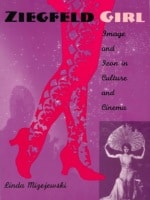
Ziegfeld Girl
Image and Icon in Culture and CinemaLinda Mizejewski
Duke University Press, 1999
Mizejewski traces the Ziegfeld Girl’s connections to turn-of-the-century celebrity culture, black Broadway, the fashion industry, and the changing sexual and gender identities evident in mainstream entertainment during the Ziegfeld years. In addition, she emphasizes how crises of immigration and integration made the identity and whiteness of the American Girl an urgent issue on Broadway’s revue stages during that era. Although her focus is on the showgirl as a “type,” the analysis is intermingled with discussions of figures like Anna Held, Fanny Brice, and Bessie McCoy, the Yama Yama girl, as well as Ziegfeld himself. Finally, Mizejewski discusses the classic American films that have most vividly kept this showgirl alive in both popular and camp culture, including The Great Ziegfeld, Ziegfeld Girl, and the Busby Berkeley musicals that cloned Ziegfeld’s showgirls for decades.
Ziegfeld Girl will appeal to scholars and students in American studies, popular culture, theater and performance studies, film history, gender studies, gay and lesbian studies, and social history.
Zion in the Valley, Volume I
The Jewish Community of St. Louis, Volume I, 1807-1907Walter Ehrlich
University of Missouri Press, 1997
St. Louis contains one of the largest Jewish communities in the interior of the United States. Yet, despite the important contributions of St. Louis Jews to the city's cultural and economic growth and to national and international Jewry, no history of their accomplishments has heretofore been written.
In this masterful book, Walter Ehrlich shows how the St. Louis Jewish community grew in two separate yet intricately related milieux. One was the internal socioreligious community, which centered on relations of Jews with fellow Jews. The other was the broader secular environment, in which Jews individually and collectively interacted with the non-Jewish population, assuming significant roles in the political, economic, social, and religious developments of one of the country's most important urban centers.
Employing many previously unused primary materials--especially congregational archives, organizational and business records, contemporary newspapers, and vivid personal memoirs--Ehrlich presents a fascinating description of how individuals and groups contributed to the growth and development of a major American urban area. He clarifies significant aspects of social and economic structure, mobility, and philanthropy within the Jewish community and integrates them within the broader framework of American society. In the process, Ehrlich provides a unique perspective on St. Louis history, as well as on American urban, ethnic, and immigration history.
Zion in the Valley is an invaluable contribution to the field of Jewish studies. It will appeal to scholars and students of Jewish, urban, and ethnic history, as well as to members of the broader St. Louis community.
Zion in the Valley, Volume II
The Jewish Community of St. Louis, Volume II, The Twentieth CenturyWalter Ehrlich
University of Missouri Press, 2002
Zionism
An Emotional StateDerek J. Penslar
Rutgers University Press, 2023
Finalist for the National Jewish Book Award for Modern Jewish Thought and Experience.
Emotion lies at the heart of all national movements, and Zionism is no exception. For those who identify as Zionist, the word connotes liberation and redemption, uniqueness and vulnerability. Yet for many, Zionism is a source of distaste if not disgust, and those who reject it are no less passionate than those who embrace it. The power of such emotions helps explain why a word originally associated with territorial aspiration has survived so many years after the establishment of the Israeli state.
Zionism: An Emotional State expertly demonstrates how the energy propelling the Zionist project originates from bundles of feeling whose elements have varied in volume, intensity, and durability across space and time. Beginning with an original typology of Zionism and a new take on its relationship to colonialism, Penslar then examines the emotions that have shaped Zionist sensibilities and practices over the course of the movement’s history. The resulting portrait of Zionism reconfigures how we understand Jewish identity amidst continuing debates on the role of nationalism in the modern world.

Zion’s Last Frontier
LDS Ranchers, Federal Regulators, and the Clash of the New West in Capitol Reef Country, UtahThomas E. Sheridan
University of Arizona Press, 2026
Zion’s Last Frontier is a historical ethnography that documents the uniquely Latter-Day Saints (Mormon) ranching community around Capitol Reef National Park in south-central Utah over the last 150 years.
From the arrival of the first LDS pioneers in the 1870s to fifth- and sixth-generation descendants of those pioneers today, anthropologist Thomas E. Sheridan documents their ongoing struggles with the federal and state agencies that control 96 percent of the land they ranch. Changing policies and management philosophies profoundly impact the ranchers’ livelihoods and ways of life. Sheridan argues that the ranchers should qualify as Traditionally Associated People. Only one allotment on the Park remains, but the Park still allows ranchers to drive their cattle on horseback along the few canyons that cut through the Waterpocket Fold as they move their herds from their traditional summer grazing lands to their winter grazing lands.
Pushing beyond binary arguments, Sheridan offers an empathetic look at the lived experiences of rural communities often mischaracterized in debates over public lands and environmentalism. Tensions have been aggravated by a massive increase in the number of tourists that swarm the area in the warmer months and a steady increase in the number of seasonal residents who build second homes there.
Zion’s Last Frontier provides an in-depth look at the clash of cultures between the agrarian Old West and the New West of tourism and second-homers that is playing itself out across so many parts of the rural West today.
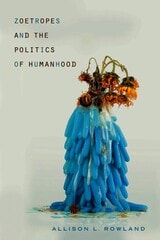
Zoetropes and the Politics of Humanhood
Allison L. Rowland
The Ohio State University Press, 2020
Honorable Mention, Marie Hochmuth Nichols Award for Outstanding Published Scholarship in Public Address, 2021
Honorable Mention, 2021 Rhetoric Society of America Book Award
The way we talk about living beings can raise or lower their perceived value. Consider the pro-life strategy of calling a fetus a child, thereby effectively promoting the value of fetal life. In the opposite direction, calling a Pakistani child killed by a US drone strike collateral damage can implicitly demote the value of that child’s life. Allison L. Rowland’s Zoetropes and the Politics of Humanhood looks at such discursive practices—providing the first systematic account of how transvaluations like these operate in public discourse and lurk at the edges of all language.
Building on the necropolitical concept that we are constantly parsing populations into worthy lives, subhuman lives, and lives sentenced to death, Rowland’s study focuses specifically at zoetropes—the rhetorical devices and figures that result in such transvaluations. Through a series of case studies, including microbial life (at the American Gut Project), fetal life (at the National Memorial for the Unborn), and vital human life (at two of the nation’s premier fitness centers)—and in conversation with cutting-edge theories of race, gender, sexuality, and disability—this book brings to light the discursive practices that set the terms for inclusion into humanhood and make us who we are.

Zombie Cinema
Olney, Ian
Rutgers University Press, 2017
Zombie Cinema is a lively and accessible introduction to this massively popular genre. Presenting a historical overview of zombie appearances in cinema and on television, Ian Olney also considers why, more than any other horror movie monster, zombies have captured the imagination of twenty-first-century audiences.
Surveying the landmarks of zombie film and TV, from White Zombie to The Walking Dead, the book also offers unique insight into why zombies have gone global, spreading well beyond the borders of American and European cinema to turn up in films from countries as far-flung as Cuba, India, Japan, New Zealand, and Nigeria. Both fun and thought-provoking, Zombie Cinema will give readers a new perspective on our ravenous hunger for the living dead.

Zombies in the Academy
Living Death in Higher EducationEdited by Andrew Whelan, Ruth Walker, and Christopher Moore
Intellect Books, 2013
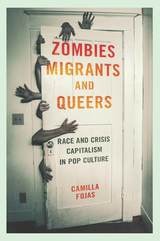
Zombies, Migrants, and Queers
Race and Crisis Capitalism in Pop CultureCamilla Fojas
University of Illinois Press, 2017
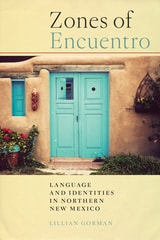
Zones of Encuentro
Language and Identities in Northern New MexicoLillian Gorman
The Ohio State University Press, 2024
Winner, 2025 New Mexico Book Awards, Multicultural Category
Finalist, New Mexico Book Awards, BIPOC Author or Subject Category and First Book Category
Working at the intersection of Latina/o/x cultural studies, sociocultural linguistics, and Chicana feminist studies, Lillian Gorman’s Zones of Encuentro takes an in-depth look at the cultural and linguistic interactions between two distinct Latina/o/x communities in the region: Nuevomexicanos (Hispanic people who trace their presence in the region to colonial times and whose families have historically spoken Traditional New Mexican Spanish, or TNMS) and first-generation Mexicano immigrants (who tend to speak Mexican Spanish). Gorman examines the everyday lived language experiences and ethnolinguistic identities of Mexicanos and Nuevomexicanos together, specifically through the case of mixed Mexicano-Nuevomexicano families. Through an interdisciplinary critical reading of ethnographic data, pláticas (informal conversations that gather family and community knowledge), interviews, articles, and historical memoirs, Gorman analyzes language ideologies, identity formations, and language practices by exploring complex spaces of encounter within Mexicano-Nuevomexicano families. Zones of Encuentro complicates homogeneous notions of language and identity and contemplates what a shared cultural and linguistic homeplace looks like for Mexicanos and Nuevomexicanos in northern New Mexico.

Zoo Culture
Bob Mullan and Garry Marvin
University of Illinois Press, 1999
In this provocative book, the authors demonstrate that zoos tell us as
much about humans as they do about animals and suggest that while animals
may not need zoos, urban societies seem to.
A new introduction takes note of dramatic changes in the perceived role
of zoos that have occurred since the book's original publication.
"Bob Mullan and Garry Marvin delve into the assumptions about animals
that are embedded in our culture. . . . A thought-provoking glimpse of
our own ideas about the exotic, the foreign." -- Tess Lemmon, BBC
Wildlife Magazine
"A thoughtful and entertaining guided tour." -- David White,
New Society
"[An] unusual and intriguing combination of historical survey, psychological
enquiry, and compendium of fascinating facts." -- Evening Standard

Zooarchaeology and Conservation Biology
Richard Lee Lyman
University of Utah Press, 2004
Many modern ecological problems such as rain forest destruction, decreasing marine harvests, and fire suppression are directly or indirectly anthropogenic. Zooarchaeology and Conservation Biology presents an argument that conservation biology and wildlife management cannot afford to ignore zooarchaeological research—the identification and analysis of faunal remains recovered from archaeological deposits. The editors contend that we can learn important lessons by studying long-term human and nonhuman influences on biota and ecosystems. From this perspective we can begin to understand biogeographic dynamics and behavioral patterns that are invisible to researchers who study living organisms over just a small span of years.
The focus of this volume is on the North American faunal record. Contributors identify a specific management or conservation issue, describe and analyze relevant zooarchaeological data, and offer recommendations or at least establish a baseline for possible resolution. The volume brings together both case studies and research about past ecosystems, and examines how such knowledge can be of current utility and relevance.
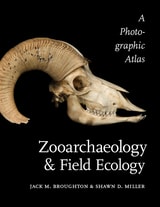
Zooarchaeology and Field Ecology
A Photographic AtlasJack M. Broughton and Shawn D. Miller
University of Utah Press, 2016
Zooarchaeology beyond Human Subsistence
Gillian L. Wong and Amy Milson Klemmer, eds.
University of Utah Press, 2025
In this dynamic volume, Gillian L. Wong and Amy Milson Klemmer present seven groundbreaking chapters that delve into the diverse ways humans have interacted with animals in the past, as revealed through archaeological research into animal remains. Zooarchaeology beyond Human Subsistence explores a wide range of topics, from the role of animals in trade and prestige to their influence on cultural development and the shared spaces humans and animals occupied. The studies also highlight the importance of community engagement, showcasing collaborations between archaeologists and heritage communities.
Ideal for professionals and enthusiasts in archaeology, anthropology, zoology, biology, ecology, history, and beyond, this book offers a fresh perspective on zooarchaeology, emphasizing human-animal bonds, trade, ritual, and environmental impacts. With Spanish translations for chapters on South America, this volume invites a broader audience to explore the intricate web of human-animal interactions throughout history, offering insights far beyond mere subsistence.
Zooarchaeology of Six Prehistoric Sites in the Sierra Blanca Region, New Mexico
Jonathan C. Driver
University of Michigan Press, 1985
Zoological Surrealism
The Nonhuman Cinema of Jean PainlevéJames Leo Cahill
University of Minnesota Press, 2019
An archive-based, in-depth analysis of the surreal nature and science movies of the pioneering French filmmaker Jean Painlevé
Before Jacques-Yves Cousteau, there was Jean Painlevé, a pioneering French scientific and nature filmmaker with a Surrealist’s eye. Creator of more than two hundred films, his studies of strange animal worlds doubled as critical reimaginations of humanity. With an unerring eye for the uncanny and unexpected, Painlevé and his assistant Geneviève Hamon captured oneiric octopuses, metamorphic crustaceans, erotic seahorses, mythic vampire bats, and insatiable predatory insects.
Zoological Surrealism draws from Painlevé’s early oeuvre to rethink the entangled histories of cinema, Surrealism, and scientific research in interwar France. Delving deeply into Painlevé’s archive, James Leo Cahill develops an account of “cinema’s Copernican vocation”—how it was used to forge new scientific discoveries while also displacing and critiquing anthropocentric viewpoints.
From Painlevé’s engagements with Sergei Eisenstein, Georges Franju, and competing Surrealists to the historiographical dimensions of Jean Vigo’s concept of social cinema, Zoological Surrealism taps never-before-examined sources to offer a completely original perspective on a cutting-edge filmmaker. The first extensive English-language study of Painlevé’s early films and their contexts, it adds important new insight to our understanding of film while also contributing to contemporary investigations of the increasingly surreal landscapes of climate change and ecological emergency.

Zoom-In to Madisonville
Penelope Ballard Drooker
University of Michigan Press, 0
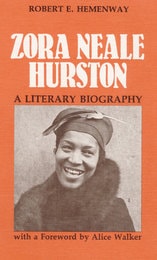
Zora Neale Hurston
A Literary BiographyRobert E. Hemenway. Foreword by Alice Walker
University of Illinois Press, 1977
The life and work of the iconic author and intellectual
Zora Neale Hurston transformed each hour of her life into something bubbling, exuberant, and brimming with joy. Robert Hemenway’s biography is a towering portrait of the novelist, folklorist, and anthropologist. Drawing on archival documents and interviews with people who knew her, Hemenway explores Hurston’s art and work, from her extraordinary novels and autobiography to a popular treatment of black folkways that revealed her deep commitment to the black folk tradition. He also provides a sensitive look at her two marriages; her relationships with Mrs. R. Osgood Mason, Franz Boas, and Langston Hughes; her time as a member of the black literati of the 1920s and 1930s; and the penniless final years leading to her death.
Sophisticated and original, Zora Neale Hurston tells the compelling story of a woman who reveled in a fully lived life dedicated to a lasting art and the preservation of a vital cultural heritage.
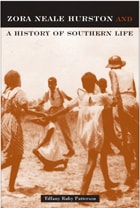
Zora Neale Hurston
And A History Of Southern LifeTiffany Ruby Patterson
Temple University Press, 2005
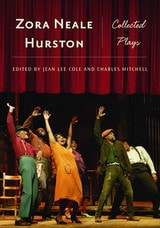
Zora Neale Hurston
Collected PlaysJean Lee Cole and Charles Mitchell
Rutgers University Press, 2008
Though she died penniless and forgotten, Zora Neale Hurston is now recognized as a major figure in African American literature. Best known for her 1937 novel Their Eyes Were Watching God, she also published numerous short stories and essays, three other novels, and two books on black folklore.
Even avid readers of Hurston’s prose, however, may be surprised to know that she was also a serious and ambitious playwright throughout her career. Although several of her plays were produced during her lifetime—and some to public acclaim—they have languished in obscurity for years. Even now, most critics and historians gloss over these texts, treating them as supplementary material for understanding her novels. Yet, Hurston’s dramatic works stand on their own merits and independently of her fiction.
Now, eleven of these forgotten dramatic writings are being published together for the first time in this carefully edited and annotated volume. Filled with lively characters, vibrant images of rural and city life, biblical and folk tales, voodoo, and, most importantly, the blues, readers will discover a “real Negro theater” that embraces all the richness of black life.
Zuni Origins
Toward a New Synthesis of Southwestern ArchaeologyEdited by David A. Gregory and David R. Wilcox; Foreword by William H. Doelle
University of Arizona Press, 2007
The Zuni are a Southwestern people whose origins have long intrigued anthropologists. This volume presents fresh approaches to that question from both anthropological and traditional perspectives, exploring the origins of the tribe and the influences that have affected their way of life. Utilizing macro-regional approaches, it brings together many decades of research in the Zuni and Mogollon areas, incorporating archaeological evidence, environmental data, and linguistic analyses to propose new links among early Southwestern peoples.
The findings reported here postulate the differentiation of the Zuni language at least 7,000 to 8,000 years ago, following the initial peopling of the hemisphere, and both formulate and test the hypothesis that many Mogollon populations were Zunian speakers. Some of the contributions situate Zuni within the developmental context of Southwestern societies from Paleoindian to Mogollon. Others test the Mogollon-Zuni hypothesis by searching for contrasts between these and neighboring peoples and tracing these contrasts through macro-regional analyses of environments, sites, pottery, basketry, and rock art. Several studies of late prehistoric and protohistoric settlement systems in the Zuni area then express more cautious views on the Mogollon connection and present insights from Zuni traditional history and cultural geography. Two internationally known scholars then critique the essays, and the editors present a new research design for pursuing the question of Zuni origins.
By taking stock and synthesizing what is currently known about the origins of the Zuni language and the development of modern Zuni culture, Zuni Origins is the only volume to address this subject with such a breadth of data and interpretations. It will prove invaluable to archaeologists working throughout the North American Southwest as well as to others struggling with issues of ethnicity, migration, incipient agriculture, and linguistic origins.
Zuñi Coyote Tales
Frank Hamilton Cushing
University of Arizona Press, 1998
These tales pit the wily Coyote against various demons and other creatures in order to convey simple lessons or explain animal characteristics or behavior. They tell how the tip of the coyote's tail became black after dancing with blackbirds and how coyotes learned never to insult horned-toads—and to keep clear of burrowing-owls. Through these tales, we learn why Coyote meddles with everything that does not concern him, makes a universal nuisance of himself, and is ready to jump into any trap laid for him.