Results by title

4 books match the query '(1787)'
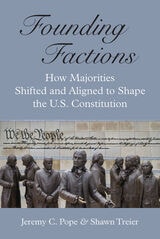
cover of Founding Factions: How Majorities Shifted and Aligned to Shape the U.S. Constitution

Founding Factions

How Majorities Shifted and Aligned to Shape the U.S. Constitution

Jeremy C. Pope and Shawn Treier

University of Michigan Press, 2020
The fundamental importance of the 1787 Constitutional Convention continues to affect contemporary politics. The Constitution defines the structure and limits of the American system of government, and it organizes contemporary debates about policy and legal issues—debates that explicitly invoke the intentions and actions of those delegates to the Convention. Virtually all scholarship emphasizes the importance of compromise between key actors or factions at the Convention. In truth, the deep structure of voting at the Convention remains somewhat murky because the traditional stories are incomplete. There were three key factions at the Convention, not two. The alliance of the core reformers with the slave interests helped change representation and make a stronger national government. When it came time to create a strong executive, a group of small state delegates provided the crucial votes. Traditional accounts gloss over the complicated coalition politics that produced these important compromises, while this book shows the specific voting alignments. It is true that the delegates came with common purposes, but they were divided by both interests and ideas into three crosscutting factions. There was no persistent dominant coalition of reformers or nationalists; rather, there was a series of minority factions allying with one another on the major issues to fashion the compromise. Founding Factions helps us understand the nature of shifting majorities and how they created the American government.
[more]
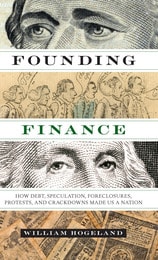
cover of Founding Finance: How Debt, Speculation, Foreclosures, Protests, and Crackdowns Made Us a Nation

Founding Finance

How Debt, Speculation, Foreclosures, Protests, and Crackdowns Made Us a Nation

By William Hogeland

University of Texas Press, 2014

Recent movements such as the Tea Party and anti-tax “constitutional conservatism” lay claim to the finance and taxation ideas of America’s founders, but how much do we really know about the dramatic clashes over finance and economics that marked the founding of America? Dissenting from both right-wing claims and certain liberal preconceptions, Founding Finance brings to life the violent conflicts over economics, class, and finance that played directly, and in many ways ironically, into the hardball politics of forming the nation and ratifying the Constitution—conflicts that still continue to affect our politics, legislation, and debate today.

Mixing lively narrative with fresh views of America’s founders, William Hogeland offers a new perspective on America’s economic infancy: foreclosure crises that make our current one look mild; investment bubbles in land and securities that drove rich men to high-risk borrowing and mad displays of ostentation before dropping them into debtors’ prisons; depressions longer and deeper than the great one of the twentieth century; crony mercantilism, war profiteering, and government corruption that undermine any nostalgia for a virtuous early republic; and predatory lending of scarce cash at exorbitant, unregulated rates, which forced people into bankruptcy, landlessness, and working in the factories and on the commercial farms of their creditors. This story exposes and corrects a perpetual historical denial—by movements across the political spectrum—of America’s all-important founding economic clashes, a denial that weakens and cheapens public discourse on American finance just when we need it most.
[more]
cover of Letters from the Federal Farmer to the Republican

Letters from the Federal Farmer to the Republican

Walter Bennett

University of Alabama Press, 1978

The Federal Farmer’s letters were written in opposition to the Constitution in the form in which it had come from the Federal Convention of 1787. Their immediate objective was to secure amendments to the Constitution before it was ratified by state convention. But the letters are valuable also for the basic political philosophy that they represent, specifically, the political philosophy of the revolution and the Bill of Rights. This philosophy stresses principles of federalism and republicanism and exemplifies the liberal idealism that took root in America during the Revolutionary War era.

 
As first published, the letters comprised two separate pamphlets, one appearing in the fall of 1787 and consisting of five letters, the other appearing in the spring of 1788 and consisting of thirteen letters. The letters have seldom been reprinted, and until now they have never been issued together in a single edition. One of the merits of the present volume is that it includes all the letters exactly as they appeared in the original printed texts. A synoptic table of contents for the entire series has been supplied by the editor, in addition to an editor’s introduction, which includes a critical analysis of the Federal Farmer’s main arguments and also deals with the authorship of the letters.
 
Richard Henry Lee of Virginia was early identified as the author of the letters, and in the course of the nineteenth century this attribution came to be generally accepted. However, Lee gave no hint in his known writings that he had written the letters, and in recent years the attribution of authorship to him has been questioned by competent scholars. The editor makes clear that he considers the evidence supporting the attribution to Lee to be strong, but he concludes, on the basis of his own investigation, that the question of authorship should not at this point be considered to have been settled. He makes no assumption that the matter will eventually be settled but suggests that a thoroughgoing linguistic and comparative analysis of Lee’s known writings and the Federal Farmer’s letters should be helpful in considering the question further.
 
The letters have long been considered to be among the most significant of the political literature published in America during the great debate over the ratification of the Constitution. Alexander Hamilton refers to the Federal Farmer in the sixty-eight essay of The Federalist as “the most plausible” of the opponents of the Constitution to have appeared in print. Recent scholars probing into the literature of these so-called antifederalists have indicated that they have been quite impressed by the general content and comparatively moderate tone of the Federal Farmer’s letters, and also by the seemingly substantial influence that the letters had in articulating arguments that appeared sooner or later in other writings against ratifying the Constitution in it original form.
[more]
cover of The Constitutional Convention and Formation of Union

The Constitutional Convention and Formation of Union

Edited by Winton U. Solberg

University of Illinois Press, 1990

The American Constitution was hammered out in debates by the founding fathers at the 1787 Philadelphia Convention. This book contains James Madison's notes on the debates which provide a first-hand view of the drafting of the nation's fundamental charter. An introduction by Winton U. Solberg places the origins of the Constitution in the broader historical perspective of the development of political theory and constitutional practice in Western civilization. The book also links the formation of the Constitution, biographical sketches of each participant in the Philadelphia Convention, and population figures on which representation was to be based.
 
[more]