Results by title
4 books match the query '- Between'
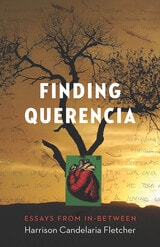
Finding Querencia
Essays from In-BetweenHarrison Candelaria Fletcher
The Ohio State University Press, 2022
With its roots in the Spanish verb querer—“to want, to love”—the term querencia has been called untranslatable but has come to mean a place of safety and belonging, that which we yearn for when we yearn for home. In this striking essay collection, Harrison Candelaria Fletcher shows that querencia is also a state of being: the peace that arises when we reconcile who we are. A New Mexican of mixed Latinx and white ethnicity, Candelaria Fletcher ventures into the fault lines of culture, landscape, and spirit to discover the source of his lifelong hauntings. Writing in the persona of coyote, New Mexican slang for “mixed,” he explores the hyphenated elements within himself, including his whiteness. Blending memory, imagination, form, and language, each essay spirals outward to investigate, accept, and embrace hybridity. Ultimately, Finding Querencia offers a new vocabulary of mixed-ness, a way to reconcile the crosscurrents of self and soul.
The Art of Being In-between
Native Intermediaries, Indian Identity, and Local Rule in Colonial OaxacaYanna Yannakakis
Duke University Press, 2008
Through interpretation of a wide array of historical sources—including descriptions of public rituals, accounts of indigenous rebellions, idolatry trials, legal petitions, court cases, land disputes, and indigenous pictorial histories—Yannakakis weaves together an elegant narrative that illuminates political and cultural struggles over the terms of local rule. As cultural brokers, native intermediaries at times reconciled conflicting interests, and at other times positioned themselves in opposing camps over the outcome of municipal elections, the provision of goods and labor, landholding, community ritual, the meaning of indigenous “custom” in relation to Spanish law, and representations of the past. In the process, they shaped an emergent “Indian” identity in tension with other forms of indigenous identity and a political order characterized by a persistent conflict between local autonomy and colonial control. This innovative study provides fresh insight into colonialism’s disparate cultures and the making of race, ethnicity, and the colonial state and legal system in Spanish America.
The Space In-Between
Essays on Latin American CultureSilviano Santiago
Duke University Press, 2001
Santiago’s work creates a theoretical field that transcends both the study of a specific national literature and the traditional perspectives of comparative literature. He examines the pedagogical and modernizing mission of Western voyagers from the conquistadors to the present. He deconstructs the ideas of “original” and “copy,” unpacking their implications for the notions of so-called dominant and dominated cultures. Santiago also confronts questions of cultural dependency and analyzes the problems involved in the imposition of an alien European history, the cultural displacements experienced by the Indians through their religious conversion, and the hierarchical suppression of native and Afro-Brazilian values.
Elegantly written and translated, The Space In-Between will provide insights and perspectives that will interest cultural and literary theorists, postcolonial scholars, and other students of contemporary culture.
ePortfolios@edu
What We Know, What We Don’t Know, and Everything In-BetweenMary Ann Dellinger
University Press of Colorado, 2021
This book is also available as an open access ebook through the WAC Clearinghouse.