Results by title
3 books match the query '-approximately 1540'

DR. FAUSTUS
ARCHETYPAL SUBTEXT AT THE MILLENNIUMPETER WERRES
West Virginia University Press, 1999

Faust
A Tragedy, Part IEugene Stelzig
Bucknell University Press, 2019
Published by Bucknell University Press. Distributed worldwide by Rutgers University Press.
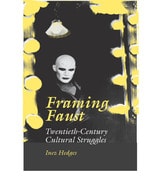
Framing Faust
Twentieth-Century Cultural StrugglesInez Hedges
Southern Illinois University Press, 2009
In this interdisciplinary cultural history that encompasses film, literature, music, and drama, Inez Hedges follows the thread of the Faustian rebel in the major intellectual currents of the last hundred years. She presents Faust and his counterpart Mephistopheles as antagonistic—yet complementary—figures whose productive conflict was integral to such phenomena as the birth of narrative cinema, the rise of modernist avant-gardes before World War II, and feminist critiques of Western cultural traditions.
Framing Faust: Twentieth-Century Cultural Struggles pursues a dialectical approach to cultural history. Using the probing lens of cultural studies, Hedges shows how claims to the Faustian legacy permeated the struggle against Nazism in the 1930s while infusing not only the search for socialist utopias in Russia, France, and Germany, but also the quest for legitimacy on both sides of the Cold War divide after 1945.
Hedges balances new perspectives on such well-known works as Thomas Mann’s Dr. Faustus and Jack Kerouac’s Dr. Sax with discussions of previously overlooked twentieth-century expressions of the Faust myth, including American film noir and the Faust films of Stan Brakhage. She evaluates musical compositions—Hanns Eisler’s Faust libretto, the opera Votre Faust by Henri Pousseur and Michel Butor, and Alfred Schnittke’s Faust Cantata—as well as works of fiction and drama in French and German, many of which have heretofore never been discussed outside narrow disciplinary confines.
Enhanced by twenty-four illustrations, Framing Faust provides a fascinating and focused narrative of some of the major cultural struggles of the past century as seen through the Faustian prism, and establishes Faust as an important present-day frame of reference.