Results by title
4 books match the query '1500 - 1700'
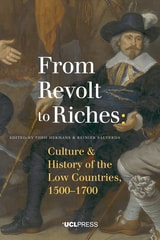
From Revolt to Riches
Culture and History of the Low Countries, 1500–1700Edited by Theo Hermans, Reinier Salverda, and Ulrich Tiedau
University College London, 2017
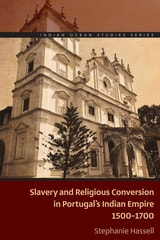
Slavery and Religious Conversion in Portugal's Indian Empire, 1500-1700
Stephanie Hassell
Ohio University Press, 2025
In the sixteenth and seventeenth centuries, enslaved Africans and Asians were part of the larger Portuguese project of building and maintaining a Catholic empire in the Indian Ocean. Both the Church and the Crown influenced the owner-slave relationship across households, the most basic organizational unit of power over the populace. Responsible for their enslaved dependents’ conversion to Catholicism, slaveholders became religious stewards whose spiritual duties toward their slaves helped expand the Christian population. This converted population was part of the imperial security apparatus, which conceptualized enslaved Catholics as loyal allies against neighboring Muslim states. They became members of the broader colonial community in which Catholicism also conveyed rights, enabled agency, and provoked household struggles between owners and slaves. Thus, the making of a Catholic empire was a contested process tied to the complex relationships between enslaved individuals, their enslavers, and the Church. The Portuguese Inquisition was a hybrid ecclesiastical and state institution, and its records detail the Crown’s commitment to the creation of a worldwide Catholic empire. Accordingly, inquisitorial encounters brought conversion, slavery, and empire into one field of vision. The Portuguese Inquisition had only one overseas tribunal, located in Goa, India. While most trial records of the Goa Tribunal were destroyed, author Stephanie Hassell has utilized extant sixteenth- and seventeenth-century cases featuring enslaved defendants and witnesses. Her use of thousands of case summaries provides a broader inquisitorial context by showing how prosecutorial trends reflected the anxieties of the Portuguese imperial state. Parish records, ecclesiastical council records, and municipal council records likewise emphasize the significance of religious conversion.
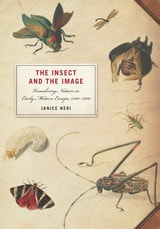
The Insect and the Image
Visualizing Nature in Early Modern Europe, 1500-1700Janice Neri
University of Minnesota Press, 2011
Once considered marginal members of the animal world (at best) or vile and offensive creatures (at worst), insects saw a remarkable uptick in their status during the early Renaissance. This quickened interest was primarily manifested in visual images—in illuminated manuscripts, still life paintings, the decorative arts, embroidery, textile design, and cabinets of curiosity. In The Insect and the Image, Janice Neri explores the ways in which such imagery defined the insect as a proper subject of study for Europeans of the early modern period.
It was not until the sixteenth century that insects began to appear as the sole focus of paintings and drawings—as isolated objects, or specimens, against a blank background. The artists and other image makers Neri discusses deployed this “specimen logic” and so associated themselves with a mode of picturing in which the ability to create a highly detailed image was a sign of artistic talent and a keenly observant eye. The Insect and the Image shows how specimen logic both reflected and advanced a particular understanding of the natural world—an understanding that, in turn, supported the commodification of nature that was central to global trade and commerce during the early modern era.
Revealing how sixteenth- and seventeenth-century artists and image makers shaped ideas of the natural world, Neri’s work enhances our knowledge of the convergence of art, science, and commerce today.
The Mirror of Spain, 1500-1700
The Formation of a MythJ. N. Hillgarth
University of Michigan Press, 2000
In the first of the volume's four parts, the author discusses the reasons--geographic, political, and religious--why Spain has proved a hard country to understand. Hillgarth looks at travelers to Spain, from pilgrims to diplomats, spies, exiles, and foreign residents. In its second part, special attention is devoted to the interaction between Christians, Jews, and Muslims, including Jewish and Muslim exiles and secret Jews within Spain.
In its third section, The Mirror of Spain explores reactions to Spain by those who saw it from the outside, the Italians, Dutch, French, and English. One chapter deals with the English, Scottish, and Irish Catholics, who, like the Jewish and Muslim exiles, played a double role in that they were at once "insiders" and outsiders. Finally, Hillgarth attempts to show how two crucial centuries have affected the way Spain has been seen down to the present.
The Mirror of Spain draws on a wide range of sources in different languages. It relies on documents in the Public Record Office and the British Library, the Archivo General de Simancas and the collections of the colleges founded by exiles in Spain, and on major libraries in Venice and Jerusalem. The volume will be of interest to a broad spectrum of scholars--to medievalists, historians of Spain, scholars of political and literary thought, and all those interested in notions of national identity.
J. N. Hillgarth has taught for many years at the University of Toronto and the Pontifical Institute of Mediaeval Studies. He is a Fellow of the British Academy and has received awards and honors from a wide variety of distinguished institutions in Europe and North America.