Results by title
3 books match the query '1508-1797'

Heavenly Supper
The Story of Maria JanisFulvio Tomizza
University of Chicago Press, 1991
So begins Fulvio Tomizza's absorbing account of the true story of Maria Janis, a devout peasant woman from the mountains north of Bergamo. Too poor to enter a convent, Maria had set out to serve God by relinquishing the little she had, through renunciation of all food but the bread and wine of communion. Encouraged by the restless village priest Pietro Morali, Maria claimed to have existed in this sanctified state for five years. During this time, she, Morali, and the weaver Pietro Palazzi travel from a little village in the Alps to Rome and then to Venice, where their alleged sacrilege is discovered and they are brought to trial. Both revered as a saint and reviled as a fraud, Maria with her "privilege" inspires and threatens believers within the Church. Combining the historian's precision with the novelist's imagination, Tomizza painstakingly reconstructs her story, crafting a fascinating portrait of sublimated love, ambition, and jealousy.
Heavenly Supper alternates a chronological account of the trial with analyses of each protagonist's life history. Along the way, Tomizza gives voice to the minds and hearts of his characters, allowing them to speak for themselves in their own words. The world he recreates resonates with the fervor of the Counter Reformation when faith and its consequences were rigidly controlled by the Church. As suspenseful as a detective novel, Tomizza's story goes beyond the trial to evoke a panoramic view of seventeenth-century Italian culture.
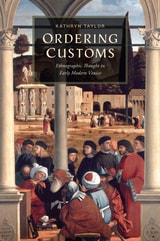
Ordering Customs
Ethnographic Thought in Early Modern VeniceKathryn Taylor
University of Delaware Press, 2023
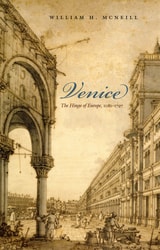
Venice
William H. McNeill
University of Chicago Press, 1974
In this magisterial history, National Book Award winner William H. McNeill chronicles the interactions and disputes between Latin Christians and the Orthodox communities of eastern Europe during the period 1081–1797. Concentrating on Venice as the hinge of European history in the late medieval and early modern period, McNeill explores the technological, economic, and political bases of Venetian power and wealth, and the city’s unique status at the frontier between the papal and Orthodox Christian worlds. He pays particular attention to Venetian influence upon southeastern Europe, and from such an angle of vision, the familiar pattern of European history changes shape.
“No other historian would have been capable of writing a book as direct, as well-informed and as little weighed down by purple prose as this one. Or as impartial. McNeill has succeeded admirably.”—Fernand Braudel, Times Literary Supplement
“The book is serious, interesting, occasionally compelling, and always suggestive.”—Stanley Chojnacki, American Historical Review