Results by title
9 books match the query '1516-1700'
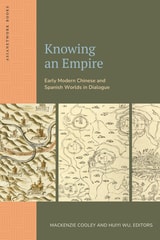
Knowing an Empire
Early Modern Chinese and Spanish Worlds in DialogueEdited by Mackenzie Cooley and Huiyi Wu
Lever Press, 2025
2026 NECLAS D. Scott Palmer Best Edited Book Prize Honorable Mention
Knowing an Empire: Early Modern Chinese and Spanish Worlds in Dialogue unveils how these two vast empires, separated by thousands of miles, developed comparable systems to gather, order, and wield knowledge about their local worlds in the process of empire-building. From the sixteenth to the eighteenth centuries, officials in both empires compiled large quantities of structured data on the climate, topography, natural products, languages, religions, and more of their locales, creating a vision of their empires as diverse yet unified. Through a new methodology of “juxtapositional comparison,” the book reads the difangzhi 地方志 (local gazetteers) of China and the relaciones geográficas of the Spanish world in parallel.
Knowing an Empire does not see the conveyance of information across an empire as a top-down process with an active center as a knowledge-maker. Instead, it amplifies a blend of voices that speak as much to imperial bureaucracy as to the rich local and Indigenous cultures, revealing these two early modern empires as diverse polities whose equilibria were constantly rebalanced among local powers. Comprised of 18 chapters, this edited collection reflects on the historical evolution and inner structures of the imperial epistemologies, as well as the many ways historians today read difangzhi and relaciones geográficas to understand the spatial, natural, and social order in both the Chinese and the Spanish empires. At once a comparative and a connected history, it places Chinese and Spanish imperial knowledge in the globalizing early modern world, highlighting the migration of people, goods, and ideas and revealing how these wide-ranging influences are reflected—or not—in the difangzhi and the relaciones. The book concludes by broadening our scope beyond China and Spain to reflect how other early modern empires, such as the Portuguese, failed to develop such systematized imperial genres.
With contributions from leading scholars across Latin American and Asian Studies, this book synthesizes political, environmental, and socio-economic history with historical anthropology to highlight parallel governance and knowledge structures. The contributors challenge conventional binaries of Western versus Eastern, and colonial versus non-colonial, presenting a nuanced perspective of early modern empires as dynamic, interconnected entities through the shared challenges of scale, diversity, and increasing globalization. Through these dialogues, Knowing an Empire illuminates the complex entanglement of ruling and understanding. This groundbreaking collection offers a highly innovative and dialogic approach to comparative studies of empires, with major implications for Asian, European, Latin American, transnational, and global history.
Lexikon of the Hispanic Baroque
Transatlantic Exchange and TransformationEdited by Evonne Levy and Kenneth Mills
University of Texas Press, 2014
Over the course of some two centuries following the conquests and consolidations of Spanish rule in the Americas during the late fifteenth and early sixteenth centuries—the period designated as the Baroque—new cultural forms sprang from the cross-fertilization of Spanish, Amerindian, and African traditions. This dynamism of motion, relocation, and mutation changed things not only in Spanish America, but also in Spain, creating a transatlantic Hispanic world with new understandings of personhood, place, foodstuffs, music, animals, ownership, money and objects of value, beauty, human nature, divinity and the sacred, cultural proclivities—a whole lexikon of things in motion, variation, and relation to one another.
Featuring the most creative thinking by the foremost scholars across a number of disciplines, the Lexikon of the Hispanic Baroque is a uniquely wide-ranging and sustained exploration of the profound cultural transfers and transformations that define the transatlantic Spanish world in the Baroque era. Pairs of authors—one treating the peninsular Spanish kingdoms, the other those of the Americas—provocatively investigate over forty key concepts, ranging from material objects to metaphysical notions. Illuminating difference as much as complementarity, departure as much as continuity, the book captures a dynamic universe of meanings in the various midst of its own re-creations. The Lexikon of the Hispanic Baroque joins leading work in a number of intersecting fields and will fire new research—it is the indispensible starting point for all serious scholars of the early modern Spanish world.
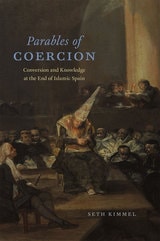
Parables of Coercion
Conversion and Knowledge at the End of Islamic SpainSeth Kimmel
University of Chicago Press, 2015
In its careful examination of how Spanish authors transformed the history of scholarship through debate about forced religious conversion, Parables of Coercion makes us rethink what we mean by tolerance and intolerance, and shows that debates about forced conversion and assimilation were also disputes over the methods and practices that demarcated one scholarly discipline from another.
Rereading the Black Legend
The Discourses of Religious and Racial Difference in the Renaissance EmpiresEdited by Margaret R. Greer, Walter D. Mignolo, and Maureen Quilligan
University of Chicago Press, 2008
A distinguished group of contributors here examine early modern imperialisms including the Ottomans in Eastern Europe, the Portuguese in East India, and the cases of Mughal India and China, to historicize the charge of unique Spanish brutality in encounters with indigenous peoples during the Age of Exploration. The geographic reach and linguistic breadth of this ambitious collection will make it a valuable resource for any discussion of race, national identity, and religious belief in the European Renaissance.
The Age of Subtlety
Nature and Rhetorical Conceits in Early Modern EuropeJavier Patiño Loira
University of Delaware Press, 2024
The Indies of the Setting Sun
How Early Modern Spain Mapped the Far East as the Transpacific WestRicardo Padrón
University of Chicago Press, 2020
Narratives of Europe’s westward expansion often tell of how the Americas came to be known as a distinct landmass, separate from Asia and uniquely positioned as new ground ripe for transatlantic colonialism. But this geographic vision of the Americas was not shared by all Europeans. While some imperialists imagined North and Central America as undiscovered land, the Spanish pushed to define the New World as part of a larger and eminently flexible geography that they called las Indias, and that by right, belonged to the Crown of Castile and León. Las Indias included all of the New World as well as East and Southeast Asia, although Spain’s understanding of the relationship between the two areas changed as the realities of the Pacific Rim came into sharper focus. At first, the Spanish insisted that North and Central America were an extension of the continent of Asia. Eventually, they came to understand East and Southeast Asia as a transpacific extension of their empire in America called las Indias del poniente, or the Indies of the Setting Sun.
The Indies of the Setting Sun charts the Spanish vision of a transpacific imperial expanse, beginning with Balboa’s discovery of the South Sea and ending almost a hundred years later with Spain’s final push for control of the Pacific. Padrón traces a series of attempts—both cartographic and discursive—to map the space from Mexico to Malacca, revealing the geopolitical imaginations at play in the quest for control of the New World and Asia.
The Mirror of Spain, 1500-1700
The Formation of a MythJ. N. Hillgarth
University of Michigan Press, 2000
In the first of the volume's four parts, the author discusses the reasons--geographic, political, and religious--why Spain has proved a hard country to understand. Hillgarth looks at travelers to Spain, from pilgrims to diplomats, spies, exiles, and foreign residents. In its second part, special attention is devoted to the interaction between Christians, Jews, and Muslims, including Jewish and Muslim exiles and secret Jews within Spain.
In its third section, The Mirror of Spain explores reactions to Spain by those who saw it from the outside, the Italians, Dutch, French, and English. One chapter deals with the English, Scottish, and Irish Catholics, who, like the Jewish and Muslim exiles, played a double role in that they were at once "insiders" and outsiders. Finally, Hillgarth attempts to show how two crucial centuries have affected the way Spain has been seen down to the present.
The Mirror of Spain draws on a wide range of sources in different languages. It relies on documents in the Public Record Office and the British Library, the Archivo General de Simancas and the collections of the colleges founded by exiles in Spain, and on major libraries in Venice and Jerusalem. The volume will be of interest to a broad spectrum of scholars--to medievalists, historians of Spain, scholars of political and literary thought, and all those interested in notions of national identity.
J. N. Hillgarth has taught for many years at the University of Toronto and the Pontifical Institute of Mediaeval Studies. He is a Fellow of the British Academy and has received awards and honors from a wide variety of distinguished institutions in Europe and North America.
The Misfortunes of Alonso Ramírez
The True Adventures of a Spanish American with 17th-Century PiratesBy Fabio López Lázaro
University of Texas Press, 2011
In 1690, a dramatic account of piracy was published in Mexico City. The Misfortunes of Alonso Ramírez described the incredible adventures of a poor Spanish American carpenter who was taken captive by British pirates near the Philippines and forced to work for them for two years. After circumnavigating the world, he was freed and managed to return to Mexico, where the Spanish viceroy commissioned the well-known Mexican scholar Carlos de Sigüenza y Góngora to write down Ramírez's account as part of an imperial propaganda campaign against pirates.
The Misfortunes of Alonso Ramírez has long been regarded as a work of fiction—in fact, as Latin America's first novel—but Fabio López Lázaro makes a convincing case that the book is a historical account of real events, albeit full of distortions and lies. Using contemporary published accounts, as well as newly discovered documents from Spanish, English, French, Portuguese, and Dutch archives, he proves that Ramírez voyaged with one of the most famous pirates of all time, William Dampier. López Lázaro's critical translation of The Misfortunes provides the only extensive Spanish eyewitness account of pirates during the period in world history (1650–1750) when they became key agents of the European powers jockeying for international political and economic dominance. An extensive introduction places The Misfortunes within the worldwide struggle that Spain, England, and Holland waged against the ambitious Louis XIV of France, which some historians consider to be the first world war.
The Spanish Disquiet
The Biblical Natural Philosophy of Benito Arias MontanoMaría M. Portuondo
University of Chicago Press, 2019
Foremost among them was Benito Arias Montano—Spain’s most prominent biblical scholar and exegete of the sixteenth century. He was also a widely read member of the European intellectual community, and his motivation to reform natural philosophy shows that the Spanish Disquiet was a local manifestation of greater concerns about Aristotelian natural philosophy that were overtaking Europe on the eve of the Scientific Revolution. His approach to the study of nature framed the natural world as unfolding from a series of events described in the Book of Genesis, ultimately resulting in a new metaphysics, cosmology, physics, and even a natural history of the world. By bringing Arias Montano’s intellectual and personal biography into conversation with broader themes that inform histories of science of the era, The Spanish Disquiet ensures an appreciation of the variety and richness of Arias Montano’s thought and his influence on early modern science.