Results by title
10 books match the query '1548-1820'
An Inca Account of the Conquest of Peru
Titu Cusi Yupanqui
University Press of Colorado, 2005
Titu Cusi tells of his father's maltreatment at the hands of the conquerors; his father's ensuing military campaigns, withdrawal, and murder; and his own succession as ruler. Although he continued to resist Spanish attempts at "pacification," Titu Cusi entertained Spanish missionaries, converted to Christianity, and then, most importantly, narrated his story of the conquest to enlighten Emperor Phillip II about the behavior of the emperor's subjects in Peru. This vivid narrative illuminates the Incan view of the Spanish invaders and offers an important account of indigenous resistance, accommodation, change, and survival in the face of the European conquest.
Informed by literary, historical, and anthropological scholarship, Bauer's introduction points out the hybrid elements of Titu Cusi's account, revealing how it merges native Andean and Spanish rhetorical and cultural practices. Supported in part by the Colorado Endowment for the Humanities.
Andean Cosmopolitans
Seeking Justice and Reward at the Spanish Royal CourtBy José Carlos de la Puente Luna
University of Texas Press, 2018
Winner, Premio Flora Tristán Al Mejor Libro, Peru Section, Latin American Studies Association, 2019
After the Spanish victories over the Inca claimed Tawantinsuyu for Charles V in the 1530s, native Andeans undertook a series of perilous trips from Peru to the royal court in Spain. Ranging from an indigenous commoner entrusted with delivering birds of prey for courtly entertainment to an Inca prince who spent his days amid titles, pensions, and other royal favors, these sojourners were both exceptional and paradigmatic. Together, they shared a conviction that the sovereign’s absolute authority would guarantee that justice would be done and service would receive its due reward. As they negotiated their claims with imperial officials, Amerindian peoples helped forge the connections that sustained the expanding Habsburg realm’s imaginary and gave the modern global age its defining character.
Andean Cosmopolitans recovers these travelers’ dramatic experiences, while simultaneously highlighting their profound influences on the making and remaking of the colonial world. While Spain’s American possessions became Spanish in many ways, the Andean travelers (in their cosmopolitan lives and journeys) also helped to shape Spain in the image and likeness of Peru. De la Puente brings remarkable insights to a narrative showing how previously unknown peoples and ideas created new power structures and institutions, as well as novel ways of being urban, Indian, elite, and subject. As indigenous people articulated and defended their own views regarding the legal and political character of the “Republic of the Indians,” they became state-builders of a special kind, cocreating the colonial order.
Indigenous Migration and Social Change
The Foresteros of Cuzco, 1570-1720Ann M. Wightman
Duke University Press, 1990
Wightman shows that the dismissal of the forasteros as marginalized rural poor is superficial at best, and through laborious and painstaking archival research she presents a clear picture of the transformation of traditional society as the native populations coped with the disruptions of the conquest—and in doing so, reveals the reciprocal adaptations of the colonial power. Her choice of Cuzco is particularly appropriate, as this was a “heartland” region crucial to both the Incan and Spanish empires. The questions addressed by Wightman are of great concern to current Andean ethnohistory, one of the liveliest areas of such research, and are sure to have an important impact.
Into the Archive
Writing and Power in Colonial PeruKathryn Burns
Duke University Press, 2010
Kathryn Burns argues that the archive itself must be historicized. Using the case of colonial Cuzco, she examines the practices that shaped document-making. Notaries were businessmen, selling clients a product that conformed to local “custom” as well as Spanish templates. Clients, for their part, were knowledgeable consumers, with strategies of their own for getting what they wanted. In this inside story of the early modern archive, Burns offers a wealth of possibilities for seeing sources in fresh perspective.
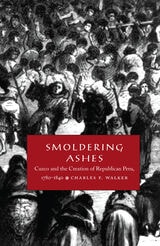
Smoldering Ashes
Cuzco and the Creation of Republican Peru, 1780-1840Charles F. Walker
Duke University Press, 1999
Peru’s Indian majority and non-Indian elite were both opposed to Spanish rule, and both groups participated in uprisings during the late colonial period. But, at the same time, seething tensions between the two groups were evident, and non-Indians feared a mass uprising. As Walker shows, this internal conflict shaped the many struggles to come, including the Tupac Amaru uprising and other Indian-based rebellions, the long War of Independence, the caudillo civil wars, and the Peru-Bolivian Confederation. Smoldering Ashes not only reinterprets these conflicts but also examines the debates that took place—in the courts, in the press, in taverns, and even during public festivities—over the place of Indians in the republic. In clear and elegant prose, Walker explores why the fate of the indigenous population, despite its participation in decades of anticolonial battles, was little improved by republican rule, as Indians were denied citizenship in the new nation—an unhappy legacy with which Peru still grapples.
Informed by the notion of political culture and grounded in Walker’s archival research and knowledge of Peruvian and Latin American history, Smoldering Ashes will be essential reading for experts in Andean history, as well as scholars and students in the fields of nationalism, peasant and Native American studies, colonialism and postcolonialism, and state formation.
Spanish Peru, 1532–1560
A Social HistoryJames Lockhart
University of Wisconsin Press, 1994
When Spanish Peru, 1532–1560 was published in 1968, it was acclaimed as an innovative study of the early Spanish presence in Peru. It has since become a classic of the literature in Spanish American social history, important in helping to introduce career-pattern history to the field and notable for its broad yet intimate picture of the functioning of an entire society. In this second edition, James Lockhart provides a new conclusion and preface, updated terminology, and additional footnotes.
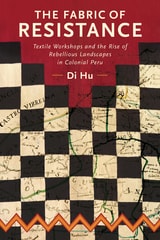
The Fabric of Resistance
Textile Workshops and the Rise of Rebellious Landscapes in Colonial PeruDi Hu
University of Alabama Press, 2022
Textiles as sites of power, production, and rebellion in the early modern Andes.
The Fabric of Resistance: Textile Workshops and the Rise of Rebellious Landscapes in Colonial Peru documents the impact of Spanish colonial institutions of labor on identity and social cohesion in Peru. Through archaeological and historical lines of evidence, Di Hu examines the long-term social conditions that enabled the large-scale rebellions in the late Spanish colonial period in Peru. Hu argues that ordinary people from different backgrounds pushed back against the top-down identity categories imposed by the Spanish colonial government and in the process created a cosmopolitan social landscape that later facilitated broader rebellion.
Hu’s case study is Pomacocha, the site of an important Spanish colonial hacienda (agricultural estate) and obraje (textile workshop). At its height, the latter had more than one hundred working families and sold textiles all over the Andes. Through analysis of this site, Hu explores three main long-term causes of rebellions against Spanish oppression. First, the Spanish colonial economy provided motivation and the social spaces for intercaste (indigenous, African, and mestizo) mixing at textile workshops. Second, new hybrid cultural practices and political solidarity arose there that facilitated the creation of new rebellious identities. Third, the maturation in the eighteenth century of popular folklore that reflected the harsh nature of Spanish labor institutions helped workers from diverse backgrounds gain a systemic understanding of exploitation.
This study provides a fresh archaeological and historical perspectives on the largest and most cosmopolitan indigenous-led rebellions of the Americas. Hu interweaves analyses of society at multiple scales including fine-grained perspectives of social networks, demography, and intimate details of material life in the textile workshop. She examines a wide range of data sources including artifacts, food remains, architectural plans, account books, censuses, court documents, contracts, maps, and land title disputes.
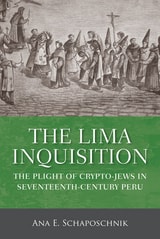
The Lima Inquisition
The Plight of Crypto-Jews in Seventeenth-Century PeruAna E. Schaposchnik
University of Wisconsin Press, 2017
Delving into the records of the tribunal, Schaposchnik brings to light the experiences of individuals on both sides of the process. Some prisoners, she discovers, developed a limited degree of agency as they managed to stall trials or mitigate the most extreme punishments. Training her attention on the accusers, Schaposchnik uncovers the agendas of specific inquisitors in bringing the condemned from the dungeons to the 1639 Auto General de Fe ceremony of public penance and execution. Through this fine-grained study of the tribunal's participants, Schaposchnik finds that the Inquisition sought to discipline and shape culture not so much through frequency of trials or number of sentences as through the potency of individual examples.
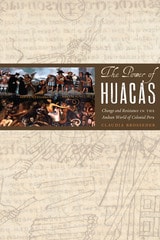
The Power of Huacas
Change and Resistance in the Andean World of Colonial PeruBy Claudia Brosseder
University of Texas Press, 2014
Based on extensive archival research, The Power of Huacas is the first book to take account of the reciprocal effects of religious colonization as they impacted Andean populations and, simultaneously, dramatically changed the culture and beliefs of Spanish Christians.
Winner, Award for Excellence in the Study of Religion in the category of Historical Studies, American Academy of Religion, 2015
The role of the religious specialist in Andean cultures of the sixteenth, seventeenth, and eighteenth centuries was a complicated one, balanced between local traditions and the culture of the Spanish. In The Power of Huacas, Claudia Brosseder reconstructs the dynamic interaction between religious specialists and the colonial world that unfolded around them, considering how the discourse about religion shifted on both sides of the Spanish and Andean relationship in complex and unexpected ways. In The Power of Huacas, Brosseder examines evidence of transcultural exchange through religious history, anthropology, and cultural studies. Taking Andean religious specialists—or hechizeros (sorcerers) in colonial Spanish terminology—as a starting point, she considers the different ways in which Andeans and Spaniards thought about key cultural and religious concepts. Unlike previous studies, this important book fully outlines both sides of the colonial relationship; Brosseder uses extensive archival research in Bolivia, Chile, Ecuador, Peru, Spain, Italy, and the United States, as well as careful analysis of archaeological and art historical objects, to present the Andean religious worldview of the period on equal footing with that of the Spanish. Throughout the colonial period, she argues, Andean religious specialists retained their own unique logic, which encompassed specific ideas about holiness, nature, sickness, and social harmony. The Power of Huacas deepens our understanding of the complexities of assimilation, showing that, within the maelstrom of transcultural exchange in the Spanish Americas, European paradigms ultimately changed more than Andean ones.
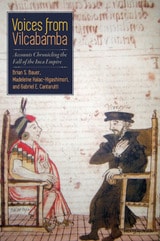
Voices from Vilcabamba
Accounts Chronicling the Fall of the Inca EmpireBrian S. Bauer
University Press of Colorado, 2016
A rich new source of important archival information, Voices from Vilcabamba examines the fall of the Inca Empire in unprecedented detail. Containing English translations of seven major documents from the Vilcabamba era (1536–1572), this volume presents an overview of the major events that occurred in the Vilcabamba region of Peru during the final decades of Inca rule.
Brian S. Bauer, Madeleine Halac-Higashimori, and Gabriel E. Cantarutti have translated and analyzed seven documents, most notably Description of Vilcabamba by Baltasar de Ocampo Conejeros and a selection from Martín de Murúa’s General History of Peru, which focuses on the fall of Vilcabamba. Additional documents from a range of sources that include Augustinian investigations, battlefield reports, and critical eyewitness accounts are translated into English for the first time.
With a critical introduction on the history of the region during the Spanish Conquest and introductions to each of the translated documents, the volume provides an enhanced narrative on the nature of European-American relations during this time of important cultural transformation.