Results by title
6 books match the query '1627-1691'
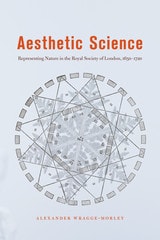
Aesthetic Science
Representing Nature in the Royal Society of London, 1650-1720Alexander Wragge-Morley
University of Chicago Press, 2020
The scientists affiliated with the early Royal Society of London have long been regarded as forerunners of modern empiricism, rejecting the symbolic and moral goals of Renaissance natural history in favor of plainly representing the world as it really was. In Aesthetic Science, Alexander Wragge-Morley challenges this interpretation by arguing that key figures such as John Ray, Robert Boyle, Nehemiah Grew, Robert Hooke, and Thomas Willis saw the study of nature as an aesthetic project.
To show how early modern naturalists conceived of the interplay between sensory experience and the production of knowledge, Aesthetic Science explores natural-historical and anatomical works of the Royal Society through the lens of the aesthetic. By underscoring the importance of subjective experience to the communication of knowledge about nature, Wragge-Morley offers a groundbreaking reconsideration of scientific representation in the early modern period and brings to light the hitherto overlooked role of aesthetic experience in the history of the empirical sciences.
To show how early modern naturalists conceived of the interplay between sensory experience and the production of knowledge, Aesthetic Science explores natural-historical and anatomical works of the Royal Society through the lens of the aesthetic. By underscoring the importance of subjective experience to the communication of knowledge about nature, Wragge-Morley offers a groundbreaking reconsideration of scientific representation in the early modern period and brings to light the hitherto overlooked role of aesthetic experience in the history of the empirical sciences.
[more]
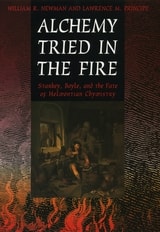
Alchemy Tried in the Fire
Starkey, Boyle, and the Fate of Helmontian ChymistryWilliam R. Newman and Lawrence M. Principe
University of Chicago Press, 2002
Winner of the 2005 Pfizer Prize from the History of Science Society.
What actually took place in the private laboratory of a mid-seventeenth century alchemist? How did he direct his quest after the secrets of Nature? What instruments and theoretical principles did he employ?
Using, as their guide, the previously misunderstood interactions between Robert Boyle, widely known as "the father of chemistry," and George Starkey, an alchemist and the most prominent American scientific writer before Benjamin Franklin as their guide, Newman and Principe reveal the hitherto hidden laboratory operations of a famous alchemist and argue that many of the principles and practices characteristic of modern chemistry derive from alchemy. By analyzing Starkey's extraordinary laboratory notebooks, the authors show how this American "chymist" translated the wildly figurative writings of traditional alchemy into quantitative, carefully reasoned laboratory practice—and then encoded his own work in allegorical, secretive treatises under the name of Eirenaeus Philalethes. The intriguing "mystic" Joan Baptista Van Helmont—a favorite of Starkey, Boyle, and even of Lavoisier—emerges from this study as a surprisingly central figure in seventeenth-century "chymistry." A common emphasis on quantification, material production, and analysis/synthesis, the authors argue, illustrates a continuity of goals and practices from late medieval alchemy down to and beyond the Chemical Revolution.
For anyone who wants to understand how alchemy was actually practiced during the Scientific Revolution and what it contributed to the development of modern chemistry, Alchemy Tried in the Fire will be a veritable philosopher's stone.
[more]
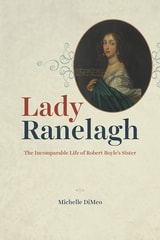
Lady Ranelagh
The Incomparable Life of Robert Boyle's SisterMichelle DiMeo
University of Chicago Press, 2021
For centuries, historians have speculated about the life of Katherine Jones, Lady Ranelagh. Dominant depictions show her either as a maternal figure to her younger brother Robert Boyle, one of the most significant scientists of his day, or as a patroness of the European correspondence network now known as the Hartlib circle—but neither portrait captures the depth of her intellect or the range of her knowledge and influence.
Philosophers, mathematicians, politicians, and religious authorities sought her opinion on everything from decimalizing the currency to producing Hebrew grammars. She practiced medicine alongside distinguished male physicians, treating some of the most elite patients in London. Her medical recipes, political commentaries, and testimony concerning the philosophers’ stone gained international circulation. She was an important influence on Boyle and a formidable thinker in her own right.
Drawing from a wealth of new archival sources, Michelle DiMeo fills out Lady Ranelagh’s legacy in the context of a historically sensitive and nuanced interpretation of gender, science, and religion. The book re-creates the intellectual life of one of the most respected and influential women in seventeenth-century Europe, revealing how she managed to gain the admiration of diverse contemporaries, effect social change, and shape contemporary science.
[more]
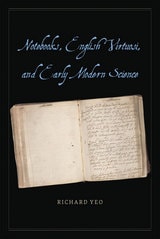
Notebooks, English Virtuosi, and Early Modern Science
Richard Yeo
University of Chicago Press, 2014
In Notebooks, English Virtuosi, and Early Modern Science, Richard Yeo interprets a relatively unexplored set of primary archival sources: the notes and notebooks of some of the leading figures of the Scientific Revolution. Notebooks were important to several key members of the Royal Society of London, including Robert Boyle, John Evelyn, Robert Hooke, John Locke, and others, who drew on Renaissance humanist techniques of excerpting from texts to build storehouses of proverbs, maxims, quotations, and other material in personal notebooks, or commonplace books. Yeo shows that these men appreciated the value of their own notes both as powerful tools for personal recollection, and, following Francis Bacon, as a system of precise record keeping from which they could retrieve large quantities of detailed information for collaboration.
The virtuosi of the seventeenth century were also able to reach beyond Bacon and the humanists, drawing inspiration from the ancient Hippocratic medical tradition and its emphasis on the gradual accumulation of information over time. By reflecting on the interaction of memory, notebooks, and other records, Yeo argues, the English virtuosi shaped an ethos of long-term empirical scientific inquiry.
[more]
Regimens of the Mind
Boyle, Locke, and the Early Modern Cultura Animi TraditionSorana Corneanu
University of Chicago Press, 2011
In Regimens of the Mind, Sorana Corneanu proposes a new approach to the epistemological and methodological doctrines of the leading experimental philosophers of seventeenth-century England, an approach that considers their often overlooked moral, psychological, and theological elements. Corneanu focuses on the views about the pursuit of knowledge in the writings of Robert Boyle and John Locke, as well as in those of several of their influences, including Francis Bacon and the early Royal Society virtuosi. She argues that their experimental programs of inquiry fulfill the role of regimens for curing, ordering, and educating the mind toward an ethical purpose, an idea she tracks back to the ancient tradition of cultura animi. Corneanu traces this idea through its early modern revival and illustrates how it organizes the experimental philosophers’ reflections on the discipline of judgment, the study of nature, and the study of Scripture.
It is through this lens, the author suggests, that the core features of the early modern English experimental philosophy—including its defense of experience, its epistemic modesty, its communal nature, and its pursuit of “objectivity”—are best understood.
[more]
The Diffident Naturalist
Robert Boyle and the Philosophy of ExperimentRose-Mary Sargent
University of Chicago Press, 1995
In a provocative reassessment of one of the quintessential figures of early modern science, Rose-Mary Sargent explores Robert Boyle's philosophy of experiment, a central aspect of his life and work that became a model for mid- to late seventeenth-century natural philosophers and for many who followed them.
Sargent examines the philosophical, legal, experimental, and religious traditions—among them English common law, alchemy, medicine, and Christianity—that played a part in shaping Boyle's experimental thought and practice. The roots of his philosophy in his early life and education, in his religious ideals, and in the work of his predecessors—particularly Bacon, Descartes, and Galileo—are fully explored, as are the possible influences of his social and intellectual circle. Drawing on the full range of Boyle's published works, as well as on his unpublished notebooks and manuscripts, Sargent shows how these diverse influences were transformed and incorporated into Boyle's views on and practice of experiment.
Sargent examines the philosophical, legal, experimental, and religious traditions—among them English common law, alchemy, medicine, and Christianity—that played a part in shaping Boyle's experimental thought and practice. The roots of his philosophy in his early life and education, in his religious ideals, and in the work of his predecessors—particularly Bacon, Descartes, and Galileo—are fully explored, as are the possible influences of his social and intellectual circle. Drawing on the full range of Boyle's published works, as well as on his unpublished notebooks and manuscripts, Sargent shows how these diverse influences were transformed and incorporated into Boyle's views on and practice of experiment.
[more]