Results by title
5 books match the query '1775 - 1776'

A Peregrine Ethnography
Reinterpreting Francisco Garcés’s Diary of Native Arizona and the Californias, 1775–1776Translated and Edited by Peter M. Whiteley
University of Arizona Press, 2026
In 1775–1776, Francisco Garcés, O.F.M., undertook a remarkable three-thousand-kilometer journey through modern Arizona and the Californias. As a participant in a side-branch of Juan Bautista de Anza’s colonizing expedition to San Francisco, Garcés recorded a diary that provides a fascinating glimpse of Native peoples, several who had minimal or no prior contact with the Spanish empire. Garcés described customs, detailed alliances and enmities, and offered recommendations, both missionary and military. When he reached Hopi from the west (the first European to do so), Garcés completed a route between Monterey and Santa Fe, in effect completing a road across North America a generation before Lewis and Clark. The Hopi leaders, who clearly understood the implications, expelled him, declaring their independence on July 4, 1776.
Garcés’s diary remains vital for the Indigenous history of western North America. Yet the standard translation is flawed, not least owing to the state of ethnographic knowledge when it was made (1900), resulting in more than a century of reiterated misinterpretations of Indigenous history by anthropologists and historians. Peter M. Whiteley identifies the ur-version of Garcés's diary—a previously unknown copy written up by Pedro Font—and offers a new translation focusing on ethnographic significance in geographic context. Presenting also the Spanish text, Whiteley engages directly with Garcés’s account and provides readers with new interpretation and context.
Garcés was a genuine ethnographer and his accounts of Hopi, River Yumans, Takic, Yokuts, Numic, and Pai peoples, contain unparalleled and foundational insights.
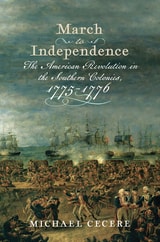
March to Independence
The Revolutionary War in the Southern Colonies, 1775–1776Michael Cecere
Westholme Publishing, 2027
The Independence Trilogy
The American Revolutionary War began when Massachusetts militiamen and British troops clashed at Lexington and Concord on April 19, 1775. Two months later, a much larger engagement occurred at Bunker Hill in Boston. The conflict then expanded into a continent-wide war for independence from Great Britain. Or so we are taught. A closer look at events in the South in the eighteen months following Lexington and Concord tells different story. The practice of teaching the Revolutionary War as one generalized conflict between the American colonies and Great Britain assumes the South’s support for the Revolutionary War was a foregone conclusion. However, once shots were fired, it was not certain that the southern colonies would support the independence movement. What is clear is that both the fledgling American republic and the British knew that the southern colonies were critical to any successful prosecution of the war by either side.
In March to Independence: The American Revolution in the Southern Colonies, 1775–1776, historian Michael Cecere, consulting primary source documents, examines how Virginia, North Carolina, South Carolina, and Georgia ended up supporting the colonies to the north, while East Florida remained within the British sphere. South Carolina, Georgia, and East Florida all retained their royal governors through the summer of 1775, and no military engagements occurred in any of the southern colonies in the six months following the battles in Massachusetts. The situation changed significantly in the fall, however, with armed clashes in Virginia and South Carolina; by early 1776 the war had spread to all of the southern colonies except East Florida. Although their march to independence did not follow the exact route as the colonies to the north, events in the South pulled the southern colonists in the same direction, culminating with a united Declaration of Independence on July 4, 1776. This book explores the crucial events in the southern colonies that led all but East Florida to support the American cause.

Quebec During the American Invasion, 1775-1776
The Journal of Francois Baby, Gabriel Taschereau, and Jenkin WilliamsMichael P. Gabriel
Michigan State University Press, 2005
Available for the first time in English, the 1776 journal of François Baby, Gabriel Taschereau, and Jenkin Williams provides an insight into the failure to incite rebellion in Quebec by American revolutionaries. While other sources have shown how British soldiers and civilians and the French-Canadian gentry (the seigneurs) responded to the American invasion of 1775–1776, this journal focuses on French-Canadian peasants (les habitants) who made up the vast majority of the population; in other words, the journal helps explain why Quebec did not become the "fourteenth colony."
After American forces were expelled from Quebec in early 1776, the British governor, Sir Guy Carleton, sent three trusted envoys to discover who had collaborated with the rebels from the south. They traveled to fifty-six parishes and missions in the Quebec and Trois Rivières district, discharging disloyal militia officers and replacing them with faithful subjects. They prepared a report on each parish, revealing actions taken to support the Americans or the king. Baby and his colleagues documented a wide range of responses. Some habitants enlisted with the Americans; others supplied them with food, firewood, and transportation. Some habitants refused to cooperate with the king’s soldiers. In some parishes, women were the Americans’ most zealous supporters. Overall, the Baby Journal clearly reveals that the habitants played an important, but often overlooked, role in the American invasion.
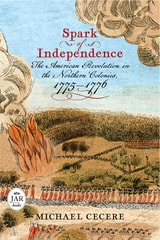
Spark of Independence
The American Revolution in the Northern Colonies, 1775–1776Michael Cecere
Westholme Publishing, 2024
The Independence Trilogy (Spark of Independence, United for Independence, March to Independence) seeks to answer one simple question. What happened in the thirteen colonies after bloodshed erupted at Lexington and Concord in April 1775 until independence was declared in July 1776?
For the Northern colonies, the traditional view is that they reacted as one in their opposition to Great Britain, each sending troops to Massachusetts to help form an Army of Observation that within two months of Lexington became the Continental Army. This is indeed what happened, and the events at Lexington and Concord, Bunker Hill, and the siege of Boston had a tremendous impact on each New England colony.But so too did other events that occurred in New Hampshire, Massachusetts, Rhode Island and Connecticut. Clashes with the British navy in far-away Machias, on the coast of present-day Maine, as well as in Boston Harbor, Massachusetts Bay, Buzzards Bay, Narragansett Bay, and the Long Island Sound; the destruction of Falmouth (present-day Portland, Maine), the bombardment of Stonington, Connecticut, and the threatened destruction of Portsmouth, New Hampshire, and Newport, Rhode Island, all contributed to the growing sentiment for independence that grew in New England following the outbreak of war. New Englanders, too, participated in the American effort to seize Canada in 1775 with troops under Colonel Benedict Arnold who marched through the wilderness of Maine to Quebec. New Englanders also joined General Philip Schuyler and participated in the capture of St. Jeans and Montreal. New England soldiers captured Fort Ticonderoga in New York just a few weeks after Lexington, and of course most notably, the Continental Army that besieged Boston in 1775 was comprised almost entirely of New England volunteers.
Like its companion volumes, Spark of Independence: The American Revolution in the Northern Colonies, 1775–1776 by historian Michael Cecere extensively uses primary source documents to explore both the well known and less-known clashes and events that occurred during the fifteen months between Lexington and Concord and the Declaration of Independence, and how these events contributed to the growing support across the colonies for independence from Great Britain by 1776.

United for Independence
The American Revolution in the Middle Colonies, 1775–1776Michael Cecere
Westholme Publishing, 2027
In the aftermath of the battles of Lexington and Concord in April 1775 and the start of the Revolutionary War, it was not clear whether the colonies outside of New England would participate militarily in the conflict. Troops from the four New England colonies surrounded Boston immediately after the fighting at Lexington and Concord, and two months into the standoff the Continental Congress, meeting in Philadelphia, assumed authority over the New England army, but the middle and southern colonies had yet to see armed conflict or bloodshed with British forces.
In United for Independence: The American Revolution in the Middle Colonies, 1775–1776, historian Michael Cecere examines how the inhabitants of New York, New Jersey, Pennsylvania, Delaware, and Maryland reacted to the outbreak of war in Massachusetts. Leaders in these middle colonies, influenced by strong Loyalist sentiment within their borders and, in some cases, among themselves, fiercely debated whether to support the war in New England. Congress’s decision in the summer to establish the Continental Army, and its authorization for an invasion of Canada, both of which involved troops from the middle colonies, set the stage for their full-scale involvement in the Revolutionary War.
Using primary source extracts and proceeding chronologically from the spring of 1775 to the fall of 1776, the author presents the key events in each of these colonies, from the political struggles between Whigs and Tories, through the failed Canadian expedition, to the loss of Long Island and New York City. Designed for readers to understand the sequence of events that transformed a resistance movement into a war for independence, United for Independence provides an important overview of events in the middle colonies at the start of the Revolutionary War that complements other works that focus on specific military clashes and campaigns.