Results by title
31 books match the query '1775-1865'
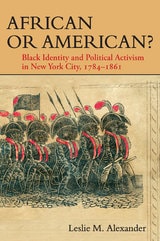
African or American?
Black Identity and Political Activism in New York City, 1784-1861Leslie M. ALexander
University of Illinois Press, 2012
During the early national and antebellum eras, black leaders in New York City confronted the tenuous nature of Northern emancipation. Despite the hope of freedom, black New Yorkers faced a series of sociopolitical issues including the persistence of Southern slavery, the threat of forced removal, racial violence, and the denial of American citizenship. Even efforts to create community space within the urban landscape, such as the African Burial Ground and Seneca Village, were eventually demolished to make way for the city's rapid development. In this illuminating history, Leslie M. Alexander chronicles the growth and development of black activism in New York from the formation of the first black organization, the African Society, in 1784 to the eve of the Civil War in 1861. In this critical period, black activists sought to formulate an effective response to their unequal freedom. Examining black newspapers, speeches, and organizational records, this study documents the creation of mutual relief, religious, and political associations, which black men and women infused with African cultural traditions and values.
As Alexander reveals, conflicts over early black political strategy foreshadowed critical ideological struggles that would bedevil the black leadership for generations to come. Initially, black leaders advocated racial uplift through a sense of communalism and connection to their African heritage. Yet by the antebellum era, black activists struggled to reconcile their African identity with a growing desire to gain American citizenship. Ultimately, this battle resulted in competing agendas; while some leaders argued that the black community should dedicate themselves to moral improvement and American citizenship, others began to consider emigrating to Africa or Haiti. In the end, the black leadership resolved to assert an American identity and to expand their mission for full equality and citizenship in the United States. This decision marked a crucial turning point in black political strategy, for it signaled a new phase in the quest for racial advancement and fostered the creation of a nascent Black Nationalism.
Bones on the Ground
Elizabeth O'Maley
Indiana Historical Society Press, 2014
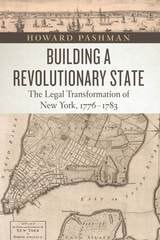
Building a Revolutionary State
The Legal Transformation of New York, 1776-1783Howard Pashman
University of Chicago Press, 2018
Building a Revolutionary State looks closely at one state, New York, to understand the broader question of how legal structures emerged from an insurgency. By examining law as New Yorkers experienced it in daily life during the war, Pashman reconstructs a world of revolutionary law that prevailed during America’s transition to independence. In doing so, Pashman explores a central paradox of the revolutionary era: aggressive enforcement of partisan property rules actually had stabilizing effects that allowed insurgents to build legal institutions that enjoyed popular support. Tracing the transformation from revolutionary disorder to legal order, Building a New Revolutionary State gives us a radically fresh way to understand the emergence of new states.
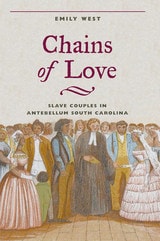
Chains of Love
Slave Couples in Antebellum South CarolinaEmily West
University of Illinois Press, 2004
Focusing on South Carolina, West deals directly with the most intimate areas of the slave experience including courtship, love and affection between spouses, the abuse of slave women by white men, and the devastating consequences of forced separations. Slaves fought these separations through cross-gender bonding and cross-plantation marriages, illustrating West's thesis about slave marriage as a fierce source of resistance to the oppression of slavery in general.
Making expert use of sources such as the Works Progress Administration narratives, slave autobiographies, slave owner records, and church records, this book-length study is the first to focus on the primacy of spousal support as a means for facing oppression. Chains of Love provides telling insights into the nature of the slave family that emerged from these tensions, celebrates its strength, and reveals new dimensions to the slaves' struggle for freedom.
Clergy Dissent in the Old South, 1830 - 1865
David B. Chesebrough
Southern Illinois University Press, 1996
Emphasizing the courage required and the cost of dissent before and throughout the Civil War, David B. Chesebrough identifies dissenters among the southern clergy, tells their stories, and discusses the issues that caused these Christians to split from the majority
After an opening chapter in which he provides an overview of the role of the southern clergy in the antebellum and war years, Chesebrough turns to the South’s efforts to present a united proslavery front from 1830 to 1861. Clergy who could not support the "peculiar institution" kept silent, moved to the North, or suffered various consequences for their nonconformity.
Chesebrough then deals with the war years (1861–1865), when opposition to secession and the war was regarded as much more serious than opposition to slavery had been. Some members of the clergy who formally supported and justified slavery could not support secession and war. This was a dangerous stance, sometimes carrying a death sentence.
The final chapter, "The Creative Minority" stresses the important societal role of dissenters, who, history shows, often perceive events more clearly than the majority.
The dissenters Chesebrough discusses include John H. Aughey, a Presbyterian evangelist from Mississippi who was imprisoned and sentenced to death for his opposition to secession; William G. Brownlow, a Methodist cleric and newspaper publisher who, though he later became governor of Tennessee, was imprisoned and forced to leave the state because of his opposition to secession and the Civil War; John Gregg Fee, the founder of Berea College in Kentucky, who was denounced by his family and forced to leave the state because of his abolitionist views; and Melinda Rankin, a Presbyterian missionary worker in Brownsville, Texas, who was dismissed from her teaching responsibilities because of alleged northern sympathies.
Cracker Culture
Celtic Ways in the Old SouthGrady McWhiney
University of Alabama Press, 1989
Cracker Culture is a provocative study of social life in the Old South that probes the origin of cultural differences between the South and the North throughout American history.
Among Scotch-Irish settlers the term “Cracker” initially designated a person who boasted, but in American usage the word has come to designate poor whites. McWhiney uses the term to define culture rather than to signify an economic condition. Although all poor whites were Crackers, not all Crackers were poor whites; both, however, were Southerners.
The author insists that Southerners and Northerners were never alike. American colonists who settled south and west of Pennsylvania during the 17th and 18th centuries were mainly from the “Celtic fringe” of the British Isles. The culture that these people retained in the New World accounts in considerable measure for the difference between them and the Yankees of New England, most of whom originated in the lowlands of the southeastern half of the island of Britain. From their solid base in the southern backcountry, Celts and their “Cracker” descendants swept westward throughout the antebellum period until they had established themselves and their practices across the Old South. Basic among those practices that determined their traditional folkways, values, norms, and attitudes was the herding of livestock on the open range, in contrast to the mixed agriculture that was the norm both in southeastern Britain and in New England. The Celts brought to the Old South leisurely ways that fostered idleness and gaiety. Like their Celtic ancestors, Southerners were characteristically violent; they scorned pacifism; they considered fights and duels honorable and consistently ignored laws designed to control their actions. In addition, family and kinship were much more important in Celtic Britain and the antebellum South than in England and the Northern United States. Fundamental differences between Southerners and Northerners shaped the course of antebellum American history; their conflict in the 1860s was not so much brother against brother as culture against culture.
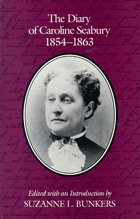
Diary of Caroline Seabury
Caroline Seabury
University of Wisconsin Press, 1991
In 1854 Caroline Seabury of Brooklyn, New York, set out for Columbus, Mississippi, to teach French at its Institute for Young Ladies. She lived in Columbus until 1863, through the years of mounting sectional bitterness that preceded the Civil War and through the turmoil and hardships of the war itself. During that time, her most intimate confidant was her diary. Discovered in the archives of the Minnesota State Historical Society, it is published here for the first time.
The diary is an illuminating account of southern plantation society and the “peculiar institution” of slavery on the eve of its destruction. Seabury also records her uneasy attempts to come to terms with her position as an unmarried, white, Northern woman whose job was to educate wealthy, white, Southern girls in a setting seemingly oblivious to the horrors of slavery. The diary is not simply a chronicle of daily happenings; Seabury concentrates on remarkable events and the memorable feelings and ideas they generate, shaping them into entries that reveal her as an accomplished writer. She frames her narrative with her journey south in 1854 and the hazardous and exhausting return north through battle lines in 1863.
Disapproving of slavery, yet deeply attached to friends and her life in Columbus and also painfully conscious of the fragility of her own economic and social position, Seabury condemned privately in her diary the evils that she endured silently in public. There are striking scenes of plantation life that depict the brutalities of slavery and benumbed responses to them. Seabury also successfully captures the mood of Mississippi as it changed from a fire-eating appetite to fight the Yankees to a grim apprehension of inexorable defeat. Most impressive of all is Seabury’s poignantly honest presentation of herself, caught in the middle.
Editors Make War
Donald E. Reynolds
Southern Illinois University Press, 2006
General Thomas Posey
Son of the American RevolutionJohn Thornton Posey
Michigan State University Press, 1992
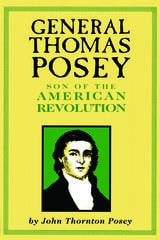
Revolutionary War general Thomas Posey (1750-1818) lived his life against the backdrop of one of the most dramatic periods in American history. Posey, who played a minor role in the actual War for Independence, went on to participate in the development and foundation of several states in the transappalachian West. His experiences on the late 18th- and early 19th-century American frontier were varied and in a certain sense extraordinary; he served as Indian agent in Illinois Territory; as Lieutenant Governor of Kentucky, as U.S. Senator from Louisiana, and as Governor of Indiana during its transition from territorial status to statehood.
His biographer speculates on the contrasting influences of Thomas's ne'er-do-well father, Captain John Posey, and the family's close friend, General George Washington. Posey's progress is then followed as he raises his own family in the newly formed nation. Of particular interest is an appendix containing a detailed analysis of evidence available to support popular 29th-century speculation that Thomas Posey was, in fact, George Washington's illicit son.

Guy Rivers
A Tale of GeorgiaWilliam G. Simms
University of Arkansas Press, 1993
In the Shadow of Slavery
African Americans in New York City, 1626-1863Leslie M. Harris
University of Chicago Press, 2003
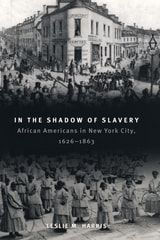
In 1991 in lower Manhattan, a team of construction workers made an astonishing discovery. Just two blocks from City Hall, under twenty feet of asphalt, concrete, and rubble, lay the remains of an eighteenth-century "Negro Burial Ground." Closed in 1790 and covered over by roads and buildings throughout the nineteenth and twentieth centuries, the site turned out to be the largest such find in North America, containing the remains of as many as 20,000 African Americans. The graves revealed to New Yorkers and the nation an aspect of American history long hidden: the vast number of enslaved blacks who labored to create our nation's largest city.
In the Shadow of Slavery lays bare this history of African Americans in New York City, starting with the arrival of the first slaves in 1626, moving through the turbulent years before emancipation in 1827, and culminating in one of the most terrifying displays of racism in U.S. history, the New York City Draft Riots of 1863. Drawing on extensive travel accounts, autobiographies, newspapers, literature, and organizational records, Leslie M. Harris extends beyond prior studies of racial discrimination by tracing the undeniable impact of African Americans on class, politics, and community formation and by offering vivid portraits of the lives and aspirations of countless black New Yorkers.
Written with clarity and grace, In the Shadow of Slavery is an ambitious new work that will prove indispensable to historians of the African American experience, as well as anyone interested in the history of New York City.
In the Shadow of Slavery
African Americans in New York City, 1626-1863Leslie M. Harris
University of Chicago Press, 2024
The popular understanding of the history of slavery in America almost entirely ignores the institution’s extensive reach in the North. But the cities of the North were built by—and became the home of—tens of thousands of enslaved African Americans, many of whom would continue to live there as free people after Emancipation.
In the Shadow of Slavery reveals the history of African Americans in the nation’s largest metropolis, New York City. Leslie M. Harris draws on travel accounts, autobiographies, newspapers, literature, and organizational records to extend prior studies of racial discrimination. She traces the undeniable impact of African Americans on class distinctions, politics, and community formation by offering vivid portraits of the lives and aspirations of countless black New Yorkers. This new edition includes an afterword by the author addressing subsequent research and the ongoing arguments over how slavery and its legacy should be taught, memorialized, and acknowledged by governments.
James Barbour, a Jeffersonian Repulican
Charles D. Lowery
University of Alabama Press, 1984
Barbour, a Virginia contemporary of Thomas Jefferson and James Madison, during a long public career spanning the years 1798-1842, exerted a constructive influence on the nation’s history. Active in state and national politics during the formative decades of the republic, Barbour was a political nationalist who grafted to the dominant political philosophy of the day those elements of the Hamiltonian Federalist creed necessary for governing a dynamic, changing nation.
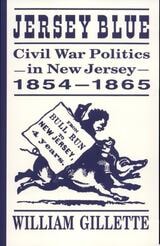
Jersey Blue
Civil War Politics in New Jersey, 1854–1865Gillette, William
Rutgers University Press, 1994
Gillette takes a broader view of the politics of the Civil War as he touches on the economy, geography, demography, immigration, nativism, conscription, and law. The result is a pioneering history of New Jersey that deepens our understanding of the Civil War.
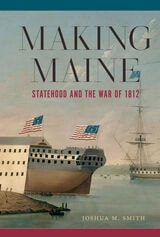
Making Maine
Statehood and the War of 1812Joshua M. Smith
University of Massachusetts Press, 2022
Honorable mention for U.S. Maritime History, John Lyman Book Awards
After the Revolutionary War ended, the new American nation grappled with a question about its identity: Were the states sovereign entities or subordinates to a powerful federal government? The War of 1812 brought this vexing issue into sharp relief, as a national government intent on waging an unpopular war confronted a populace in Massachusetts that was vigorously opposed to it. Maine, which at the time was part of Massachusetts, served as the battleground in this political struggle.
Joshua M. Smith recounts an innovative history of the war, focusing on how it specifically affected what was then called the District of Maine. Drawing on archival materials from the United States, Britain, and Canada, Smith exposes the bitter experience of Maine’s citizens during that conflict as they endured multiple hardships, including starvation, burdensome taxation, smuggling, treason, and enemy occupation. War’s inherent miseries, along with a changing relationship between regional and national identities, gave rise to a statehood movement that rejected a Boston-centric worldview in favor of a broadly American identity.
Pathways to the Old Northwest
An Observance of the Bicentennial of the Northwest OrdinanceLloyd A. Hunter, et al
Indiana Historical Society Press, 1988
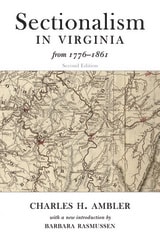
Sectionalism in Virginia from 1776 - 1861
Charles H. Ambler with a new introduction by Barbara Rasmussen
West Virginia University Press, 2008
This 1910 study of sectionalism in Virginia illustrates how the east and west of Virginia were destined to separate into two states. Barbara Rasmussen, professor of Public History and Director of Cultural Resource Management at West Virginia University writes a new introduction to Sectionalism in Virginia, setting Ambler’s classic grand achievement into the context of its production by creating an historical process for studying West Virginia history.
Speculators And Slaves
Masters, Traders, And Slaves In The Old SouthMichael Tadman
University of Wisconsin Press, 1996
Stagecoach and Tavern Tales of the Old Northwest
Harry Ellsworth Cole. Edited by Louise Phelps Kellogg. Foreword by Patrick J. Brunet
Southern Illinois University Press, 1997
One journalist curious about life in the taverns along the stagecoach lines in Wisconsin and northern Illinois from the early 1800s until the 1880s was Harry Ellsworth Cole. While he could not sample strong ales at all of the taverns he wrote about, Cole did study newspaper accounts, wrote hundreds of letters to families of tavern owners, read widely in regional history, and traveled extensively throughout the territory. The result, according to Brunet, is a "nostalgic, sometimes romantic, well-written, and easily digested social history."
At Cole’s death, historian Louise Phelps Kellogg edited his manuscript, which in this case involved turning his notes and illustrations into a book and publishing it with the Arthur H. Clark Company in 1930.
Subfloor Pits and the Archaeology of Slavery in Colonial Virginia
Patricia Samford
University of Alabama Press, 2007
Enslaved Africans and their descendants comprised a significant portion of colonial Virginia populations, with most living on rural slave quarters adjacent to the agricultural fields in which they labored. Archaeological excavations into these home sites have provided unique windows into the daily lifeways and culture of these early inhabitants.
The Algerine Spy in Pennsylvania
Peter Markoe
Westholme Publishing, 2008
An Important Book in America’s Early Encounter with the Arab World
“A pungent satire on American affairs.” —Samuel Eliot Morison
In 1787, while American sailors languished in a Barbary prison, delegates debated the Constitution in Philadelphia. Despite America’s desire to respond to the crisis, without a central government, the new republic had no means to create a naval force. Enter an anonymously published book, The Algerine Spy in Pennsylvania: or, Letters Written by a Native of Algiers on the Affairs of the United States in America, which began circulating among the delegates. Consisting of a series of letters ostensibly written by an Algerian agent “Mehmet” back to his leader, the spy predicted that the former colonies would never be able to resolve their differences and be “ruined by disunion.” The book created a sensation and it helped tip the balance for those in favor of adopting the new Constitution. Following the Constitution’s final ratification in 1789, the United States created a navy and began asserting its power overseas. With its commentary about men and women, business and pleasure, and historical and religious comparisons between nations, The Algerine Spy in Pennsylvania provides both a contemporary snapshot of early American life and the political ideas of the period. Never before reprinted, and recently rated one of the five best works in the history of America’s encounter with the Arab world, this new edition is edited by historian Timothy Marr, who reconsiders the importance of this early work in the political and literary history of the United States.
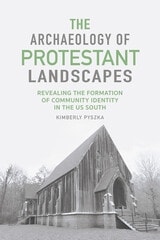
The Archaeology of Protestant Landscapes
Revealing the Formation of Community Identity in the US SouthKimberly Pyszka
University of Alabama Press, 2023
How religious institutions used landscapes and architecture to express their religious and social ideologies
The Archaeology of Protestant Landscapes focuses on three religious institutions in the US South in the eighteenth and nineteenth centuries: St. Paul’s Parish Church in coastal South Carolina, St. Luke’s Episcopal Church in central Alabama, and Cane Hill College in Northwest Arkansas. Drawing from archaeological surveys and excavations, artifact analysis, archival research, geophysical testing, and architectural information on religious structures, Kimberly Pyszka offers case studies of these institutions, which were located in developing communities that varied socially, politically, and economically.
Pyszka uses these case studies to demonstrate that select religious institutions used and modified natural landscape features to create cultural landscapes to express their ideology, identity, goals, and social, religious, and political power. She notes that where those structures were constructed, how they sat on the landscape, their architectural style, and their overall visual appearance were well-considered decisions made by religious leaders to benefit their organizations, communities, and, sometimes, themselves.
Pyszka also uses these case studies to highlight the social roles that religious organizations played in the development of communities. She points to landscape decisions—specifically to how the architectural design of religious structures was used, intentionally or not, to unite people, often those of differing religious backgrounds—as contributing to the creation of a common identity among people living in new and still-growing settlements, aiding in community development. This book contributes to the growing body of work within historical archaeology on churches, churchyards, and cemeteries and to the increasing awareness among archaeologists of how these sites contribute to questions of identity, consumerism, trade, and colonialism.
The Federal Road Through Georgia, the Creek Nation, and Alabama, 1806–1836
Henry deLeon Southerland
University of Alabama Press, 1990
The Federal Road was a major influence in settlement of the Mississippi Territory during the period between the Louisiana Purchase and removal of the Creek Indians
The Fires of New England
A Story of Protest and Rebellion in Antebellum AmericaEric J. Morser
University of Massachusetts Press, 2017
Few people embraced the manifesto and its radical message. Nonetheless, as Eric J. Morser illustrates in this eloquently written and deeply researched book, the address matters because it reveals how commercial, cultural, political, and social changes were remaking the lives of the men who drafted and shared it in the 1830s. Using an imaginative range of sources, Morser artfully reconstructs their moving personal tales and locates them in a grander historical context. By doing so, he demonstrates that even seemingly small stories from antebellum America can help us understand the rich complexities of the era.
The Militant South, 1800-1861
John Hope Franklin
University of Illinois Press, 2002
Franklin asserts that the South was dominated by militant white men who resorted to violence in the face of social, personal, or political conflict. Fueled by their defense of slavery and a persistent desire to keep the North out of their affairs, Southerners adopted a vicious bellicosity that intensified as war drew nearer.
Drawing from Southern newspapers, government archives, memoirs, letters, and firsthand accounts, Franklin masterfully details the sources and consequences of antebellum aggression in the South. First published in 1956, this classic volume is an enduring and impeccably researched contribution to Southern history. This paperback edition features a new preface in which the author discusses controversial responses to the book.
The Northwest Ordinance
Essays on its Formulation, Provisions, and LegacyFrederick D. Williams
Michigan State University Press, 1989
Adoption of the Northwest Ordinance in 1787 ended a long and sometimes acrimonious debate over the question of how to organize and govern the western territories of the United States. Many eastern leaders viewed the Northwest Territory as a colonial possession, while freedom-loving settlers demanded local self- government. These essays address the ambiguities of the Ordinance, balance of power politics in North America, missionary activity in the territory, slavery, and higher education in the Old Northwest.
The Precious Birthright
Black Leaders and the Fight to Vote in Antebellum Rhode IslandCJ Martin
University of Massachusetts Press, 2024
In 1842, Black Rhode Islanders secured a stunning victory, a success rarely seen in antebellum America: they won the right to vote. Amid heightened public discourse around shifting ideas of race, citizenship, and political rights, they methodically deconstructed the arguments against their enfranchisement, exposing the arbitrariness of the color line in delineating citizenship rights and choosing the perfect moments in which to act forcefully. At the head of this movement, a cohort of prominent business and community members formed an early example of a Black leadership class in the US.
CJ Martin draws upon a wealth of sources—including personal correspondences, government and organizational documents, tax records, and petitions—to argue that Black leaders employed a unique combination of agitation and accommodation to ensure the success of the movement. By investigating their tactics, Martin deepens the story of how race played a crucial role in American citizenship, and by focusing on Black leadership, he relates this history through the people who lived it—who thought, debated, petitioned, and enacted their own liberation. Telling the story of a fight that was as important to the pioneers of interracial democracy as it was for the civil rights activists of the twentieth century, The Precious Birthright provides new insight into the larger story of Black freedom.

The Southern Debate over Slavery
Volume 1: Petitions to Southern Legislatures, 1778-1864Edited by Loren Schweninger
University of Illinois Press, 2001
These petitions, filed by slaveholders and nonslaveholders, slaves and free blacks, women and men, abolitionists and staunch defenders of slavery, constitute a uniquely important primary source. Petitioners were compelled to present the most accurate and fully documented case they could, since their claims would be subject to public scrutiny and legal verification. Unlike the many reminiscences and autobiographies of the period, these petitions record with great immediacy and minute detail the dynamics, common understandings, and legal restrictions and parameters that shaped southern society during this period.
Arranged chronologically, with their original spelling and idiosyncratic phraseology intact, these documents reveal the grim and brutal nature of human bondage, the fears of whites who lived among large concentrations of blacks, and the workings of the complicated legal system designed to control blacks. They tell about the yearning of bondspeople to gain their freedom, the attitudes of freed blacks who were forced to leave the South, and the efforts of African Americans to overcome harsh and restrictive laws. They also underscore the unique situation of free women of color and the reliance of manumitted (formally freed) blacks on their former owners for protection, travel passes, guardianship papers, and reference letters.
Astonishingly intimate and frank,The Southern Debate over Slavery illuminates how slavery penetrated nearly every aspect of southern life and how various groups of southerners responded to the difficulties they confronted as a result of living in a slave society.
The Southern Debate over Slavery
Volume 2: Petitions to Southern County Courts, 1775-1867Edited by Loren Schweninger
University of Illinois Press, 2007
An incomparably rich source of period information, the second volume of The Southern Debate over Slavery offers a representative and extraordinary sampling of the thousands of petitions about issues of race and slavery that southerners submitted to county courts between the American Revolution and Civil War. These petitions, filed by slaveholders and nonslaveholders, slaves and free blacks, women and men, abolitionists and staunch defenders of slavery, constitute a uniquely important primary source. The collection records with great immediacy and minute detail the dynamics and legal restrictions that shaped southern society.
The Very Worst Road
Travellers' Accounts of Crossing Alabama's Old Creek Indian Territory, 1820-1847Jeffrey C. Benton
University of Alabama Press, 2009
This Happy Land
The Jews of Colonial and Antebellum CharlestonJames William Hagy
University of Alabama Press, 1993