Results by title
7 books match the query '1783-1815'
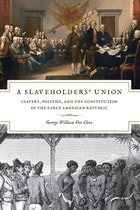
A Slaveholders' Union
Slavery, Politics, and the Constitution in the Early American RepublicGeorge William Van Cleve
University of Chicago Press, 2010
After its early introduction into the English colonies in North America, slavery in the United States lasted as a legal institution until the passage of the Thirteenth Amendment to the Constitution in 1865. But increasingly during the contested politics of the early republic, abolitionists cried out that the Constitution itself was a slaveowners’ document, produced to protect and further their rights. A Slaveholders’ Union furthers this unsettling claim by demonstrating once and for all that slavery was indeed an essential part of the foundation of the nascent republic.
In this powerful book, George William Van Cleve demonstrates that the Constitution was pro-slavery in its politics, its economics, and its law. He convincingly shows that the Constitutional provisions protecting slavery were much more than mere “political” compromises—they were integral to the principles of the new nation. By the late 1780s, a majority of Americans wanted to create a strong federal republic that would be capable of expanding into a continental empire. In order for America to become an empire on such a scale, Van Cleve argues, the Southern states had to be willing partners in the endeavor, and the cost of their allegiance was the deliberate long-term protection of slavery by America’s leaders through the nation’s early expansion. Reconsidering the role played by the gradual abolition of slavery in the North, Van Cleve also shows that abolition there was much less progressive in its origins—and had much less influence on slavery’s expansion—than previously thought.
Deftly interweaving historical and political analyses, A Slaveholders’ Union will likely become the definitive explanation of slavery’s persistence and growth—and of its influence on American constitutional development—from the Revolutionary War through the Missouri Compromise of 1821.
Class Politics and the Creation of the American State
James Parisot
University of Michigan Press, 2026
Why does the American federal government seem to prioritize elite capitalist interests over those of other groups? Class Politics and the Creation of the American State draws on a wide range of sources—personal letters, official government documents, private notes, and newspaper articles—to reveal that the federal government was built to give the emerging capitalist elite a way to consolidate and institutionalize their power. Challenging both liberal and conservative interpretations about what the US Constitution means, this book tells a new story about how the American state took shape.
The framers of the Constitution constructed an image of the state, enshrined in the Constitution, that presented their power as universal: a system meant to serve all Americans equally. This image helped legitimize the new order, even if the rising capitalist class stood to benefit most of all. Since the United States of the late 1780s was not yet a fully capitalist society, the state that was built opened space for less capitalistically incorporated social classes, including some artisans and yeoman farmers, to have limited representation. Class Politics and the Creation of the American State shows how the structure of the early American state worked primarily to advance capitalist interests, while incorporating other groups enough to maintain a sense of broad representation and inclusion.
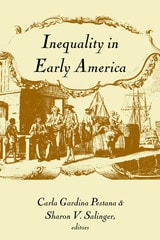
Inequality in Early America
Carla Gardina Pestana
Dartmouth College Press, 2015

National Duties
Custom Houses and the Making of the American StateGautham Rao
University of Chicago Press, 2016
In the wake of the American Revolution, if you had asked a citizen whether his fledgling state would survive more than two centuries, the answer would have been far from confident. The problem, as is so often the case, was money. Left millions of dollars of debt by the war, the nascent federal government created a system of taxes on imported goods and installed custom houses at the nation’s ports, which were charged with collecting these fees. Gradually, the houses amassed enough revenue from import merchants to stabilize the new government. But, as the fragile United States was dependent on this same revenue, the merchants at the same time gained outsized influence over the daily affairs of customs houses. As the United States tried to police this commerce in the early nineteenth century, the merchants’ stranglehold on custom house governance proved to be formidable.
In National Duties, Gautham Rao makes the case that the origins of the federal government and the modern American state lie in these conflicts at government custom houses between the American Revolution and the presidency of Andrew Jackson. He argues that the contours of the government emerged from the push-and-pull between these groups, with commercial interests gradually losing power to the administrative state, which only continued to grow and lives on today.
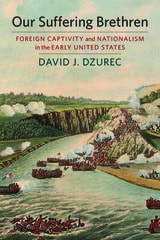
Our Suffering Brethren
Foreign Captivity and Nationalism in the Early United StatesDavid J. Dzurec III
University of Massachusetts Press, 2019
In October 1785, American statesman John Jay acknowledged that the more his countrymen “are treated ill abroad, the more we shall unite and consolidate at home.” Behind this simple statement lies a complicated history. From the British impressment of patriots during the Revolution to the capture of American sailors by Algerian corsairs and Barbary pirates at the dawn of the nineteenth century, stories of Americans imprisoned abroad helped jumpstart democratic debate as citizens acted on their newly unified identity to demand that their government strengthen efforts to free their fellow Americans. Deliberations about the country's vulnerabilities in the Atlantic world reveal America's commitment to protecting the legacy of the Revolution as well as growing political divisions.
Drawing on newspaper accounts, prisoner narratives, and government records, David J. Dzurec III explores how stories of American captivity in North America, Europe, and Africa played a critical role in the development of American political culture, adding a new layer to our understanding of foreign relations and domestic politics in the early American republic.

Sex and the Founding Fathers
The American Quest for a Relatable PastThomas A. Foster
Temple University Press, 2016
Biographers, journalists, and satirists have long used the subject of sex to define the masculine character and political authority of America's Founding Fathers. Tracing these commentaries on the Revolutionary Era's major political figures in Sex and the Founding Fathers, Thomas Foster shows how continual attempts to reveal the true character of these men instead exposes much more about Americans and American culture than about the Founders themselves.
Sex and the Founding Fathers examines the remarkable and varied assessments of the intimate lives of George Washington, Thomas Jefferson, John Adams, Benjamin Franklin, Alexander Hamilton, and Gouverneur Morris from their own time to ours. Interpretations can change radically; consider how Jefferson has been variously idealized as a chaste widower, condemned as a child molester, and recently celebrated as a multicultural hero.
Foster considers the public and private images of these generally romanticized leaders to show how each generation uses them to reshape and reinforce American civic and national identity.
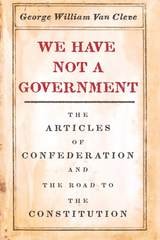
We Have Not a Government
The Articles of Confederation and the Road to the ConstitutionGeorge William Van Cleve
University of Chicago Press, 2017
In George William Van Cleve’s book, we encounter a sharply divided America. The Confederation faced massive war debts with virtually no authority to compel its members to pay them. It experienced punishing trade restrictions and strong resistance to American territorial expansion from powerful European governments. Bitter sectional divisions that deadlocked the Continental Congress arose from exploding western settlement. And a deep, long-lasting recession led to sharp controversies and social unrest across the country amid roiling debates over greatly increased taxes, debt relief, and paper money. Van Cleve shows how these remarkable stresses transformed the Confederation into a stalemate government and eventually led previously conflicting states, sections, and interest groups to advocate for a union powerful enough to govern a continental empire.
Touching on the stories of a wide-ranging cast of characters—including John Adams, Patrick Henry, Daniel Shays, George Washington, and Thayendanegea—Van Cleve makes clear that it was the Confederation’s failures that created a political crisis and led to the 1787 Constitution. Clearly argued and superbly written, We Have Not a Government is a must-read history of this crucial period in our nation’s early life.