Results by title
11 books match the query '1783-1850'
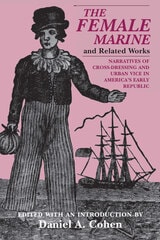
"The Female Marine" and Related Works
Narratives of Cross-Dressing and Urban Vice in America's Early RepublicDaniel A. Cohen
University of Massachusetts Press, 1997
The alternately racy and moralistic narrative recounts the adventures of a young woman from rural Massachusetts who is seduced by a false-hearted lover, flees to Boston, and is entrapped in a brothel. She eventually escapes by disguising herself as a man and serves with distinction on board the U.S. frigate Constitution during the War of 1812. After subsequent onshore adventures in and out of male dress, she is happily married to a wealthy New York gentleman.
In his introduction, Daniel A. Cohen situates the story in both its literary and historical contexts. He explains how the tale draws upon a number of popular Anglo-American literary genres, including the female warrior narrative, the sentimental novel, and the urban exposé. He then explores how The Female Marine reflects early-nineteenth-century anxieties concerning changing gender norms, the expansion of urban prostitution, the growth of Boston's African American community, and feelings of guilt aroused by New England's notoriously unpatriotic activities during the War of 1812.
A Road Course in Early American Literature
Travel and Teaching from Atzlán to AmherstThomas Hallock
University of Alabama Press, 2021
Essays that fuse literary scholarship and personal travelogue to explore American identity
A Road Course in Early American Literature: Travel and Teaching from Atzlán to Amherst explores a two-part question: what does travel teach us about literature, and how can reading guide us to a deeper understanding of place and identity? Thomas Hallock charts a teacher’s journey to answering these questions, framing personal experiences around the continued need for a survey course covering early American literature up to the mid-nineteenth century.
Hallock approaches literary study from the overlapping perspectives of pedagogue, scholar, unrepentant tourist, husband, father, friend, and son. Building on Ralph Waldo Emerson’s premise that there is “creative reading as well as creative writing,” Hallock turns to the vibrant and accessible tradition of American travel writing, employing the form of biblio-memoir to bridge the impasse between public and academic discourse and reintroduce the dynamic field of early American literature to wider audiences.
Hallock’s own road course begins and ends at the Low country of Georgia and South Carolina, following a circular structure of reflection. He weaves his journey through a wide swath of American literatures and authors: from Native American and African American oral traditions, to Wheatley and Equiano, through Emerson, Poe, and Dickinson, among others. A series of longer, place-oriented narratives explore familiar and lesser-known literary works from the sixteenth-century invasion of Florida through the Mexican War of 1846–1848 and the American Civil War. Shorter chapters bridge the book’s central themes—the mapping of cognitive and physical space, our personal stake in reading, the tensions that follow earlier acts of erasure, and the impossibility of ever fully shutting out the past.
Exploring complex cultural histories and contemporary landscapes filled with ghosts and new voices, this volume draws inspiration from a tradition of travel, place-oriented, and literature-based works ranging from William Carlos Williams’s In the American Grain and Jack Kerouac’s On the Road to Alice Walker’s In Search of Our Mother’s Gardens, Wendy Lesser’s Why I Read: The Serious Pleasure of Books, and Rebecca Mead’s My Life in Middlemarch.
An accompanying bibliographic essay is periodically updated and available at Hallock’s website: www.roadcourse.us.
American Romanticism and the Marketplace
Michael T. Gilmore
University of Chicago Press, 1985
"[Gilmore] demonstrates the profound, sustained, engagement with society embodied in the works of Emerson, Hawthorne, Thoreau and Melville. In effect, he relocates the American Renaissance where it properly belongs, at the centre of a broad social, economic, and ideological movement from the Jacksonian era to the Civil War. Basically, Gilmore's argument concerns the writers' participation in what Thoreau called 'the curse of trade.' He details their mixed resistance to and complicity in the burgeoning literary marketplace and, by extension, the entire ' economic revolution' which between 1830 and 1860 'transformed the United States into a market society'. . . .
"The result is a model of literary-historical revisionism. Gilmore's opening chapters on Emerson and Thoreau show that 'transcendental' thought and language can come fully alive when understood within the material processes and ideological constraints of their time. . . . The remaining five chapters, on Hawthorne and Melville, contain some of the most penetrating recent commentaries on the aesthetic strategies of American Romantic fiction, presented within and through some of the most astute, thoughtful considerations I know of commodification and the 'democratic public' in mid-nineteenth-century America. . . . Practically and methodologically, American Romanticism and the Marketplace has a significant place in the movement towards a new American literary history. It places Gilmore at the forefront of a new generation of critics who are not just reinterpreting familiar texts or discovering new texts to interpret, but reshaping our ways of thinking about literature and culture."—Sacvan Bercovitch, Times Literary Supplement
"Gilmore writes with energy, clarity, and wit. The reader is enriched by this book." William H. Shurr, American Literature
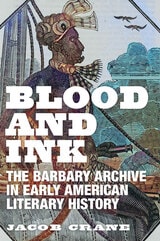
Blood and Ink
The Barbary Archive in Early American Literary HistoryJacob Crane
University of Massachusetts Press, 2023
In the late eighteenth and early nineteenth centuries, Algerian piracy in the Mediterranean loomed large in the American imagination. An estimated seven hundred American citizens, sailors, and naval officers were taken captive over the course of the Barbary Crises (1784–1815), and this overseas danger threatened to grow and irreparably harm the young republic.
Blood and Ink reconstructs the largely forgotten influence of these early American conflicts with North Africa on notions of publicity, print culture, and racial and national identity from independence to the Civil War. Exploring the extensive archive of texts inspired by the conflicts—from captivity narratives, novels, plays, and poems to broadsides, travel narratives, children’s literature, newspaper articles, and visual ephemera—Jacob Crane connects anxieties surrounding North African piracy and white slavery to both the development of American abolitionism and representations of transatlantic African and Jewish identities in the early national and antebellum periods.
Early American Almanac Humor
University of Wisconsin Press, 1987
Early American Poetry
Selections from Bradstreet, Taylor, Dwight, Freneau, and BryantEdited by Jane Donahue Eberwein
University of Wisconsin Press, 1978
Here is the first major-figure anthology of American poetry of the colonial and early national periods, an indispensable volume for both students and scholars of American literature and civilization.
Five major literary figures are spotlighted: Anne Bradstreet (1612-1672), Edward Taylor (1642?"-1729), Timothy Dwight (1752-1817), Philip Freneau (1752-1832), and William Cullen Bryant (1794-1878). An introduction to each chapter summarizes the life of the poet, reviews his or her literary career, describes and evaluates artistic achievement, and places the poet in an intellectual context. The writer's relationship to changing religious, philosophical, political, and cultural patters is established. The contemporary perspective is augmented by the inclusion of an appendix which presents three important poems by other writers: Micheal Wigglesworth's "God's Controversy with New England," Ebenezer Cook's The Sot-Weed Factor, and Joel Barlow's "Hasty Pudding."
Eberwein goes beyond the most popular and familiar works to include those of unrecognized literary merit, presenting a thoroughly unique approach which illuminates the full range of the writers' themes, forms and poetic voices.
Risk Culture
Performance and Danger in Early AmericaJoseph Fichtelberg
University of Michigan Press, 2010
---David Shields, University of South Carolina
The Black Aesthetic Unbound
Theorizing the Dilemma of Eighteenth-Century African American LiteratureApril C. E. Langley
The Ohio State University Press, 2007
Consequently, this book has three aims: to locate the eighteenth century as the genesis of the cultural and historical movements which mark twentieth-century black aestheticism—known as the Black Aesthetic; to analyze problematic associations of African identity as manifested in an essentialized Afro-America; and to study the relationship between specific West African modes of thought and expression and the emergence of a black aesthetic in eighteenth-century North America. By exploring how Senegalese, Igbo, and other West African traditions provide striking new lenses for reading poetry and prose by six significant writers, Langley offers a fresh perspective on this important era in our literary history. Ultimately, the author confronts the difficult dilemma of how to use diasporic, syncretic, and vernacular theories of Black culture to think through the massive cultural transformations wrought by the Middle Passage.
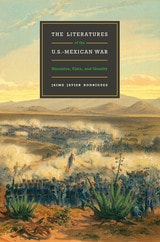
The Literatures of the U.S.-Mexican War
Narrative, Time, and IdentityBy Jaime Javier Rodríguez
University of Texas Press, 2010
The literary archive of the U.S.-Mexican War (1846–1848) opens to view the conflicts and relationships across one of the most contested borders in the Americas. Most studies of this literature focus on the war's nineteenth-century moment of national expansion. In The Literatures of the U.S.-Mexican War, Jaime Javier Rodríguez brings the discussion forward to our own moment by charting a new path into the legacies of a military conflict embedded in the cultural cores of both nations.
Rodríguez's groundbreaking study moves beyond the terms of Manifest Destiny to ask a fundamental question: How do the war's literary expressions shape contemporary tensions and exchanges among Anglo Americans, Mexicans, and Mexican Americans. By probing the war's traumas, anxieties, and consequences with a fresh attention to narrative, Rodríguez shows us the relevance of the U.S.-Mexican War to our own era of demographic and cultural change. Reading across dime novels, frontline battle accounts, Mexican American writings and a wide range of other popular discourse about the war, Rodríguez reveals how historical awareness itself lies at the center of contemporary cultural fears of a Mexican "invasion," and how the displacements caused by the war set key terms for the ways Mexican Americans in subsequent generations would come to understand their own identities. Further, this is also the first major comparative study that analyzes key Mexican war texts and their impact on Mexico's national identity.
The Rise and Fall of Early American Magazine Culture
Jared Gardner
University of Illinois Press, 2014
Voicing America
Language, Literary Form, and the Origins of the United StatesChristopher Looby
University of Chicago Press, 1996