Results by title
3 books match the query '1789-1797'
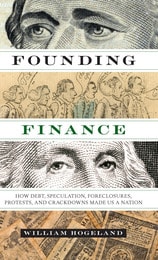
Founding Finance
How Debt, Speculation, Foreclosures, Protests, and Crackdowns Made Us a NationBy William Hogeland
University of Texas Press, 2014
Recent movements such as the Tea Party and anti-tax “constitutional conservatism” lay claim to the finance and taxation ideas of America’s founders, but how much do we really know about the dramatic clashes over finance and economics that marked the founding of America? Dissenting from both right-wing claims and certain liberal preconceptions, Founding Finance brings to life the violent conflicts over economics, class, and finance that played directly, and in many ways ironically, into the hardball politics of forming the nation and ratifying the Constitution—conflicts that still continue to affect our politics, legislation, and debate today.
Mixing lively narrative with fresh views of America’s founders, William Hogeland offers a new perspective on America’s economic infancy: foreclosure crises that make our current one look mild; investment bubbles in land and securities that drove rich men to high-risk borrowing and mad displays of ostentation before dropping them into debtors’ prisons; depressions longer and deeper than the great one of the twentieth century; crony mercantilism, war profiteering, and government corruption that undermine any nostalgia for a virtuous early republic; and predatory lending of scarce cash at exorbitant, unregulated rates, which forced people into bankruptcy, landlessness, and working in the factories and on the commercial farms of their creditors. This story exposes and corrects a perpetual historical denial—by movements across the political spectrum—of America’s all-important founding economic clashes, a denial that weakens and cheapens public discourse on American finance just when we need it most.

Inventing Congress
Origins and Establishment of the First Federal CongressKenneth R. Bowling
Ohio University Press, 1999
On March 4, 1789, New York City's church bells pealed, cannons fired, and flags snapped in the wind to celebrate the date set for the opening of the First Federal Congress. In many ways the establishment of Congress marked the culmination of the American Revolution as the ship of state was launched from the foundation of the legislative system outlined in Article I of the Constitution.
Inventing Congress presents the latest scholarship on the interrelated intellectual, institutional, cultural, and political antecedents of the formation of the First Federal Congress. The first section covers the origins of the body, ranging in discussion from the question of how the founders' understanding of classical Greek and Roman republican precedent shaped their thinking, to the political lessons learned during the Continental and Confederation Congresses.
The second section concerns itself with the establishment of the First Federal Congress, examining several heretofore little-treated aspects of the most important Congress in history, including its relationship to the press, morality, the arts and sciences, and economic philosophy.
Inventing Congress represents the papers from the first two conferences sponsored by the United States Capitol Historical Society in its series, “Perspectives on the History of Congress, 1789-1801.”
Neither Separate Nor Equal
Congress in the 1790sKenneth R. Bowling
Ohio University Press, 2000
Scholars today take for granted the existence of a “wall of separation” dividing the three branches of the federal government. Neither Separate nor Equal: Congress in the 1790s demonstrates that such lines of separation among the legislative, executive, and judicial branches, however, were neither so clearly delineated nor observed in the first decade of the federal government's history.
The first two essays describe the social and cultural milieu attending the movement of the republican court from New York to Philadelphia and the physical and social environment of Philadelphia in the 1790s. The following section examines the congressional career of New York's Egbert Benson, the senatorial career of Robert Morris as an expression of his economic interests, the vigorous opposition of Rep. William Branch Giles to the Federalist policies of the Washington administration, and finally the underappreciated role of congressional spouses.
The last five essays concentrate on areas of interbranch cooperation and conflict. In particular, they discuss the meaning of separation of powers in the 1790s, Washington as an active president with Congress, the contrast between Hamilton's and Jefferson's exercise of political influence with Congress, and John Adams's relationship with Congress during the Quasi-War crisis.
The essays in this collection, the second volume of the series Perspectives on the History of Congress, 1789-1801, originated in two conferences held in 1995 and 1996 by the United States Capitol Historical Society.