Results by title
7 books match the query '1789-1815'

Engineering the Revolution
Arms and Enlightenment in France, 1763-1815Ken Alder
University of Chicago Press, 2010
Engineering the Revolution documents the forging of a new relationship between technology and politics in Revolutionary France, and the inauguration of a distinctively modern form of the “technological life.” Here, Ken Alder rewrites the history of the eighteenth century as the total history of one particular artifact—the gun—by offering a novel and historical account of how material artifacts emerge as the outcome of political struggle. By expanding the “political” to include conflict over material objects, this volume rethinks the nature of engineering rationality, the origins of mass production, the rise of meritocracy, and our interpretation of the Enlightenment and the French Revolution.
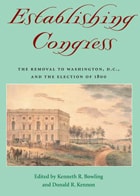
Establishing Congress
The Removal to Washington, D.C., and the Election of 1800Kenneth R. Bowling
Ohio University Press, 2005
Establishing Congress: The Removal to Washington, D.C., and the Election of 1800 focuses on the end of the 1790s, when, in rapid succession, George Washington died, the federal government moved to Washington, D.C., and the election of 1800 put Thomas Jefferson and the Democratic-Republican Party in charge of the federal government.
Establishing Congress dispels the myths and misinformation that surround the federal government’s move to Washington and demonstrates that the election of 1800 changed American party politics forever, establishing the success of the American experiment in government and completing the founding of the Republic. It also contends that the lame-duck session of Congress had far-reaching implications for the governance of the District of Columbia. Later chapters examine aspects of the political iconography of the Capitol—one illuminating Jefferson’s role in turning the building into a temple for the legislature and an instrument for nation-building, another analyzing the fascinating decades-long debate over whether to bury George Washington in the Capitol.
The book considers as well the political implications of social life in early Washington, examining the political lobbying by Washington women within a social context and detailing the social and political life in the city’s homes, hotels, boardinghouses, and eating messes. Establishing Congress is an invaluable reference work for anyone interested in these pivotal moments in American history.
Religion and the Politics of Time
Noah Shusterman
Catholic University of America Press, 2010

Soldiers of the French Revolution
Alan Forrest
Duke University Press, 1989
Revolutionary idealists thought of the French soldier as a willing volunteer sacrificing himself for the principles of the Revolution; Forrest examines the convergence of these ideals with the ordinary, and often dreadful, experience of protracted warfare that the soldier endured.

Teaching the Eighteenth Century Now
Pedagogy as Ethical EngagementKate Parker
Bucknell University Press, 2024
Published by Bucknell University Press. Distributed worldwide by Rutgers University Press.

The House and Senate in the 1790s
Petitioning, Lobbying, and Institutional DevelopmentKenneth R. Bowling
Ohio University Press, 2002
Amid the turbulent swirl of foreign intrigue, external and internal threats to the young nation’s existence, and the domestic partisan wrangling of the 1790s, the United States Congress solidified its role as the national legislature. The ten essays in The House and Senate in the 1790s demonstrate the mechanisms by which this bicameral legislature developed its institutional identity. The first essay sets the scene for the institutional development of Congress by examining its constitutional origins and the efforts of the Founders to empower the new national legislature. The five following essays focus on two related mechanisms—petitioning and lobbying—by which citizens and private interests communicated with national lawmakers.
Although scholars tend to see lobbying as a later nineteenth-century development, the papers presented here clearly demonstrate the existence of lobbyists and lobbying in the 1790s. The final four papers examine other aspects of the institutional development of the House and the Senate, including the evolution of political parties and congressional leadership.
The essays in this collection, the third volume in the series Perspectives on the History of Congress, 1789-1801, originated in a series of conferences held by the United States Capitol Historical Society from 1994 to 2001.
Women Against Napoleon
Historical and Fictional Responses to his Rise and LegacyEdited by Waltraud Maierhofer, Gertrud Roesch, and Caroline Bland
Campus Verlag, 2007