Results by title
9 books match the query '1789-1900'
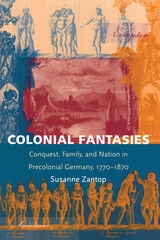
Colonial Fantasies
Conquest, Family, and Nation in Precolonial Germany, 1770-1870Susanne Zantop
Duke University Press, 1997
From as early as the sixteenth century, Germans preoccupied themselves with an imaginary drive for colonial conquest and possession that eventually grew into a collective obsession. Zantop illustrates the gendered character of Germany’s colonial imagination through critical readings of popular novels, plays, and travel literature that imagine sexual conquest and surrender in colonial territory—or love and blissful domestic relations between colonizer and colonized. She looks at scientific articles, philosophical essays, and political pamphlets that helped create a racist colonial discourse and demonstrates that from its earliest manifestations, the German colonial imagination contained ideas about a specifically German national identity, different from, if not superior to, most others.

Dom Pedro
The Struggle for Liberty in Brazil and Portugal, 1798-1834Neill Macaulay
Duke University Press, 1986
Imperial Rule
Alfred J. Rieber
Central European University Press, 2004
Masses and Man
Nationalist and Fascist Perceptions of RealityGeorge L. Mosse
University of Wisconsin Press, 2024
Masses and Man comprises three parts. The first lays out a cultural history of nationalism, essentially the first of its kind, emphasizing the importance of sacred expressions like myths, symbols, and rituals as appropriated in a political context. The second zeroes in on fascism’s most dramatic irruptions in European history in the rise of Italian Fascism and the Nazi Party in Germany, elucidating these as not just political movements but also cultural and even aesthetic ones. The third part considers nationalism and fascism from the particular standpoint of German Jews.
Taken in full, the volume offers an eloquent summation of Mosse’s groundbreaking insights into European nationalism, fascism, and Jewish history in the twentieth century. A new critical introduction by Enzo Traverso helpfully situates Mosse’s work in context and exposes the many ways in which Masses and Man, first published in 1980, remains relevant today.
Reason's Muse
Sexual Difference and the Birth of DemocracyGeneviève Fraisse
University of Chicago Press, 1994
Through an analysis of literary, religious, legal, philosophical, and medical texts, Fraisse links a range of positions on women's proper role in society to specific historical and rhetorical circumstances. She shows how the Revolution marked a sharp break in the way women were represented in language, as traditional bantering about the "war of the sexes" gave way to serious discussions of the political and social meanings of sexual difference. Following this discussion on three different planes—the economical, the political, and the biological—Fraisse looks at the exclusion of women against the backdrop of democracy's inevitable lie: the affirmation of an equality so abstract it was impossible to concretely apply.
This study of the place of sexual equality in the founding moment of democracy offers insight into a persistent question: whether female emancipation is to be found through the achievement of equality with men or in the celebration of female difference.

The End of Prussia
Gordon A. Craig
University of Wisconsin Press, 1984
One of the livelier debates amongst historians concerns the dates of the beginning and, particularly, the end of Prussian history. Eminent historian Gordon A. Craig explores the slow death of Prussia by examining several key individuals and their actions at four distinct periods of Prussian history.
"Simply said, the book is a beautiful piece. Insightful and lucid. . . . The End of Prussia has the rare quality of being suitable for both the specialist and the more casual student of German history."—Wisconsin Academy Review

The Habsburg Monarchy, 1809-1918
A History of the Austrian Empire and Austria-HungaryA. J. P. Taylor
University of Chicago Press, 1976
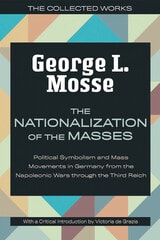
The Nationalization of the Masses
Political Symbolism and Mass Movements in Germany from the Napoleonic Wars Through the Third ReichGeorge L. Mosse
University of Wisconsin Press, 2023

What Nostalgia Was
War, Empire, and the Time of a Deadly EmotionThomas Dodman
University of Chicago Press, 2017
What Nostalgia Was unearths that history. Thomas Dodman begins his story in Basel, where a nineteen-year-old medical student invented the new diagnosis, modeled on prevailing notions of melancholy. From there, Dodman traces its spread through the European republic of letters and into Napoleon's armies, as French soldiers far from home were diagnosed and treated for the disease. Nostalgia then gradually transformed from a medical term to a more expansive cultural concept, one that encompassed Romantic notions of the aesthetic pleasure of suffering. But the decisive shift toward its contemporary meaning occurred in the colonies, where Frenchmen worried about racial and cultural mixing came to view moderate homesickness as salutary. An afterword reflects on how the history of nostalgia can help us understand the transformations of the modern world, rounding out a surprising, fascinating tour through the history of a durable idea.