Results by title
2 books match the query '1797-1801'
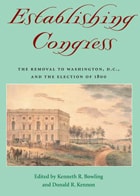
Establishing Congress
The Removal to Washington, D.C., and the Election of 1800Kenneth R. Bowling
Ohio University Press, 2005
Establishing Congress: The Removal to Washington, D.C., and the Election of 1800 focuses on the end of the 1790s, when, in rapid succession, George Washington died, the federal government moved to Washington, D.C., and the election of 1800 put Thomas Jefferson and the Democratic-Republican Party in charge of the federal government.
Establishing Congress dispels the myths and misinformation that surround the federal government’s move to Washington and demonstrates that the election of 1800 changed American party politics forever, establishing the success of the American experiment in government and completing the founding of the Republic. It also contends that the lame-duck session of Congress had far-reaching implications for the governance of the District of Columbia. Later chapters examine aspects of the political iconography of the Capitol—one illuminating Jefferson’s role in turning the building into a temple for the legislature and an instrument for nation-building, another analyzing the fascinating decades-long debate over whether to bury George Washington in the Capitol.
The book considers as well the political implications of social life in early Washington, examining the political lobbying by Washington women within a social context and detailing the social and political life in the city’s homes, hotels, boardinghouses, and eating messes. Establishing Congress is an invaluable reference work for anyone interested in these pivotal moments in American history.

Inventing Congress
Origins and Establishment of the First Federal CongressKenneth R. Bowling
Ohio University Press, 1999
On March 4, 1789, New York City's church bells pealed, cannons fired, and flags snapped in the wind to celebrate the date set for the opening of the First Federal Congress. In many ways the establishment of Congress marked the culmination of the American Revolution as the ship of state was launched from the foundation of the legislative system outlined in Article I of the Constitution.
Inventing Congress presents the latest scholarship on the interrelated intellectual, institutional, cultural, and political antecedents of the formation of the First Federal Congress. The first section covers the origins of the body, ranging in discussion from the question of how the founders' understanding of classical Greek and Roman republican precedent shaped their thinking, to the political lessons learned during the Continental and Confederation Congresses.
The second section concerns itself with the establishment of the First Federal Congress, examining several heretofore little-treated aspects of the most important Congress in history, including its relationship to the press, morality, the arts and sciences, and economic philosophy.
Inventing Congress represents the papers from the first two conferences sponsored by the United States Capitol Historical Society in its series, “Perspectives on the History of Congress, 1789-1801.”