Results by title

5 books match the query '1799-1850'
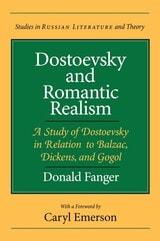
cover of Dostoevsky and Romantic Realism: A Study of Dostoevsky in Relation to Balzac, Dickens, and Gogol

Dostoevsky and Romantic Realism

A Study of Dostoevsky in Relation to Balzac, Dickens, and Gogol

Donald Fanger

Northwestern University Press, 1998
Dostoevsky and Romantic Realism is Donald Fanger's groundbreaking study of the art of Dostoevsky and the literary and historical context in which it was created. Through detailed analyses of the work of Balzac, Dickens, and Gogol, Fanger identifies romantic realism, the transformative fusion of two generic categories, as a powerful imaginary response to the great modern city. This fusion reaches its aesthetic and metaphysical climax in Dostoevsky, whose vision culminating in Crime and Punishment is seen by Fanger as the final synthesis of romantic realism.
[more]
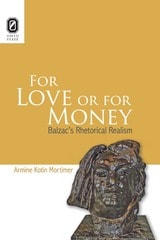
cover of For Love or for Money: Balzac's Rhetorical Realism

For Love or for Money

Balzac's Rhetorical Realism

Armine Kotin Mortimer

The Ohio State University Press, 2011
Everyone agrees that Balzac is a realistic writer, but what do we actually mean when we say that? This book examines the richness and variety of Balzac’s approaches to realism, employing several different interpretive methods. Taking love and money as the “Prime Movers” of the world of La Comédie humaine, twenty-one chapters provide detailed analyses of the many strategies by which the writing forges the powerful impression of reality, the construction we famously think of as Balzacian realism. Each chapter sets the methods and aims of its analysis, with particular attention to the language that conveys the sense of reality. Plots, devices, or interpretive systems (including genealogies) function as images or reflections of how the novels make their meanings. The analyses converge on the central point: how did Balzac invent realism? No less than this fundamental question lies behind the interpretations this book provides, a question to which the conclusion provides a full answer.
 
A major book in English devoted entirely to Balzac was overdue. Here is the American voice of Balzac studies, an engaging, insightful, and revealing excursion among the masterworks of one of the most important authors of all time.
 
[more]
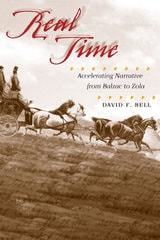
cover of Real Time: Accelerating Narrative from Balzac to Zola

Real Time

Accelerating Narrative from Balzac to Zola

David F. Bell

University of Illinois Press, 2003

In Real Time David F. Bell explores the decisive impact the accelerated movement of people and information had on the fictions of four giants of French realism--Balzac, Stendhal, Dumas, and Zola.
 
Nineteenth-century technological advances radically altered the infrastructure of France, changing the ways ordinary citizens–-and literary characters--viewed time, space, distance, and speed. The most influential of these advances included the improvement of the stagecoach, the growth of road and canal networks leading to the advent of the railway, and the increasing use of mail, and of the optical telegraph. Citing examples from a wide range of novels and stories, Bell demonstrates the numerous ways in which these trends of acceleration became not just literary devices and themes but also structuring principles of the novels themselves.
 
Beginning with both the provincial and the Parisian communications networks of Balzac, Bell proceeds to discuss the roles of horses and optical telegraphs in Stendhal and the importance of domination of communication channels to the characters of Dumas, whose Count of Monte-Cristo might be seen as the ultimate fictional master of this accelerated culture. Finally, Bell analyzes the cinematic vision created by the arrival of the railroad, as depicted by Zola in La Bète Humaine.
 
[more]
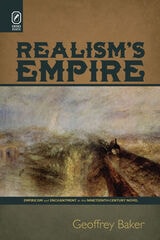
cover of Realism's Empire: Empiricism and Enchantment in the Nineteenth-Century Novel

Realism's Empire

Empiricism and Enchantment in the Nineteenth-Century Novel

Geoffrey Baker

The Ohio State University Press, 2009
If realist novels are the literary avatars of secular science and rational progress, then why are so many canonical realist works organized around a fear of that progress? Realism is openly indebted, at the level of form and content, to imperialist and scientific advances. However, critical emphasis on this has obscured the extent to which major novelists of the period openly worried about the fate of mystery and the dissolution of tradition that accompanied science’s shrinking of the world. Realism’s modernization is inseparable from nostalgia.
 
In Realism’s Empire: Empiricism and Enchantment in the Nineteenth-Century Novel, Geoffrey Baker demonstrates that realist fiction’s stance toward both progress and the foreign or supernatural is much more complex than established scholarship has assumed. The work of Honoré de Balzac, Anthony Trollope, and Theodor Fontane explicitly laments the loss of mystery in the world due to increased knowledge and exploration. To counter this loss and to generate the complications required for narrative, these three authors import peripheral, usually colonial figures into the metropolitan centers they otherwise depict as disenchanted and rationalized: Paris, London, and Berlin. Baker’s book examines the consequences of this duel for realist narrative and readers’ understandings of its historical moment. In so doing, Baker shows Balzac, Trollope, and Fontane grappling with new realities that frustrate their inherited means of representation and oversee a significant shift in the development of the novel.
 
 
[more]
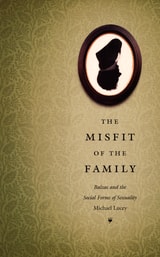
cover of The Misfit of the Family: Balzac and the Social Forms of Sexuality

The Misfit of the Family

Balzac and the Social Forms of Sexuality

Michael Lucey

Duke University Press, 2003

In more than ninety novels and novellas, Honoré de Balzac (1799–1850) created a universe teeming with over two thousand characters. The Misfit of the Family reveals how Balzac, in imagining the dense, vividly rendered social world of his novels, used his writing as a powerful means to understand and analyze—as well as represent—a range of forms of sexuality. Moving away from the many psychoanalytic approaches to the novelist's work, Michael Lucey contends that in order to grasp the full complexity with which sexuality was understood by Balzac, it is necessary to appreciate how he conceived of its relation to family, history, economics, law, and all the many structures within which sexualities take form.

The Misfit of the Family is a compelling argument that Balzac must be taken seriously as a major inventor and purveyor of new tools for analyzing connections between the sexual and the social. Lucey’s account of the novelist’s deployment of "sexual misfits" to impel a wide range of his most canonical works—Cousin Pons, Cousin Bette, Eugenie Grandet, Lost Illusions, The Girl with the Golden Eyes—demonstrates how even the flexible umbrella term "queer" barely covers the enormous diversity of erotic and social behaviors of his characters. Lucey draws on the thinking of Michel Foucault and Pierre Bourdieu and engages the work of critics of nineteenth-century French fiction, including Naomi Schor, D. A. Miller, Franco Moretti, and others. His reflections on Proust as Balzac’s most cannily attentive reader suggest how the lines of social and erotic force he locates in Balzac’s work continued to manifest themselves in twentieth-century writing and society.

[more]