Results by title
5 books match the query '1800 - 1860'
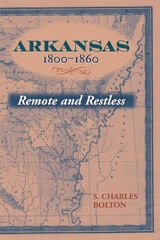
Arkansas, 1800-1860
Remote and RestlessS. Charles Bolton
University of Arkansas Press, 1998
Often thought of as a primitive backwoods peopled by rough hunters and unsavory characters, early Arkansas was actually productive and dynamic in the same manner as other American territories and states. In this, the second volume in the Histories of Arkansas, S. Charles Bolton describes the emigration, mostly from other southern states, that carried Americans into Arkansas; the growth of an agricultural economy based on cotton, corn, and pork; the dominance of evangelical religion; and the way in which women coped with the frontier and made their own contributions toward its improvement. He closely compares the actual lifestyles of the settlers with the popularly held, uncomplimentary image.
Separate chapters deal with slavery and the lives of the slaves and with Indian affairs, particularly the dispossession of the native Quapaws and the later-arriving Cherokees. Political chapters explore opportunism in Arkansas Territory, the rise of the Democratic Party under the control of the Sevier-Johnson group known as the Dynasty, and the forces that led Arkansas to secede from the Union. In addition, Arkansas’s role in the Mexican War and the California gold rush is treated in detail.
In truth, geographic isolation and a rugged terrain did keep Arkansas underpopulated, and political violence and a disastrous experience in state banking tarnished its reputation, but the state still developed rapidly and successfully in this period, playing an important role on the southwestern frontier.
Winner of the 1999 Booker Worthen Literary Prize
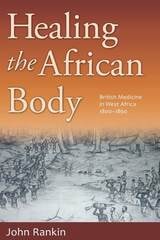
Healing the African Body
British Medicine in West Africa, 1800-1860John Rankin
University of Missouri Press, 2015
This timely book explores the troubled intertwining of religion, medicine, empire, and race relations in the early nineteenth century. John Rankin analyzes the British use of medicine in West Africa as a tool to usher in a “softer” form of imperialism, considers how British colonial officials, missionaries, and doctors regarded Africans, and explores the impact of race classification on colonial constructs.
Rankin goes beyond contemporary medical theory, examining the practice of medicine in colonial Africa as Britons dealt with the challenges of providing health care to their civilian employees, African soldiers, and the increasing numbers of freed slaves in the general population, even while the imperialists themselves were threatened by a lack of British doctors and western medicines. As Rankin writes, “The medical system sought to not only heal Africans but to ‘uplift’ them and make them more amenable to colonial control . . . Colonialism starts in the mind and can be pushed on the other solely through ideological pressure.”

Medicine and American Growth, 1800–1860
James H. Cassedy
University of Wisconsin Press, 1986
“A work of great breadth, originality, and distinction. Rarely do we see such a successful marriage between historical demography and the history of medicine. The interconnections between population increase, migration and immigration on the one hand, and disease and the development of medicine on the other in antebellum America are brilliantly presented.”—Irvine Loudon, Bulletin of the History of Medicine

Portraits of the Artist as a Young Woman
Painting and the Novel in France and Britain, 1800–1860Alexandra K. Wettlaufer
The Ohio State University Press, 2011
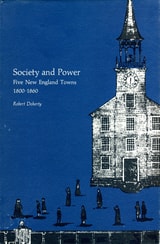
Society and Power
Five New England Towns, 1800-1860Doherty, Robert
University of Massachusetts Press, 1977
Robert Doherty's groundbreaking study examines the transformation of social structure and power dynamics across five representative New England towns during the formative decades of the nineteenth century. Through careful analysis of occupational mobility, community leadership patterns, and social stratification, Doherty traces how these previously cohesive rural communities experienced profound changes between the American Revolution and the Civil War era.
The work challenges conventional assumptions about early American society, revealing how power became increasingly concentrated despite the era's democratic rhetoric. By studying wealth distribution, occupational hierarchies, and patterns of geographic mobility, Doherty demonstrates how social relationships fundamentally shifted as communities transitioned from agriculture-based economies toward industrialization. His research methodology combines demographic analysis with social history to illuminate the lived experiences of ordinary townspeople alongside elites.
This compact but authoritative volume contributes significantly to our understanding of how New England communities adapted to modernization while grappling with questions of class, opportunity, and social order. Doherty's insights remain relevant for historians studying community formation, social stratification, and regional development in early America.