Results by title
4 books match the query '1800 - 1900'

Bankruptcy and Debt Collection in Liberal Capitalism
Switzerland, 1800–1900Mischa Suter
University of Michigan Press, 2021
Drawing on perspectives from anthropology and social theory, this book explores the quotidian routines of debt collection in nineteenth-century capitalism. It focuses on Switzerland, an exemplary case of liberal rule. Debt collection and bankruptcy relied on received practices until they were standardized in a Swiss federal law in 1889. The vast array of these practices was summarized by the idiomatic Swiss legal term “Rechtstrieb” (literally, “law drive”). Analyzing these forms of summary justice opens a window to the makeshift economies and the contested political imaginaries of nineteenth-century everyday life. Ultimately, the book advances an empirically grounded and theoretically informed history of quotidian legal practices in the everyday economy; it is an argument for studying capitalism from the bottom up.

Biology Takes Form
Animal Morphology and the German Universities, 1800-1900Lynn K. Nyhart
University of Chicago Press, 1995
Although there were neither professors of morphology nor a morphologists' society, morphologists achieved influence by "colonizing" niches in a variety of disciplines. Scientists in anatomy, zoology, natural history, and physiology considered their work morphological, and the term encompassed research that today might be classified as embryology, systematics, functional morphology, comparative physiology, ecology, behavior, evolutionary theory, or histology. Nyhart draws on research notes, correspondence, and other archival material to examine how these scientists responded to new ideas and to the work of colleagues. She examines the intertwined histories of morphology and the broader biological enterprise, demonstrating that the study of form was central to investigations of such issues as the relationships between an animal's structure and function, between an organism and its environment, and between living species and their ancestors.
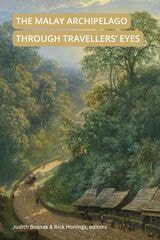
The Malay Archipelago Through Travellers' Eyes
1800–1900Edited by Judith E. Bosnak and Rick Honings
National University of Singapore Press, 2026
A history of colonial encounters in maritime Southeast Asia, through the lens of an underexplored group of nineteenth-century travelogues.
What did nineteenth-century travellers actually see when they journeyed through the Malay Archipelago—and what did they miss? The travelogues penned by British and Dutch explorers reached a wide readership; they have shaped how we imagine this region with their accounts of island kingdoms, volcanic landscapes, and maritime crossroads. Other voices—Javanese nobles venturing beyond their courts, Eurasian tourists navigating between worlds, French administrators, Scandinavian adventurers, Italian naturalists—remained in the shadows.
The Malay Archipelago through Travellers’ Eyes recovers these overlooked perspectives alongside fresh readings of celebrated figures like James Brooke, the “White Rajah” of Sarawak, and the intrepid Isabella Bird. Here we encounter Purwalelana, whose groundbreaking Javanese travelogue in modern prose abandoned centuries of poetic tradition; Kartini, whose letters became a means of traversing boundaries she could not physically cross; and Dé-Lilah, whose Eurasian heritage gave her writing an unsettling double vision. The naturalist Junghuhn scaling Java’s volcanoes, Raffles burnishing British reputation against Dutch rivals, Italian explorers charting New Guinea's coasts—each constructed not only the lands they described but also themselves.
Travel writing has often claimed to offer transparent windows onto foreign worlds. This collection reveals it as something far more interesting: a literature of encounter where imperial ambition, personal identity, and genuine curiosity intertwine. For anyone captivated by the arts of travel and observation, these essays open new ways of reading a genre we thought we knew.
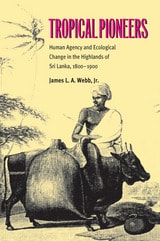
Tropical Pioneers
Human Agency and Ecological Change in the Highlands of Sri Lanka, 1800–1900James L. A. Webb Jr.
Ohio University Press, 2002
In 1800, the highlands of Sri Lanka had some of the most biologically diverse primary tropical rainforest ecosystems in the world. By 1900, only a few craggy corners and mountain caps had been spared the fire stick. Highland villagers, through the extension of slash-and-burn agriculture, and British managers, through the creation of plantations—first of coffee, then cinchona, and finally tea—had removed virtually the entire primary forest cover.
Tropical Pioneers documents the conversion of a tropical rainforest biome and the collision between what previously had been more discrete ecological zones within South Asia. The ecological impacts were transformational. Author James L. A. Webb, Jr., demonstrates that profound ecological disruption occurred in the central highlands of Sri Lanka during the nineteenth century and suggests that the theme of ecological crisis brought about by the integration of tropical ecological zones during precolonial and colonial periods alike is an important one for historians to investigate elsewhere.
Tropical Pioneers is based on extensive research in the National Archives of Sri Lanka, the National Agricultural Library at Gannaruwa, the Library of the Royal Asiatic Society-Ceylon Branch, the Royal Botanic Gardens at Kew, the Public Record Office of the United Kingdom, and the British Library.