Results by title
10 books match the query '1810-'

A Land Between Waters
Environmental Histories of Modern MexicoEdited by Christopher R. Boyer
University of Arizona Press, 2012
A Land Between Waters explores the relationship between the people and the environment in Mexico. It heralds the arrival of environmental history as a major area of study within the field of Mexican history. This volume brings together a dozen original works of environmental history by some of the foremost experts in Mexican environmental history from both the United States and Mexico.
The contributions collected in this seminal volume explore a wide array of topics, from the era of independence to the present day. Together they examine how humans have used, abused, and attended to nature in Mexico over more than two hundred years. Written in clear, accessible prose, A Land Between Waters showcases the breadth of Mexican environmental history in a way that defines the key topics in the field and suggests avenues for subsequent work. Most importantly, it assesses the impacts of environmental changes that Mexico has faced in the past with an eye to informing national debates about the challenges that the nation will face in the future.
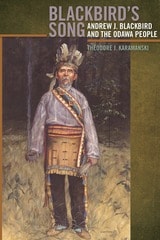
Blackbird's Song
Andrew J. Blackbird and the Odawa PeopleTheodore J. Karamanski
Michigan State University Press, 2012
For much of U.S. history, the story of native people has been written by historians and anthropologists relying on the often biased accounts of European-American observers. Though we have become well acquainted with war chiefs like Pontiac and Crazy Horse, it has been at the expense of better knowing civic-minded intellectuals like Andrew J. Blackbird, who sought in 1887 to give a voice to his people through his landmark book History of the Ottawa and Chippewa People. Blackbird chronicled the numerous ways in which these Great Lakes people fought to retain their land and culture, first with military resistance and later by claiming the tools of citizenship. This stirring account reflects on the lived experience of the Odawa people and the work of one of their greatest advocates.

Couture and Consensus
Fashion and Politics in Postcolonial ArgentinaRegina A. Root
University of Minnesota Press, 2010
Facundo and the Construction of Argentine Culture
By Diana Sorensen Goodrich
University of Texas Press, 1996
Domingo F. Sarmiento's classic 1845 essay Facundo, Civilizacion y Barbarie opened an inquiry into the nature of Argentinian culture that continues to the present day. In this elegantly written study, Diana Sorensen Goodrich explores the varied, and often conflicting, readings that Facundo has received since its publication and shows how these readings have contributed to the making and remaking of the Argentine nation and its culture.
Goodrich's analysis sheds new light on the intersection between canon formation and nation-building. While much has been written about Facundo as a primary text in Latin American letters, this is the first study that locates it within the problematics of canon formation and the cultural, social, and political contexts in which conflicting interpretations are constructed.
This new approach to Facundo illuminates the interactions among institutions, cultural ideologies, and political life. This book will be important reading for everyone interested in questions of national identity and the institutionalization of a national tradition.
From Tribute to Communal Sovereignty
The Tarascan and Caxcan Territories in TransitionEdited by Andrew Roth-Seneff, Robert V. Kemper, and Julie Adkins
University of Arizona Press, 2015
The continuities elucidated concern ancestral territorial claims that date back centuries and reflect the stable geographic locations occupied by core populations of indigenous language–speakers in or near their pre-Columbian territories since the Postclassical period, from the thirteenth to late fifteenth centuries. A common theme of this volume is the strong cohesive forces present, not only in the colonial construction of Christian village communities in Purhépecha and Nahuatl groups in Michoacán but also in the demographically less inclusive Huichol (Wixarika), Cora, and Tepehuan groups, whose territories were more extensive.
The authors review a cluster of related themes: settlement patterns of the last five centuries in central western Mexico, language distribution, ritual representation of territoriality, processes of collective identity, and the forms of participation and resistance during different phases of Mexican state formation. From such research, the question arises: does the village community constitute a unique level of organization of the experience of the original peoples of central western Mexico? The chapters address this question in rich and complex ways by first focusing on the past configurations and changes in lifeways during the transition from pre-Columbian to Spanish rule in tributary empires, then examining the long-term postcolonial process of Mexican independence that introduced the emerging theme of the communal sovereignty.
Kinship, Business, and Politics
The Martinez Del Rio Family in Mexico, 1823-1867By David W. Walker
University of Texas Press, 1987
The Martínez del Río family was a vigorous contestant in the highly politicized economy of early national Mexico. David Walker’s case study of its successes and failures provides a unique insider’s view of the trials and tribulations of doing business in a hostile environment. The family’s ordeal in Mexico—a series of personal dislocations and traumas—mirrored the painful contractions of an old society reluctantly giving birth to a new nation.
Using previously undiscovered primary source materials (including the private correspondence and business records of the family, public notary documents, transcripts of judicial proceedings, and the archives of Mexico’s Ministry of Foreign Relations and the British Foreign Office), Walker employs family history to analyze problems relating more generally to the development of state and society in newly independent Mexico.
The processes of socioeconomic formation in Mexico differed from those of Western Europe and the United States; accordingly, entrepreneurial activity had markedly contrasting implications for economic development and class formation. In the downwardly spiraling economy of nineteenth-century Mexico, economic activity was a zero-sum game. No new wealth was being created; most sectors remained stagnant and unproductive. To make their fortunes, empresarios, the Mexican capitalists, could not rely on income generated from authentic economic growth. Instead, they exploited the arbitrary acts of the interventionist Mexican state, which proscribed the free movement of factors within the marketplace. Speculation in the public debt took the place of more substantive undertakings. Coercive state power was diverted to create artificial environments in which otherwise inefficient and unproductive enterprises could flourish. But however well the empresarios might imitate the outward forms of industrial capitalism, they could not unlock the productive capacity of the Mexican economy. Instead, they and their allies and rivals engaged in destructive struggles to manipulate the state for personal gain, to the detriment of class interests, economic growth, and political stability.
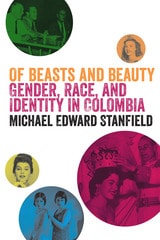
Of Beasts and Beauty
Gender, Race, and Identity in ColombiaBy Michael Edward Stanfield
University of Texas Press, 2013
All societies around the world and through time value beauty highly. Tracing the evolutions of the Colombian standards of beauty since 1845, Michael Edward Stanfield explores their significance to and symbiotic relationship with violence and inequality in the country. Arguing that beauty holds not only social power but also economic and political power, he positions it as a pacific and inclusive influence in a country “ripped apart by violence, private armies, seizures of land, and abuse of governmental authority, one hoping that female beauty could save it from the ravages of the male beast.” One specific means of obscuring those harsh realities is the beauty pageant, of which Colombia has over 300 per year. Stanfield investigates the ways in which these pageants reveal the effects of European modernity and notions of ethnicity on Colombian women, and how beauty for Colombians has become an external representation of order and morality that can counter the pathological effects of violence, inequality, and exclusion in their country.
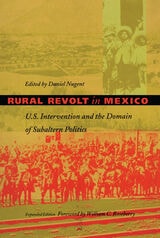
Rural Revolt in Mexico
U.S. Intervention and the Domain of Subaltern PoliticsDaniel Nugent, ed.
Duke University Press, 1998
Through their studies of social movements and popular mobilization in the Mexican countryside, the contributors argue for understanding rural revolts in terms of the specific historical contexts of particular regions and peoples, as well as the broader context of unequal cultural, political, and economic relations between Mexico and the United States. Exploring the connections between external and internal factors in social movements, these essays reveal the wide range of organized efforts through which peasants and Indians have struggled to shape their own destiny while confronted by the influence of U.S. capital and military might. Originally published as a limited edition in 1988 by the Center for U. S.–Mexican Studies, this volume presents a pioneering effort by Latin Americanist scholars to sympathetically embrace and enrich work begun in Subaltern Studies between 1982 and 1987 by projecting it onto a different region of historical experience. This revised and expanded edition includes a new introduction by Daniel Nugent and an extensive essay by Adolfo Gilly on the recent Chiapas uprising.
State Formation in the Liberal Era
Capitalisms and Claims of Citizenship in Mexico and PeruEdited by Ben Fallaw and David Nugent
University of Arizona Press, 2020
Mexico and Peru are widely regarded as two great centers of Latin American civilization. In State Formation in the Liberal Era, a diverse group of historians and anthropologists from the United States, the United Kingdom, and Latin America compare how the two countries advanced claims of statehood from the dawning of the age of global liberal capitalism to the onset of the Cold War. Chapters cover themes ranging from foreign banks to road building and labor relations. The introductions serve as an original interpretation of Peru’s and Mexico’s modern histories from a comparative perspective.
Focusing on the tensions between disparate circuits of capital, claims of statehood, and the contested nature of citizenship, the volume spans disciplinary and geographic boundaries. It reveals how the presence (or absence) of U.S. influence shaped Latin American history and also challenges notions of Mexico’s revolutionary exceptionality. The book offers a new template for ethnographically informed comparative history of nation building in Latin America.

The European Revolutions of 1848 and the Americas
Edited by Guy Thomson
University of London Press, 2002