Results by title
4 books match the query '1810-1891'
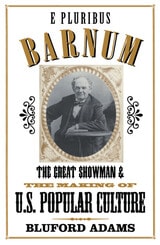
E Pluribus Barnum
The Great Showman and the Making of U.S. Popular CultureBluford Adams
University of Minnesota Press, 1997
The first book to consider the career of P. T. Barnum from a cultural studies perspective.
Phineas Taylor Barnum lived from 1810 until 1891, and in the eighty-one years of his life he created show business as we know it. In E Pluribus Barnum, Bluford Adams investigates the influence Barnum had on American popular culture of the nineteenth century, and expands our understanding of the ways he continues to influence us today.
Beginning with a discussion of Barnum’s early shows, Adams demonstrates the dynamic interplay between Barnum’s increasingly “respectable” aspirations for his entertainments and his active cultivation of middle-class sensibilities in his audiences. In his discussion of the 1850-51 concert tour of the “Swedish Nightingale” Jenny Lind, Adams explores the role played by women’s rights and class issues in Barnum’s management of these concerts. Barnum’s American Museum and the “moral dramas” presented in its theater (which included a play of Uncle Tom’s Cabin) are examined in the context of debates about slavery and temperance. The later circuses are discussed in terms of their international pageants and their staging of orientalism through racial exhibitions. Adams relates the rise of Barnum to the emergence of a new U.S. society, one riven by conflicts over slavery, feminism, immigration, and capitalism. He documents Barnum’s efforts to negotiate those conflicts by steadily remaking his amusements and his public image. E Pluribus Barnum examines Barnum’s shifting political allegiances for what they tell us about American culture at the time, examines the audiences he created, and considers his career as a crucial moment in the ongoing struggle over the politics of U.S. commercial entertainments.[more]
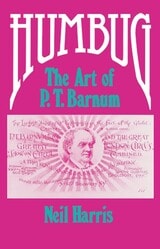
Humbug
The Art of P. T. BarnumNeil Harris
University of Chicago Press, 1981
This carefully researched study of America's greatest showman, huckster, and impresario is both an inclusive analysis of the historical and cultural forces that were the conditions of P. T. Barnum's success, and, as befits its subject, a richly entertaining presentation of the outrageous man and his exploits.
[more]
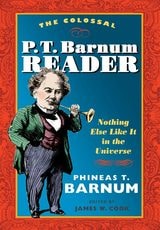
The Colossal P. T. Barnum Reader
Nothing Else Like It in the UniversePhineas T. Barnum. Edited by James W. Cook
University of Illinois Press, 2005
The P. T. Barnum Reader reveals the trailblazing American showman P. T. Barnum as, by turns, a moral reformer, a habitual hoaxer, an insightful critic, a savvy "puffer," a master of images, a sparkling writer, a relentless provocateur, and an early advocate of "family" entertainments. Taken together, these selections paint a new and more complete portrait of this complex man than has ever been seen before.
James W. Cook's The Colossal P. T. Barnum Reader is the largest collection of Barnum's works ever produced. Included are excerpts from his pseudo-autobiographical novel The Adventures of an Adventurer (1841), his European letters from 1844-46 informing readers of the New York Atlas of his regal reception overseas, and a large selection from his Ancient and Modern Humbugs of the World, Barnum's 1864-65 insider's look into the frauds of nineteenth-century American culture. It offers a glimpse of Tom Thumb's minstrel and singing performances in front of Queen Victoria, Barnum's many fraudulent representations of the supposedly ancient Joice Heth, and a more immediate, less filtered sense of Barnum as cultural and social critic in his serialized writings and travelogues. This volume also features reproductions of difficult to find posters from Barnum's two-decade collaboration with the prominent New York lithographers, Currier and Ives, and vintage photographs.
Finally, the reader also helps us to understand Barnum's role in building the modern culture industry. We follow his career from itinerant hawker, hardly distinguishable from his pre-industrial forebears, to manager of the world's first show business empire, with a staff of thousands and brand recognition across four continents. The Colossal P. T. Barnum Reader tracks the shifting personas of the great showman, his representational choices, and his publics across the nineteenth century.
[more]
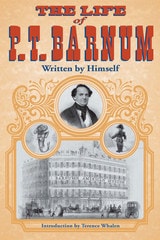
The Life of P. T. Barnum, Written by Himself
Phineas T. BarnumIntroduction by Terence Whalen
University of Illinois Press, 2000
For more than fifty years, Phineas T. Barnum embodied all that was grand and fraudulent in American mass culture. Over the course of a life that spanned the nineteenth century (1810-91), he inflicted himself upon a surprisingly willing public in a variety of guises, from newspaper editor (or libeler) to traveling showman (or charlatan) and distinguished public benefactor (or shameless hypocrite).
Barnum deliberately cultivated his ambiguous public image through a lifelong advertising campaign, shrewdly exploiting the cultural and technological capabilities of the new publishing industry. While running his numerous shows and exhibitions, Barnum managed to publish newspaper articles, exposés of fraud (not his own), self-help tracts, and a series of best-selling autobiographies, each promising to give "the true history of my many adventures."
Updated editions of The Life of P. T. Barnum appeared regularly, allowing Barnum to keep up with demand and prune the narrative of details that might offend posterity. The present volume is the first modern edition of Barnum's original and outrageous autobiography, published in 1855 and unavailable for more than a century. Brazen, confessional, and immensely entertaining, it immortalizes the showman who hoodwinked customers into paying to hear the reminiscences of a woman presented as George Washington's 161-year-old nurse, the impresario who brought Jenny Lind to America and toured Europe with General Tom Thumb, and the grand entrepreneur of the American Museum of New York. Above all, it ensures that Barnum would be properly remembered . . . exactly as he created himself.
[more]