Results by title
6 books match the query '1810-1899'
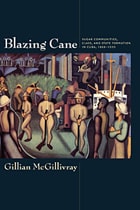
Blazing Cane
Sugar Communities, Class, and State Formation in Cuba, 1868–1959Gillian McGillivray
Duke University Press, 2009
Focusing on sugar communities in eastern and central Cuba, McGillivray recounts how farmers and workers pushed the Cuban government to move from exclusive to inclusive politics and back again. The revolutionary caudillo networks that formed between 1895 and 1898, the farmer alliances that coalesced in the 1920s, and the working-class groups of the 1930s affected both day-to-day local politics and larger state-building efforts. Not limiting her analysis to the island, McGillivray shows that twentieth-century Cuban history reflected broader trends in the Western Hemisphere, from modernity to popular nationalism to Cold War repression.
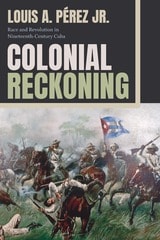
Colonial Reckoning
Race and Revolution in Nineteenth-Century CubaLouis A. Pérez Jr.
Duke University Press, 2023
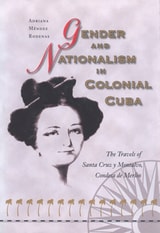
Gender and Nationalism in Colonial Cuba
The Travels of Santa Cruz y Montalvo, Condesa de MerlinAdriana Mendez Rodenas
Vanderbilt University Press, 1998
Born in colonial Havana to an aristocratic Creole family, the future countess of Merlin left Cuba for Spain at an early age. Later, her marriage to the French count Antoine Christophe Merlin and the invasion of French Napoleonic troops precipitated another move to France, where she became one of the belle dames of Paris and began her literary career. She returned only once to Cuba after the death of her husband in 1840, a journey that produced Viaje a la Habana. Upon her return to Paris, Merlin expanded this into La Havane, an ambitious three-volume account of the political, social, and economic organization of the island.
From the viewpoint of feminist and psychoanalytical theory, Gender and Nationalism in Colonial Cuba brilliantly explores the many ways in which issues of gender have contributed to Merlin's virtual absence from the canons of literature and from the discourses on Cuban national identity. Merlin's double identity as both Cuban and French is symbolic of the Cuban exiled condition, a fact taken up by contemporary exiled Cuban writers who see the countess as an alter-ego.
Mendez Rodenas seeks to restore Merlin as the first woman writer in Cuban literary history to articulate a sense of national identity, as well as being Cuba's first female historian. She focuses on Merlin's travel writings because they examine such issues as slavery, independence, nationhood, the role of women, education, and local literature. Together her writings construct an alternative, gendered history of nineteenth-century Cuba that must be acknowledged as both functional and authentic.
By situating Merlin at the intersection of the discourses of gender and nationalism, Mendez Rodenas reveals not only her pioneering role but also the need to expand current critical categories to account for the specificity of the Latin American literary tradition. In the process of restoring Merlin to her appropriate place in the canon of Latin American literature, she broadens our understanding of colonial Cuban history and expands our knowledge of the ways in which travel writing can influence a country's national literature .
Gothic Geoculture
Nineteenth-Century Representations of Cuba in the Transamerican ImaginaryIvonne M. García
The Ohio State University Press, 2019

Slave Society in Cuba during the Nineteenth Century
Franklin W. Knight
University of Wisconsin Press, 1970
Knight examines the conditions that maintained slavery in Cuba in the nineteenth century and perceptively analyzes the sociological effect of the institution on the island's politics, culture, and economy. He attacks the long-held theory that an Iberian cultural heritage and the Roman Catholic Church significantly modified the institution of slavery and shows that Cuban slave society shared many characteristics with other Caribbean societies, whether Anglo-Saxon, French, or Spanish. Knight's systematic study includes important new material from the archives of the Ministerio del Ultramar in Madrid.
With All, and for the Good of All
The Emergence of Popular Nationalism in the Cuban Communities of the United States, 1848–1898Gerald E. Poyo
Duke University Press, 1989
Poyo differentiates between the development of nationalist sentiment among liberal elites and popular groups and reveals how these distinct strains influenced the thought and conduct of Martí and the successful Cuban revolution of the 1890s.