Results by title
21 books match the query '1815-1861'
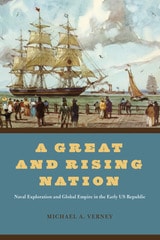
A Great and Rising Nation
Naval Exploration and Global Empire in the Early US RepublicMichael A. Verney
University of Chicago Press, 2022
Conventional wisdom holds that, until the Spanish-American War of 1898, the United States was a feeble player on the world stage, with an international presence rooted in commerce rather than military might. Michael A. Verney’s A Great and Rising Nation flips this notion on its head, arguing that early US naval expeditions, often characterized as merely scientific, were in fact deeply imperialist. Circling the globe from the Mediterranean to South America and the Arctic, these voyages reflected the diverse imperial aspirations of the new republic, including commercial dominance in the Pacific World, religious empire in the Holy Land, proslavery expansion in South America, and diplomatic prestige in Europe. As Verney makes clear, the United States had global imperial aspirations far earlier than is commonly thought.
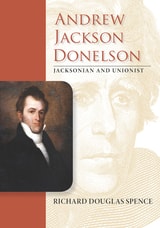
Andrew Jackson Donelson
Jacksonian and UnionistRichard Douglas Spence
Vanderbilt University Press, 2017
As his uncle's secretary, he weathered Old Hickory's tumultuous presidency, including the notorious "Petticoat War." Building his own political career, he served as US chargé d'affaires to the Republic of Texas, where he struggled against an enigmatic President Sam Houston, British and French intrigues, and the threat of war by Mexico, to achieve annexation. As minister to Prussia, Donelson enjoyed a ringside seat to the revolutions of 1848 and the first attempts at German unification. A firm Unionist in the mold of his uncle, Donelson denounced the secessionists at the Nashville Convention of 1850. He attempted as editor of the Washington Union to reunite the Democratic party, and, when he failed, he was nominated as Millard Fillmore's vice-presidential running mate on the Know-Nothing party ticket in 1856. He lived to see the Civil War wreck the Union he loved, devastate his farms, and take the lives of two of his sons.
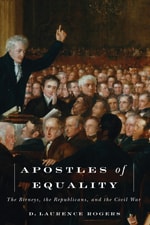
Apostles of Equality
The Birneys, the Republicans, and the Civil WarD. Laurence Rogers
Michigan State University Press, 2011
The first biographical account of the life of James Gillespie Birney in more than fifty years, this fabulously insightful history illuminates and elevates an all-but-forgotten figure whose political career contributed mightily to the American political fabric. Birney was a southern-born politician at the heart of the antislavery movement, with two southern-born sons who were major generals involved in key Union Army activities, including the leadership of the black troops. The interaction of the Birneys with historical figures (Abraham Lincoln, Harriet Beecher Stowe, and Henry Clay) highlights the significance of the family’s activities in politics and war. D. Laurence Rogers offers a unique historiography of the abolition movement, the Civil War, and Reconstruction through the experiences of one family navigating momentous developments from the founding of the Republic until the late 19th century.
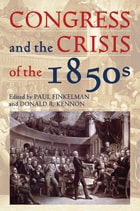
Congress and the Crisis of the 1850s
Paul Finkelman
Ohio University Press, 2011
During the long decade from 1848 to 1861 America was like a train speeding down the track, without an engineer or brakes. The new territories acquired from Mexico had vastly increased the size of the nation, but debate over their status—and more importantly the status of slavery within them—paralyzed the nation. Southerners gained access to the territories and a draconian fugitive slave law in the Compromise of 1850, but this only exacerbated sectional tensions. Virtually all northerners, even those who supported the law because they believed that it would preserve the union, despised being turned into slave catchers. In 1854, in the Kansas-Nebraska Act, Congress repealed the ban on slavery in the remaining unorganized territories. In 1857, in the Dred Scott case, the Supreme Court held that all bans on slavery in the territories were unconstitutional. Meanwhile, northern whites, free blacks, and fugitive slaves resisted the enforcement of the 1850 fugitive slave law. In Congress members carried weapons and Representative Preston Brooks assaulted Senator Charles Sumner with a cane, nearly killing him. This was the decade of the 1850s and these were the issues Congress grappled with.
This volume of new essays examines many of these issues, helping us better understand the failure of political leadership in the decade that led to the Civil War.
Contributors
Spencer R. Crew
Paul Finkelman
Matthew Glassman
Amy S. Greenberg
Martin J. Hershock
Michael F. Holt
Brooks D. Simpson
Jenny Wahl
Congress and the Emergence of Sectionalism
From the Missouri Compromise to the Age of JacksonPaul Finkelman
Ohio University Press, 2008
Dividing the Union
Jesse Burgess Thomas and the Making of the Missouri CompromiseMatthew W. Hall
Southern Illinois University Press, 2015
In 1820 the Missouri controversy erupted over the issue of slavery in the newly acquired lands of the Louisiana Purchase. It fell to Jesse Burgess Thomas (1777–1853), a junior U.S. senator from the new state of Illinois, to handle the delicate negotiations that led to the Missouri Compromise. Thomas’s maturity, good judgment, and restraint helped pull the country back from the brink of disunion and created a compromise that held for thirty-four years. In Dividing the Union, Matthew W. Hall examines the legal issues underlying the controversy and the legislative history of the Missouri Compromise while focusing on the aspects of Thomas’s life and character that gave him such influence. The first in-depth biography of Thomas, Hall’s work demonstrates how the legislative battle over the Compromise reflected the underlying nuances of the larger struggle over slavery.
The text of the Missouri Compromise originated from the Northwest Ordinance. Article VI of the Ordinance purported to prohibit slavery in the Northwest Territory, but paradoxically, a provision that assured property rights in another article was used to protect slavery. People in some parts of the Northwest sought to circumvent Article VI by formulating indenture laws and various state constitutional provisions addressing slavery. Pro- and antislavery activists eventually developed quite different interpretations of the relevant language in these documents, making negotiations over slavery in the new territory extremely complicated.
As Hall demonstrates, Thomas was perfectly situated geographically, politically, and ideologically to navigate the Missouri controversy. He was the first speaker of the Indiana Territorial General Assembly, one of the first territorial judges in the Illinois Territory, and the president of the Illinois State Constitutional Convention in 1818. Because the drive for statehood in Illinois was strong, the convention managed to skirt the divisive issue of slavery, due in large part to Thomas’s efforts. That he was never required to clearly articulate his own views on slavery allowed Thomas to maintain a degree of neutrality, and his varied political career gave him the experience necessary to craft a compromise.
Thomas’s final version of the Compromise included shrewdly worded ambiguities that supported opposing interests in the matter of slavery. These ambiguities secured the passage of the Compromise and its endurance until the Kansas-Nebraska Act of 1854. By weaving Thomas’s life story into the history of the Missouri Compromise, Hall offers new insight into both a pivotal piece of legislation and an important, previously overlooked figure in nineteenth-century American politics.
Establishing Congress
The Removal to Washington, D.C., and the Election of 1800Kenneth R. Bowling
Ohio University Press, 2005
Establishing Congress: The Removal to Washington, D.C., and the Election of 1800 focuses on the end of the 1790s, when, in rapid succession, George Washington died, the federal government moved to Washington, D.C., and the election of 1800 put Thomas Jefferson and the Democratic-Republican Party in charge of the federal government.
Establishing Congress dispels the myths and misinformation that surround the federal government’s move to Washington and demonstrates that the election of 1800 changed American party politics forever, establishing the success of the American experiment in government and completing the founding of the Republic. It also contends that the lame-duck session of Congress had far-reaching implications for the governance of the District of Columbia. Later chapters examine aspects of the political iconography of the Capitol—one illuminating Jefferson’s role in turning the building into a temple for the legislature and an instrument for nation-building, another analyzing the fascinating decades-long debate over whether to bury George Washington in the Capitol.
The book considers as well the political implications of social life in early Washington, examining the political lobbying by Washington women within a social context and detailing the social and political life in the city’s homes, hotels, boardinghouses, and eating messes. Establishing Congress is an invaluable reference work for anyone interested in these pivotal moments in American history.
Imagining Deliberative Democracy in the Early American Republic
Sandra M. Gustafson
University of Chicago Press, 2011
Deliberation, in recent years, has emerged as a form of civic engagement worth reclaiming. In this persuasive book, Sandra M. Gustafson combines historical literary analysis and political theory in order to demonstrate that current democratic practices of deliberation are rooted in the civic rhetoric that flourished in the early American republic.
Though the U.S. Constitution made deliberation central to republican self-governance, the ethical emphasis on group deliberation often conflicted with the rhetorical focus on persuasive speech. From Alexis de Tocqueville’s ideas about the deliberative basis of American democracy through the works of Walt Whitman, John Dewey, John F. Kennedy, and Martin Luther King Jr., Gustafson shows how writers and speakers have made the aesthetic and political possibilities of deliberation central to their autobiographies, manifestos, novels, and orations. Examining seven key writers from the early American republic—including James Fenimore Cooper, David Crockett, and Daniel Webster—whose works of deliberative imagination explored the intersections of style and democratic substance, Gustafson offers a mode of historical and textual analysis that displays the wide range of resources imaginative language can contribute to political life.

Jacksonian America
Society, 0ality, and PoliticsEdward Pessen
University of Illinois Press, 1985
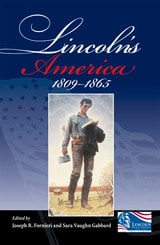
Lincoln's America
1809 - 1865Edited by Joseph R. Fornieri and Sara Vaughn Gabbard
Southern Illinois University Press, 2008
To fully understand and appreciate Abraham Lincoln’s legacy, it is important to examine the society that influenced the life, character, and leadership of the man who would become the Great Emancipator. Editors Joseph R. Fornieri and Sara Vaughn Gabbard have done just that in Lincoln’s America: 1809–1865, a collection of original essays by ten eminent historians that place Lincoln within his nineteenth-century cultural context.
Among the topics explored in Lincoln’s America are religion, education, middle-class family life, the antislavery movement, politics, and law. Of particular interest are the transition of American intellectual and philosophical thought from the Enlightenment to Romanticism and the influence of this evolution on Lincoln's own ideas.
By examining aspects of Lincoln’s life—his personal piety in comparison with the beliefs of his contemporaries, his success in self-schooling when frontier youths had limited opportunities for a formal education, his marriage and home life in Springfield, and his legal career—in light of broader cultural contexts such as the development of democracy, the growth of visual arts, the question of slaves as property, and French visitor Alexis de Tocqueville’s observations on America, the contributors delve into the mythical Lincoln of folklore and discover a developing political mind and a changing nation.
As Lincoln’s America shows, the sociopolitical culture of nineteenth-century America was instrumental in shaping Lincoln’s character and leadership. The essays in this volume paint a vivid picture of a young nation and its sixteenth president, arguably its greatest leader.

Long Road to Harpers Ferry
The Rise of the First American LeftMark A. Lause
Pluto Press, 2018
Offering new and fascinating insights into the cast of characters who created a homegrown socialist movement in America—from Thomas Paine’s revolution to Robert Owen’s utopianism, and from Thomas Skidmore’s agrarianism to George Henry Evans’s industrial workers’ reforms—Long Road to Harpers Ferry captures the spirit of the times. Showing how class solidarity and consciousness became more important to a generation of workers than notions of American citizenship, the book offers a fascinating historical background to help us understand the rise of radicalism in the United States today.
The Constitution in Congress
Democrats and Whigs, 1829-1861David P. Currie
University of Chicago Press, 2005
Like its predecessors, The Constitution in Congress: Democrats and Whigs will be an invaluable reference for legal scholars and constitutional historians alike.
The Constitution in Congress
Descent into the Maelstrom, 1829-1861David P. Currie
University of Chicago Press, 2005
This acclaimed series serves as a biography of the U.S. Constitution, offering an indispensable survey of the congressional history behind its development. In a rare examination of the role that both the legislative and executive branches have played in the development of constitutional interpretation, The Constitution in Congress shows how the actions and proceedings of these branches reveal perhaps even more about constitutional disputes than Supreme Court decisions of the time.
The centerpiece for the fourth volume in this series is the great debate over slavery and how this divisive issue led the country into the maelstrom of the Civil War. From the Jacksonian revolution of 1829 to the secession of Southern states from the Union, legal scholar David P. Currie provides an unrivaled analysis of the significant constitutional events—the Wilmot Proviso, the Compromise of 1850, the Kansas-Nebraska Act, the Lincoln-Douglas Debates, and "Bleeding Kansas"—that led up to the war. Exploring how slavery was addressed in presidential speeches and debated in Congress, Currie shows how the Southern Democrats dangerously diminished federal authority and expanded states' rights, threatening the nation's very survival.
Like its predecessors, this fourth volume of The Constitution in Congress will be an invaluable reference for legal scholars and constitutional historians alike.
The Invincible Duff Green
Whig of the WestW. Stephen Belko
University of Missouri Press, 2006
The Political Style of Conspiracy
Chase, Sumner, and LincolnMichael William Pfau
Michigan State University Press, 2005
The turbulent history of the United States has provided a fertile ground for conspiracies, both real and imagined. From the American Revolution to the present day, conspiracy discourse—linguistic and symbolic practices and artifacts revolving around themes, claims, or accusations of conspiracy—has been a staple of political rhetoric. Some conspiracy theories never catch on with the public, while others achieve widespread popularity. Whether successful or not, the means by which particular conspiracy theories spread is a rhetorical process, a process in which persuasive language, symbolism, and arguments act upon individual minds within concrete historical and political settings.
Conspiracy rhetoric was a driving force in the evolution of antebellum political culture, contributing to the rise and fall of the great parties in the nineteenth century. One conspiracy theory in particular—the "slave power" conspiracy—was instrumental in facilitating the growth of the young Republican Party's membership and ideology. The Political Style of Conspiracy analyzes the concept and reality of the "slave power" in the rhetorical discourse of the mid-nineteenth-century, in particular the speeches and writing of politicians Salmon P. Chase, Charles Sumner, and Abraham Lincoln. By examining their mainstream texts, Pfau reveals that, in addition to the "paranoid style" of conspiracy rhetoric that inhabits the margins of political life, Lincoln, Chase, and Sumner also engaged in a distinctive form of conspiracy rhetoric that is often found at the center of mainstream American society and politics.
The Republic Afloat
Law, Honor, and Citizenship in Maritime AmericaMatthew Taylor Raffety
University of Chicago Press, 2013
The Union on Trial
The Political Journals of Judge William Barclay Napton, 1829-1883Edited by Christopher Phillips & Jason L. Pendleton. Introduction by Christopher Phillips
University of Missouri Press, 2005
To the Wide Missouri
Traveling in America During the First Decades of Westward ExpansionLouis A. Garavaglia
Westholme Publishing, 2011
The Fascinating History of the Rapid Expansion of Roads, Canals, and Railways in the First Decades of the United States
While the great overland migration routes to America’s far west are well known and documented—the California, Oregon, Mormon, and Santa Fe Trails, the Central Overland and Pony Express—less attention has been given to how Americans in the first decades of the republic traveled across the western frontiers of the original colonies. Following the revolution, Americans began to seek their fortunes to the west in greater numbers. Land grants to veterans inspired others to move, including tradesmen, merchants, and tavern owners. With the Louisiana Purchase in 1803, the country doubled in size, and the rate of migration became extraordinary, with wider and more durable roads built, ferries installed at river crossings, canals cut to move goods, regular stage routes established, and ultimately the first railroad tracks laid down. Entire regions that supported few communities in the 1790s exploded in population, and as a result seven new states were admitted to the Union in the decade following the War of 1812. John Bradbury, who traveled through the United States between 1809 and 1811, wrote that “In passing through the upper parts of Virginia, I observed a great number of farms that had been abandoned, on many of which good houses had been erected, and fine apple and peach orchards had been planted. On enquiring the reason, I was always informed that the owners had gone to the western country.” In Maryland, a newspaper reporter wrote, “The time is close at hand when the region west of the Allegheny mountains will sway the destinies of the nation.” By 1839, the National Road extended more than 700 miles from Washington, DC, to central Illinois, New York’s Erie Canal operated from Albany to Buffalo, and the Baltimore and Ohio Railroad carried passengers briskly west, ultimately to the Ohio River.
United States-Latin American Relations, 1800-1850
The Formative GenerationsT. Ray Shurbutt
University of Alabama Press, 1991
Relations between the United States and the countries of Latin America have been characterized by misunderstandings based on language and culture, a lack of sustained commitment on the part of the United States, and, in some cases, incompetent diplomats. During the era when many of the Latin American countries discarded the yoke of colonial status, the young United States attempted to define itself culturally, economically, constitutionally, geographically, and diplomatically. As Latin American emerged from the crucible of revolution and international power politics, it was affected by—and in varying degrees affected—the United States and its desired position of leadership in the Western Hemisphere.
To make sense of these relationships, this volume concentrates on Central America, Peru, Colombia, Argentina, Brazil, Chile, and Mexico. Describing the particular paths taken by each of the formation of relations with the United States, Shurbutt and his colleagues focus on the American diplomatic community and its effectiveness in tense political situations.
Contributors in addition to the editor include Lawrence A. Clayton, Paul B. Goodwin, Eugene R. Huck, Phil Brian Johnson, Edward H. Moseley, Wesley P. Newton, Charles S. Stansifer, and Robert Kim Stevens.
Young America
Land, Labor, and the Republican CommunityMark A. Lause
University of Illinois Press, 2005
Rooting the movement in contemporary economic structures and social ideology, Young America examines this urban and working-class "agrarianism," demonstrating how the political preoccupations of this movement transformed socialism by drawing its adherents from communitarian preoccupations into political action. The alliance of the NRA's land reformers and radical abolitionists led unprecedented numbers to petition Congress and established the foundations of what became the new Republican Party, promising "Free Soil, Free Labor, Free Men."
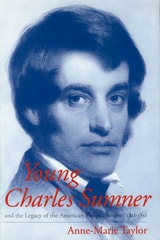
Young Charles Sumner and the Legacy of the American Enlightenment, 1811-1851
Anne-Marie Taylor
University of Massachusetts Press, 2001
In this book, Anne-Marie Taylor challenges that long-standing view, offering in its stead the portrait of a man animated more by principle than by impulse or ambition. According to Taylor, Sumner's reform-minded politics, including his fervent commitment to put an end to slavery, must be understood in the context of a young nation still struggling to live up to the Enlightenment ideals embraced by its founders and embodied in its Constitution.
Focusing on the first forty years of Sumner's life, before he took public office, Taylor traces the evolution of his character and thought among Boston's cultural elite. His belief in the virtues of cosmopolitanism, in the dignity of the human intellect and conscience, and in the possibility of a cultivated and just society, all find their roots in an education steeped in Enlightenment principles. At the same time, as a child of New England Puritanism and Revolutionary republicanism, Sumner was raised to believe in the moral obligation of the individual to work for the common good.
As Taylor shows in this richly drawn biography, much of the triumph and tragedy of Sumner's story—the energy of his idealism as well as the poignancy of his eventual disappointment— derives from the overpowering sense of duty and national destiny imbued by his upbringing.