Results by title
2 books match the query '1829-1919'
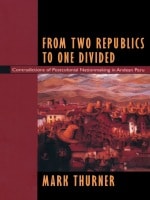
From Two Republics to One Divided
Contradictions of Postcolonial Nationmaking in Andean PeruMark Thurner
Duke University Press, 2001
From Two Republics to One Divided examines Peru’s troubled transition from colonial viceroyalty to postcolonial republic from the local perspective of Andean peasant politics. Thurner’s reading of the Andean peasantry’s engagement and disengagement with the postcolonial state challenges long-standing interpretations of Peruvian and modern Latin American history and casts a critical eye toward Creole and Eurocentric ideas about citizenship and nationalism.
Working within an innovative and panoramic historical and linguistic framework, Thurner examines the paradoxes of a resurgent Andean peasant republicanism during the mid-1800s and provides a critical revision of the meaning of republican Peru’s bloodiest peasant insurgency, the Atusparia Uprising of 1885. Displacing ahistorical and nationalist readings of Inka or Andean continuity, and undermining the long-held notion that the colonial legacy is the dominant historical force shaping contemporary Andean reality, Thurner suggests that in Peru, the postcolonial legacy of Latin America’s nation-founding nineteenth century transfigured, and ultimately reinvented, the colonial legacy in its own image.
Working within an innovative and panoramic historical and linguistic framework, Thurner examines the paradoxes of a resurgent Andean peasant republicanism during the mid-1800s and provides a critical revision of the meaning of republican Peru’s bloodiest peasant insurgency, the Atusparia Uprising of 1885. Displacing ahistorical and nationalist readings of Inka or Andean continuity, and undermining the long-held notion that the colonial legacy is the dominant historical force shaping contemporary Andean reality, Thurner suggests that in Peru, the postcolonial legacy of Latin America’s nation-founding nineteenth century transfigured, and ultimately reinvented, the colonial legacy in its own image.
[more]
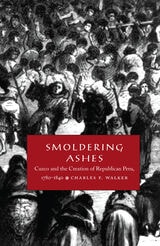
Smoldering Ashes
Cuzco and the Creation of Republican Peru, 1780-1840Charles F. Walker
Duke University Press, 1999
In Smoldering Ashes Charles F. Walker interprets the end of Spanish domination in Peru and that country’s shaky transition to an autonomous republican state. Placing the indigenous population at the center of his analysis, Walker shows how the Indian peasants played a crucial and previously unacknowledged role in the battle against colonialism and in the political clashes of the early republican period. With its focus on Cuzco, the former capital of the Inca Empire, Smoldering Ashes highlights the promises and frustrations of a critical period whose long shadow remains cast on modern Peru.
Peru’s Indian majority and non-Indian elite were both opposed to Spanish rule, and both groups participated in uprisings during the late colonial period. But, at the same time, seething tensions between the two groups were evident, and non-Indians feared a mass uprising. As Walker shows, this internal conflict shaped the many struggles to come, including the Tupac Amaru uprising and other Indian-based rebellions, the long War of Independence, the caudillo civil wars, and the Peru-Bolivian Confederation. Smoldering Ashes not only reinterprets these conflicts but also examines the debates that took place—in the courts, in the press, in taverns, and even during public festivities—over the place of Indians in the republic. In clear and elegant prose, Walker explores why the fate of the indigenous population, despite its participation in decades of anticolonial battles, was little improved by republican rule, as Indians were denied citizenship in the new nation—an unhappy legacy with which Peru still grapples.
Informed by the notion of political culture and grounded in Walker’s archival research and knowledge of Peruvian and Latin American history, Smoldering Ashes will be essential reading for experts in Andean history, as well as scholars and students in the fields of nationalism, peasant and Native American studies, colonialism and postcolonialism, and state formation.
[more]