Results by title
3 books match the query '1830-1962'
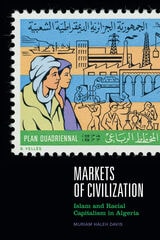
Markets of Civilization
Islam and Racial Capitalism in AlgeriaMuriam Haleh Davis
Duke University Press, 2022
In Markets of Civilization Muriam Haleh Davis provides a history of racial capitalism, showing how Islam became a racial category that shaped economic development in colonial and postcolonial Algeria. French officials in Paris and Algiers introduced what Davis terms “a racial regime of religion” that subjected Algerian Muslims to discriminatory political and economic structures. These experts believed that introducing a market economy would modernize society and discourage anticolonial nationalism. Planners, politicians, and economists implemented reforms that both sought to transform Algerians into modern economic subjects and drew on racial assumptions despite the formally color-blind policies of the French state. Following independence, convictions about the inherent link between religious beliefs and economic behavior continued to influence development policies. Algerian president Ahmed Ben Bella embraced a specifically Algerian socialism founded on Islamic principles, while French technocrats saw Algeria as a testing ground for development projects elsewhere in the Global South. Highlighting the entanglements of race and religion, Davis demonstrates that economic orthodoxies helped fashion understandings of national identity on both sides of the Mediterranean during decolonization.
[more]
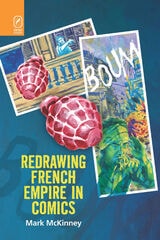
Redrawing French Empire in Comics
Mark McKinney
The Ohio State University Press, 2020
Redrawing French Empire in Comics by Mark McKinney investigates how comics have represented the colonization and liberation of Algeria and Indochina. It focuses on the conquest and colonization of Algeria (from 1830), the French war in Indochina (1946–1954), and the Algerian War (1954–1962). Imperialism and colonialism already featured prominently in nineteenth-century French-language comics and cartoons by Töpffer, Cham, and Petit. As society has evolved, so has the popular representation of those historical forces. French torture of Algerians during the Algerian War, once taboo, now features prominently in comics, especially since 2000, when debate on the subject was reignited in the media and the courts. The increasingly explicit and spectacular treatment in comics of the more violent and lurid aspects of colonial history and ideology is partly due to the post-1968 growth of an adult comics production and market. For example, the appearance of erotic and exotic, feminized images of Indochina in French comics in the 1980s indicated that colonial nostalgia for French Indochina had become fashionable in popular culture. Redrawing French Empire in Comics shows how contemporary cartoonists such as Alagbé, Baloup, Boudjellal, Ferrandez, and Sfar have staked out different, sometimes conflicting, positions on French colonial history.
[more]
The Algerian Memoirs
Days of Hope and CombatHenri Alleg
Seagull Books, 2011
The personal history of journalist Henri Alleg is tied inextricably to the history of the French-Algerian Conflict. Best known for his book The Question, a first-hand account of his torture by French troops during the Algerian war for independence, Alleg is famous both for having brought the issue of French torture to the public eye and for his passionate work as a writer, a newspaperman, and a communist activist.
Beginning with his arrival in Algiers in 1939, when he fell immediately in love with the vibrant city, to his departure in 1965, after Boumédienne seized power, this is a critical work of history made devastatingly personal. Algerian Memoirs recounts his experience under the Vichy regime and such watershed moments in colonial history as the infamous Battle of Algiers. In these pages, he relives the violence and the summary executions, the communist struggle, and his party’s strained relations with the National Liberation Front. And, of course, he revisits in stark detail his arrest and torture by the French, his years in prison, and eventual escape to Czechoslovakia.
In the telling of his own story, Alleg explores some of the key events in the history of Europe and North Africa and in the history of the radical press. This is an irreplaceable document of colonialism and its tragic aftermath.
[more]