Results by title
5 books match the query '1832-1898'
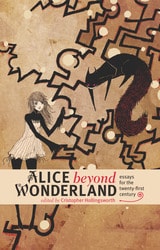
Alice beyond Wonderland
Essays for the Twenty-first CenturyCristopher Hollingsworth
University of Iowa Press, 2008
The scholars in this volume attempt to move beyond the sexually charged permutations of the "Carroll myth," the image of an introverted man fumbling into literary immortality through his love for a prepubescent Alice. Contributions include an essay comparing Dantean and Carrollian underworlds, one investigating child characters as double agents in untamed lands, one placing Wonderland within the geometrical and algebraic “fourth dimension,” one investigating the visual and verbal interplay of hand imagery, and one exploring the influence of Japanese translations of Alice on the Gothic-Lolita subculture of neo-Victorian enthusiasts. This is a bold, capacious, and challenging work.
Alice in Space
The Sideways Victorian World of Lewis CarrollGillian Beer
University of Chicago Press, 2016
Gillian Beer explores Carroll’s work through the speculative gaze of Alice, for whom no authority is unquestioned and everything can speak. Parody and Punch, evolutionary debates, philosophical dialogues, educational works for children, math and logic, manners and rituals, dream theory and childhood studies—all fueled the fireworks. While much has been written about Carroll’s biography and his influence on children’s literature, Beer convincingly shows him at play in the spaces of Victorian cultural and intellectual life, drawing on then-current controversies, reading prodigiously across many fields, and writing on multiple levels to please both children and adults in different ways.
With a welcome combination of learning and lightness, Beer reminds us that Carroll’s books are essentially about curiosity, its risks and pleasures. Along the way, Alice in Space shares Alice’s exceptional ability to spark curiosity in us, too.
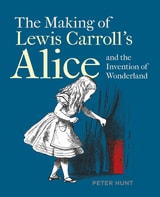
The Making of Lewis Carroll’s Alice and the Invention of Wonderland
Peter Hunt
Bodleian Library Publishing, 2020
Alice’s Adventures in Wonderland and Through the Looking-Glass are two of the most famous, translated, and quoted books in the world. What began as a simple tale told by eccentric Oxford mathematician Charles Dodgson (better known as Lewis Carroll) to Alice Liddell, daughter of the Dean of Christ Church, become a worldwide phenomenon. Fostering film adaptations and retellings, and influencing countless other works, the Alice books have a deeply cherished place in popular culture. Known for their oddities and absurdities, the books have been endlessly interpreted and analyzed for symbolism and hidden messages.
Peter Hunt cuts away the psychological speculation that has grown up around the Alice books, and instead traces the historical sources of their multilayered in-jokes and political, literary, and philosophical satire. He situates the books in the history of children’s literature and explores the local and personal references that the real Alice would have understood. Equally fascinating are the rich fragments about everything from the “sensation” novel to Darwinian theory—not to mention Dodgson’s personal feelings—that he wove into the books as they developed.
Illustrated with manuscripts, portraits, Sir John Tenniel’s original line drawings for the first editions, and contemporary photographs, this is an innovative look at two remarkable stories. The Making of Lewis Carroll’s Alice and the Invention of Wonderland takes us on a guided tour from the treacle wells of Victorian Oxford through an astonishing world of politics, philosophy, humor, and nightmare.
The Nonsense of Kant and Lewis Carroll
Unexpected Essays on Philosophy, Art, Life, and DeathBen-Ami Scharfstein
University of Chicago Press, 2014
Scharfstein begins with essays on the nature of philosophy itself, moving from an autobiographical account of the trials of being a comparativist to philosophy’s function in the outside world to the fear of death in Kant and Hume. From there he explores an impressive array of art: from China and Japan to India and the West; from an essay on sadistic and masochistic body art to one on the epistemology of the deaf and the blind. He then returns to philosophy, writing on Machiavelli and political ruthlessness, then on the ineffable, and closes with a review of Walter Kaufmann’s multivolume look at the essence of humanity, Discovering the Mind. Altogether, these essays are a testament to adventurous thought, the kind that leaps to the furthest reaches of the possible.
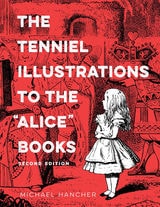
The Tenniel Illustrations to the “Alice” Books, 2nd edition
Michael Hancher
The Ohio State University Press, 2019
This new edition also pays special attention to the material circumstances that enabled and conditioned the printing of the illustrations. The original twelve chapters have been revised and updated throughout, drawing on archival and published resources made available in recent decades. Six chapters are entirely new, explaining how Tenniel’s drawings were professionally hand-engraved on wood blocks; how electrotype replicas were made from those blocks; and what problems could mar the commercial printing of such images—as notoriously happened in the first printing of Alice’s Adventures in Wonderland, which Carroll suppressed on Tenniel’s advice. Also considered for the first time here are the coloring of Tenniel’s black-and-white illustrations, by Tenniel and other artists, and the extraordinary treatment later given to Tenniel’s illustrations by the prestigious Limited Editions Club.