Results by title
31 books match the query '1846-1950'
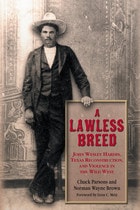
A Lawless Breed
John Wesley Hardin, Texas Reconstruction, and Violence in the Wild WestChuck Parsons
University of North Texas Press, 2013
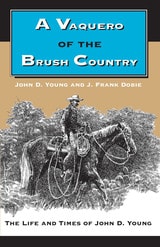
A Vaquero of the Brush Country
The Life and Times of John D. YoungBy John D. Young and J. Frank Dobie
University of Texas Press, 1998
This true story of the Texas brush range and the first cowboys, as thrilling as any tale of fiction, has become a classic in Western literature. It is the story of the land where cattle by tens of thousands were killed on the prairie and where the "Skinning War" was fought. It is the story of the Chisholm Trail up to Abilene and the Platte and of establishing a ranch on the free grass of the Texas Panhandle, of roping elk in Colorado, of trailing Billy the Kid in New Mexico, of the grim lands of the Pecos. And it is the story of John Young, old-time vaquero who was trail driver, hog chaser, sheriff, ranger, hunter of Mexican bandits, horse thief killer, prairie fire fighter, ranch manager, and other things—a man who was also something of a dreamer, a man of imagination.
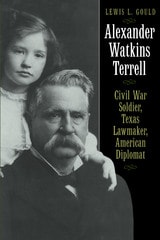
Alexander Watkins Terrell
Civil War Soldier, Texas Lawmaker, American DiplomatBy Lewis L. Gould
University of Texas Press, 2004
Alexander Terrell's career placed him at the center of some of the most pivotal events in nineteenth- and early twentieth-century history, ranging from the Civil War to Emperor Maximilian's reign over Mexico and an Armenian genocide under the Ottoman Empire. Alexander Watkins Terrell at last provides the first complete biographical portrait of this complex figure.
Born in Virginia in 1827, Terrell moved to Texas in 1852, rising to the rank of Confederate brigadier general when the Civil War erupted. Afterwards, he briefly served in Maximilian's army before returning to Texas, where he was elected to four terms in the state Senate and three terms in the House. President Grover Cleveland appointed him minister to the Ottoman Empire, dispatching him to Turkey and the Middle East for four years while the issues surrounding the existence of Christians in a Muslim empire stoked violent confrontations there. His other accomplishments included writing legislation that created the Texas Railroad Commission and what became the Permanent University Fund (the cornerstone of the University of Texas's multibillion-dollar endowment).
In this balanced exploration of Terrell's life, Gould also examines Terrell's views on race, the impact of the charges of cowardice in the Civil War that dogged him, and his spiritual searching beyond the established religions of his time. In his rich and varied life, Alexander Watkins Terrell experienced aspects of nineteenth-century Texas and American history whose effects have continued down to the present day.
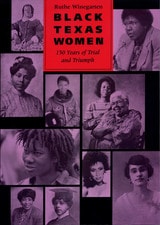
Black Texas Women
150 Years of Trial and TriumphBy Ruthe Winegarten, Janet G. Humphrey & Frieda Werden, consulting editors
University of Texas Press, 1994
Women of all colors have shaped families, communities, institutions, and societies throughout history, but only in recent decades have their contributions been widely recognized, described, and celebrated. This book presents the first comprehensive history of black Texas women, a previously neglected group whose 150 years of continued struggle and some successes against the oppression of racism and sexism deserve to be better known and understood.
Beginning with slave and free women of color during the Texas colonial period and concluding with contemporary women who serve in the Texas legislature and the United States Congress, Ruthe Winegarten organizes her history both chronologically and topically. Her narrative sparkles with the life stories of individual women and their contributions to the work force, education, religion, the club movement, community building, politics, civil rights, and culture. The product of extensive archival and oral research and illustrated with over 200 photographs, this groundbreaking work will be equally appealing to general readers and to scholars of women's history, black history, American studies, and Texas history.
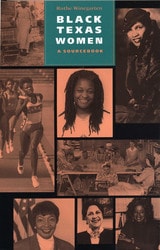
Black Texas Women
A SourcebookBy Ruthe Winegarten
University of Texas Press, 1994
When Black Texas Women: 150 Years of Trial and Triumph was published in 1995, it was acclaimed as the first comprehensive history of black women's struggles and achievements. This companion volume contains the original source materials that Ruthe Winegarten uncovered during her extensive research.
Like a time capsule of black women's history, A Sourcebook includes petitions from free women of color, lawsuits, slave testimonies, wills, plantation journals, club minutes, autobiographies, ads, congressional reports, contracts, prison records, college catalogues, newspaper clippings, protest letters, and much more.
In addition to the documents, a biographical section highlights the lives of women from various walks of life. The book concludes with a timeline that begins in 1777 and reaches to 1992. This wealth of original material will be a treasure trove for scholars and general readers interested in the emerging field of black women's history.

Brave Black Women
From Slavery to the Space ShuttleBy Ruthe Winegarten and Sharon Kahn
University of Texas Press, 1997
Brave black women have played important roles in American history. Before the Emancipation Proclamation in 1863, black women bore the bonds of slavery with courage and strength. Since Emancipation, black women have supported schools, churches, and civic organizations, entered many professions, and helped to build strong communities. This book dramatizes their impressive story and celebrates their achievements.
Writing especially for students in grades four through eight, Ruthe Winegarten and Sharon Kahn trace the history of black women from slavery until today. Their story includes many heroines, from Emily Morgan, "the Yellow Rose of Texas," to pioneer aviator Bessie Coleman, astronaut Mae Jemison, opera singer Barbara Conrad, actresses Phylicia Rashad and Debbie Allen, and Congresswoman Barbara Jordan, whose life story forms the final chapter.
In addition to these famous black women, the book also profiles teachers, businesswomen, civil rights leaders, community activists, doctors, nurses, athletes, musicians, artists, and political leaders. Adapted from the award-winning Black Texas Women: 150 Years of Trial and Triumph, it will be fascinating reading for children and their parents and grandparents, teachers, and librarians.
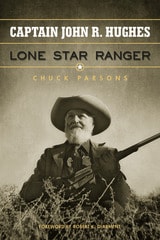
Captain John R. Hughes
Lone Star RangerChuck Parsons
University of North Texas Press, 2011
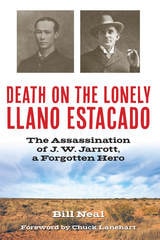
Death on the Lonely Llano Estacado
The Assassination of J. W. Jarrott, a Forgotten HeroBill Neal
University of North Texas Press, 2017
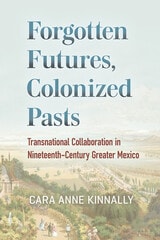
Forgotten Futures, Colonized Pasts
Transnational Collaboration in Nineteenth-Century Greater MexicoCara Anne Kinnally
Bucknell University Press, 2019
Published by Bucknell University Press. Distributed worldwide by Rutgers University Press.
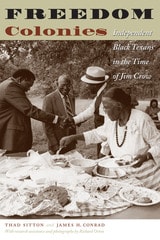
Freedom Colonies
Independent Black Texans in the Time of Jim CrowBy Thad Sitton and James H. Conrad
University of Texas Press, 2005
Friends of the Dallas Public Library Award, 2006
Best Book on East Texas, East Texas Historical Association, 2007
In the decades following the Civil War, nearly a quarter of African Americans achieved a remarkable victory—they got their own land. While other ex-slaves and many poor whites became trapped in the exploitative sharecropping system, these independence-seeking individuals settled on pockets of unclaimed land that had been deemed too poor for farming and turned them into successful family farms. In these self-sufficient rural communities, often known as "freedom colonies," African Americans created a refuge from the discrimination and violence that routinely limited the opportunities of blacks in the Jim Crow South.
Freedom Colonies is the first book to tell the story of these independent African American settlements. Thad Sitton and James Conrad focus on communities in Texas, where blacks achieved a higher percentage of land ownership than in any other state of the Deep South. The authors draw on a vast reservoir of ex-slave narratives, oral histories, written memoirs, and public records to describe how the freedom colonies formed and to recreate the lifeways of African Americans who made their living by farming or in skilled trades such as milling and blacksmithing. They also uncover the forces that led to the decline of the communities from the 1930s onward, including economic hard times and the greed of whites who found legal and illegal means of taking black-owned land. And they visit some of the remaining communities to discover how their independent way of life endures into the twenty-first century.

Friedrichsburg
A NovelBy Friedrich Armand Strubberg
University of Texas Press, 2012
Summerfield G. Roberts Award for a Work of Creative Writing, Sons of the Texas Republic, 2013
First published in Germany in 1867, this fascinating autobiographical novel of German immigrants on the antebellum Texas frontier provides a trove of revelations about the myriad communities that once called the Hill Country home.
Founded in 1846, Fredericksburg, Texas, was established by German noblemen who enticed thousands of their compatriots to flee their overcrowded homeland with the prospect of free land in a place that was portrayed as a new Garden of Eden. Few of the settlers, however, were prepared for the harsh realities of the Texas frontier or for confrontation with the Comanche. In his 1867 novel Friedrichsburg, Friedrich Armand Strubberg, a.k.a. Dr. Schubbert, interwove his personal story with a fictional romance to capture the flavor of Fredericksburg, Texas, during its founding years when he served as the first colonial director.
Now available in a contemporary translation, Friedrichsburg brings to life the little-known aspects of life among these determined but often ill-equipped settlers who sought to make the transition to a new home and community on the Texas frontier. Opening just as a peace treaty is being negotiated between the German newcomers and the Comanches, the novel describes the unlikely survival of these fledgling homesteads and provides evidence that support from the Delaware Indians, as well as the nearby Mormon community of Zodiac, was key to the Germans’ success. Along the way, Strubberg also depicts the laying of the cornerstone to the Vereinskirche, the blazing of an important new road to Austin, exciting hunting scenes, and an admirable spirit of cultural cohesion and determined resilience. In so doing, he resurrects a fascinating lost world.
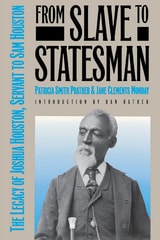
From Slave to Statesman
The Legacy of Joshua Houston, Servant to Sam HoustonPatricia Smith Prather
University of North Texas Press, 1993
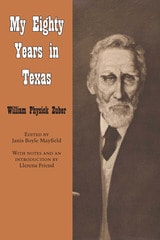
My Eighty Years in Texas
By William Physick Zuber
University of Texas Press, 1971
Almost a century and a half went into the making of My Eighty Years in Texas. It began as a diary, kept by fifteen-year-old William Physick Zuber after he joined Sam Houston’s Texas army in 1836, hoping he could emulate the heroism of American Revolutionary patriots. Although his hopes were never realized, Zuber recorded the privations, victories, and defeats of armies on the move during the Texas Revolution, the Indian campaigns, and, as he styled it, the Confederate War.
In 1910, at the age of ninety, Zuber began the enormous task of transcribing his diaries and his memories for publication. After his death in 1913, the handwritten manuscript, 1, was placed in the Texas State Archives, where it was used as a reference source by students and scholars of Texas history. Over a half century after Zuber’s death, Janis Boyle Mayfield finally brought his publication plans to fruition.
Zuber details his early zest for learning and his laborious methods of self-education. He tells of the trials of organizing and teaching schools in the sparsely populated plains. He recalls the day-by-day happenings of a private soldier in the Texas army of 1836, the Texas Militia, and the Confederate army—including the mishaps of army life and the encounters with enemies from San Jacinto to Cape Girardeau. After the Civil War, his interest turns to the politics of Reconstruction, the veterans’ pension, and the founding of the Texas Veterans Association.
This is the story of and by an outspoken Texian, complete with his attitudes, principles, and moralizings, and the nineteenth-century style and flavor of his writing.
Included as an appendix is “An Escape from the Alamo,” the account of Moses Rose for which Zuber, who was a prolific writer, was best known. A historiography of the Rose story, a bibliography of Zuber’s published and unpublished writings, annotation, and an introduction are provided by Llerena Friend.

No Hope for Heaven, No Fear of Hell
The Stafford-Townsend Feud of Colorado County, Texas 1871-1911James Kearney
University of North Texas Press, 2016
Rawhide Ranger, Ira Aten
Enforcing Law on the Texas FrontierBob Alexander
University of North Texas Press, 2011
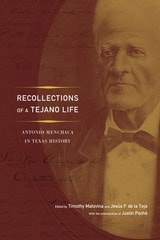
Recollections of a Tejano Life
Antonio Menchaca in Texas HistoryEdited by Timothy Matovina and Jesús F. de la Teja
University of Texas Press, 2013
San Antonio native, military veteran, merchant, and mayor pro tem José Antonio Menchaca (1800–1879) was one of only a few Tejano leaders to leave behind an extensive manuscript of recollections. Portions of the document were published in 1907, followed by a “corrected” edition in 1937, but the complete work could not be published without painstaking reconstruction. At last available in its entirety, Menchaca’s book of reminiscences captures the social life, people, and events that shaped the history of Texas’s tumultuous transformation during his lifetime. Highlighting not only Menchaca’s acclaimed military service but also his vigorous defense of Tejanos’ rights, dignity, and heritage, Recollections of a Tejano Life charts a remarkable legacy while incorporating scholarly commentary to separate fact from fiction.
Revealing how Tejanos perceived themselves and the revolutionary events that defined them, this wonderfully edited volume presents Menchaca’s remembrances of such diverse figures as Antonio López de Santa Anna, Jim Bowie, Davy Crockett, Sam Houston, General Adrián Woll, Comanche chief “Casamiro,” and Texas Ranger Jack Hays. Menchaca and his fellow Tejanos were actively engaged in local struggles as Mexico won her independence from Spain; later many joined the fight to establish the Republic of Texas, only to see it annexed to the United States nine years after the Battle of San Jacinto. This first-person account corrects important misconceptions and brings previously unspoken truths vividly to life.
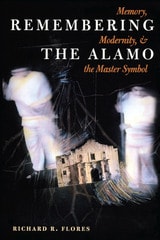
Remembering the Alamo
Memory, Modernity, and the Master SymbolBy Richard R. Flores
University of Texas Press, 2002
"Remember the Alamo!" reverberates through Texas history and culture, but what exactly are we remembering? Over nearly two centuries, the Mexican victory over an outnumbered band of Alamo defenders has been transformed into an American victory for the love of liberty. Why did the historical battle of 1836 undergo this metamorphosis in memory and mythology to become such a potent master symbol in Texan and American culture?
In this probing book, Richard Flores seeks to answer that question by examining how the Alamo's transformation into an American cultural icon helped to shape social, economic, and political relations between Anglo and Mexican Texans from the late nineteenth to the mid-twentieth centuries. In the first part of the book, he looks at how the attempts of heritage society members and political leaders to define the Alamo as a place have reflected struggles within Texas society over the place and status of Anglos and Mexicans. In the second part, he explores how Alamo movies and the transformation of Davy Crockett into an Alamo hero/martyr have advanced deeply racialized, ambiguous, and even invented understandings of the past.
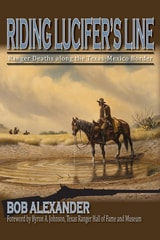
Riding Lucifer's Line
Ranger Deaths along the Texas-Mexico BorderBob Alexander
University of North Texas Press, 2013
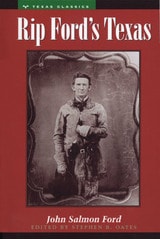
Rip Ford’s Texas
By John Salmon Ford
University of Texas Press, 1963
The Republic of Texas was still in its first exultation over independence when John Salmon "Rip" Ford arrived from South Carolina in June of 1836. Ford stayed to participate in virtually every major event in Texas history during the next sixty years. Doctor, lawyer, surveyor, newspaper reporter, elected representative, and above all, soldier and Indian fighter, Ford sat down in his old age to record the events of the turbulent years through which he had lived. Stephen Oates has edited Ford's memoirs to produce a clear and vigorous personal history of Texas.
Texas Ranger Captain William L. Wright
Richard B. McCaslin
University of North Texas Press, 2021
Texas Ranger John B. Jones and the Frontier Battalion, 1874-1881
Rick Miller
University of North Texas Press, 2012
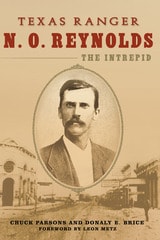
Texas Ranger N. O. Reynolds, the Intrepid
Chuck Parsons
University of North Texas Press, 2014
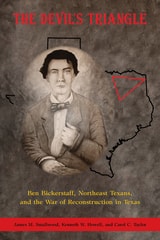
The Devil's Triangle
Ben Bickerstaff, Northeast Texans, and the War of Reconstruction in TexasJames M. Smallwood
University of North Texas Press, 2007

The Fate of Texas
The Civil War and the Lone Star StateCharles D. Grear
University of Arkansas Press, 2018
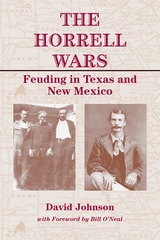
The Horrell Wars
Feuding in Texas and New MexicoDavid Johnson
University of North Texas Press, 2014
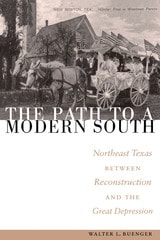
The Path to a Modern South
Northeast Texas between Reconstruction and the Great DepressionBy Walter L. Buenger
University of Texas Press, 2001
The forces that turned Northeast Texas from a poverty-stricken region into a more economically prosperous area.
Winner, Texas State Historical Association Coral H. Tullis Memorial Award for best book on Texas history, 2001
Federal New Deal programs of the 1930s and World War II are often credited for transforming the South, including Texas, from a poverty-stricken region mired in Confederate mythology into a more modern and economically prosperous part of the United States. By contrast, this history of Northeast Texas, one of the most culturally southern areas of the state, offers persuasive evidence that political, economic, and social modernization began long before the 1930s and prepared Texans to take advantage of the opportunities presented by the New Deal and World War II.
Walter L. Buenger draws on extensive primary research to tell the story of change in Northeast Texas from 1887 to 1930. Moving beyond previous, more narrowly focused studies of the South, he traces and interconnects the significant changes that occurred in politics, race relations, business and the economy, and women's roles. He also reveals how altered memories of the past and the emergence of a stronger identification with Texas history affected all facets of life in Northeast Texas.
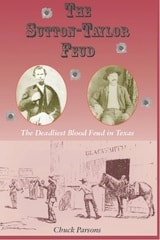
The Sutton-Taylor Feud
The Deadliest Blood Feud in TexasChuck Parsons
University of North Texas Press, 2009
Tracking the Texas Rangers
The Nineteenth CenturyBruce A. Glasrud
University of North Texas Press, 2012
Vengeance Is Mine
The Scandalous Love Triangle That Triggered the Boyce-Sneed FeudBill Neal
University of North Texas Press, 2011
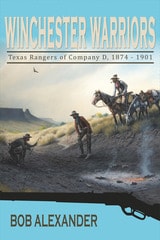
Winchester Warriors
Texas Rangers of Company D, 1874-1901Bob Alexander
University of North Texas Press, 2009
Yours to Command
The Life and Legend of Texas Ranger Captain Bill McDonaldHarold J. Weiss Jr.
University of North Texas Press, 2009