Results by title
3 books match the query '1848-1918'

Exclusive Revolutionaries
Liberal Politics, Social Experience, and National Identity in the Austrian Empire, 1848-1914Pieter M. Judson
University of Michigan Press, 1996
In the mid-1800s, Judson argues, German liberal activists built an effective political movement whose ideology was rooted in its members' social experience in voluntary associations. The liberals were committed to the creation of a market economy based on personal property rights, to a society based on the values of individual self-improvement and personal respectability, and to a fundamental distinction between active and passive citizenship. They were determined to achieve a harmonious community of free peoples, in which personal enlightenment would bring an end to the divisive influence of localism, ethnicity, religion, and feudal social hierarchy.
Yet after 1880, as newer, more radical mass political movements threatened their political fortunes, the liberals forged a German nationalist politics based increasingly on ethnic identity. Their emphasis on national identity became a way for former liberals to hold together an increasingly diverse coalition of German speakers who had little in common outside of their shared language. Only "Germanness" bridged the dangerous gulf between social classes. This nationalism helped the liberals to compete for power in the multinational, multicultural Austrian Empire down to 1914, but it left a legacy of nationalist extremism and tolerance of anti-Semitism that continues to influence political cultures in the former lands of the Habsburg Monarchy today.
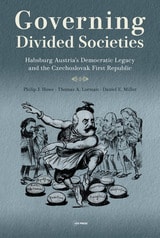
Governing Divided Societies
Habsburg Austria’s Democratic Legacy and the Czechoslovak First RepublicPhilip Howe
Central European University Press, 2026
Consociationalism has proven its worth as a model for describing contemporary democracies and diagnosing their ills. By exploring the institutions and practices of the Habsburg Monarchy before 1918 and the Czechoslovak First Republic, Howe, Lorman, and Miller prove the value of the consociational theory in analyzing the past. They hold that a multitude of parties, frequent cabinet changes, and reliance on cabinets of experts do not necessarily signal flawed democracies. In fact, they are features of consociationalism. This volume challenges historians and social scientists to view the Austrian half of the Habsburg Monarchy before 1918 as evolving toward consociational democracy and the Czechoslovak First Republic as a fully consociational state.

In the Solitude of My Soul
The Diary of Genevieve Breton, 1867-1871James Smith Allen
Southern Illinois University Press, 1994
Originally published to glowing reviews and literary prizes in France in 1985, this revealing diary not only recounts the moving and tragic relationship of its author, Geneviève Bréton, with the rising young nineteenth-century artist Henri Regnault, it also serves as a valuable historical document concerning the social, cultural, and political life of the French Second Empire.
The young Geneviève Bréton began her journal in 1867 as a consolation for the death of her eldest brother, Antoine. She met Regnault soon after on a trip to Rome. Throughout the next four years of their relationship, Bréton eloquently describes the personal, cultural, and political turbulence that affected her life. Writing against the backdrop of France’s fateful conflict with Prussia and the hardships and dangers of the siege of Paris and the Commune, Bréton, with innate candor and lyricism, creates a text that beautifully illuminates French art, literature, family life, society, and politics of the time. Her poignant account of her love for and engagement to Regnault reveals special insight into the life and mind of an extraordinary, though little known, literary talent. At Regnault’s death in 1871 during the Franco–Prussian War, the expression of her anguish is as much testimony to the political and cultural disorder of the time as it is to her own personal tragedy.
Following Bréton’s own instructions that she left before her death in 1918, this English version of the diary reincorporates material that was deleted from the French edition. Graced by rare photographs of the Bréton family as well as Regnault’s paintings, the book contains a touching foreword by the author’s granddaughter, Daphné Doublet-Vaudoyer. In its first English translation, it is a book for lovers of French life and culture, as well as students of French history; literature, and art.