Results by title
3 books match the query '1848-1925'
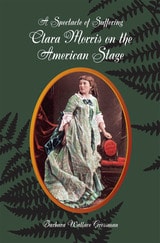
A Spectacle of Suffering
Clara Morris on the American StageBarbara Wallace Grossman
Southern Illinois University Press, 2009
Once called "America's greatest actress," renowned for the passion and power of her performances, Clara Morris (1847-1925) has been largely forgotten. A Spectacle of Suffering: Clara Morris on the American Stage is the first full-length study of the actress's importance as a feminist in the late nineteenth and early twentieth centuries. Detailing her daunting health problems and the changing tastes in entertainment that led to her retirement from the stage, Barbara Wallace Grossman explores Morris's dramatic reinvention as an author. During a second robust career, she published hundreds of newspaper and magazine articles and nine books—six works of fiction and three memoirs.
Grossman draws on the fifty-four-volume diary that Morris kept from 1868 until 1924, as well as on the manuscript fragments and notes of journalist George T. MacAdam, who died in 1929 before completing the actress's biography. Grossman provides a dramatic account of Morris's life and work from her troubled early years, through an unhappy marriage, morphine addiction, and invalidism, to the challenges of touring, the decline of her artistic reputation, and the demands of the writing career she pursued so tenaciously. A Spectacle of Suffering reveals how Morris, even after experiencing blindness and the loss of her home, livelihood, and family, did not succumb to despair and found comfort in the small pleasures of her circumscribed life.
A Spectacle of Suffering recovers an important figure in American theatre and ensures that Morris will be remembered not simply as an actress but as a respected writer and beloved public figure, admired for her courage in dealing with adversity. The book, which is enhanced by twenty-four illustrations, is the only published biography of Clara Morris. It is as much a tribute to the power of the human spirit as it is an effective means of exploring American theatre and society in the Gilded Age.

Questions of Form
Logic and Analytic Proposition from Kant to CarnapJoelle ProustTranslated by Anastasios Albert Brenner
University of Minnesota Press, 1989
Questions of Form was first published in 1989. Minnesota Archive Editions uses digital technology to make long-unavailable books once again accessible, and are published unaltered from the original University of Minnesota Press editions.
In Questions on Form, Joelle Proust traces the concept of the analytic proposition from Kant's development of the notion down to its place in the work of Rudolf Carnap, a founder of logical empiricism and a key figure in contemporary analytic philosophy. Using a method known in France as topique comparative,she provides a rigorous exposition of analyticity, situating it within four major philosophical systems—those of Kant, Bolzano, Frege, and Carnap—and clearly delineating its development from one system to the next.
Proust takes as her point of departure Kant's distinction between analytic and synthetic judgments. Though she makes clear that Kant drew on Locke, Hume, and Leibniz, she argues that his notion of analyticity was innovative, not simply an elaboration of something already found in their work. She shows that the analytic proposition unexpectedly (given its modest status in Kant) came to play an important part in efforts to convert problems considered "transcendental" into questions of belonging to formal logic.
Ultimately, her comparison of their systems reveals that the concept of the analytic, however specific its rile in each, remains linked to a foundationalist strategy—in effect, to the transcendentalist questions Kant used when he reinterpreted the findings of his empiricist predecessors. Hence, this book's provocative claim: today's so-called logical empiricism owes much more to Kant's notion of science than to Hume's.
Word and Object in Husserl, Frege, and Russell
The Roots of Twentieth-Century PhilosophyClaire Oritz Hill
Ohio University Press, 2001
In search of the origins of some of the most fundamental problems that have beset philosophers in English-speaking countries in the past century, Claire Ortiz Hill maintains that philosophers are treating symptoms of ills whose causes lie buried in history. Substantial linguistic hurdles have blocked access to Gottlob Frege's thought and even to Bertrand Russell's work to remedy the problems he found in it. Misleading translations of key concepts like intention, content, presentation, idea, meaning, concept, etc., severed analytic philosophy from its roots.
Hill argues that once linguistic and historical barriers are removed, Edmund Husserl's critical study of Frege's logic in his 1891 Philosophy of Arithmetic provides important insights into issues in philosophy now.
She supports her conclusions with analyses of Frege's, Husserl's, and Russell's works, including Principia Mathematica, and with linguistic analyses of the principal concepts of analytic philosophy. She re-establishes links that existed between English and Continental thought to show Husserl's expertise as a philosopher of mathematics and logic who had been Weierstrass's assistant and had long maintained ties with Cantor, Hilbert, and Zermelo.