Results by title
3 books match the query '1850-1950'
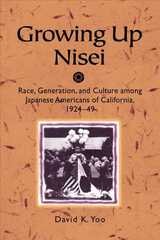
Growing Up Nisei
Race, Generation, and Culture among Japanese Americans of California, 1924-49David K. Yoo
University of Illinois Press, 2000
The place occupied by Japanese Americans within the annals of United States history often begins and ends with their cameo appearance as victims of incarceration after the bombing of Pearl Harbor. In this provocative work, David K. Yoo broadens the scope of Japanese American history to examine how the second generation—the Nisei—shaped its identity and negotiated its place within American society.
Tracing the emergence of a dynamic Nisei subculture, Yoo shows how the foundations laid during the 1920s and 1930s helped many Nisei adjust to the upheaval of the concentration camps. Schools, racial-ethnic churches, and the immigrant press served not merely as waystations to assimilation but as tools by which Nisei affirmed their identity in connection with both Japanese and American culture. The Nisei who came of age during World War II formed identities while negotiating complexities of race, gender, class, generation, economics, politics, and international relations.
A thoughtful consideration of the gray area between accommodation and resistance, Growing Up Nisei reveals the struggles and humanity of a forgotten generation of Japanese Americans.
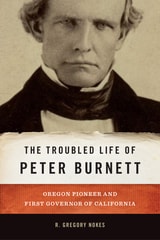
The Troubled Life of Peter Burnett
Oregon Pioneer and First Governor of CaliforniaR. Gregory Nokes
Oregon State University Press, 2018
It was one heck of a resume. Yet with the exception of the wagon road to California, in none of these roles was Burnett considered successful or well remembered. Indeed, he resigned from many of his most important positions, including the governorship, where he was widely perceived a failure.
Burnett’s weakness was that he refused to take advice from others. He insisted on marching to his own drum, even when it led to some terrible decisions. A former slaveholder, he could never seem to get beyond his single-minded goal of banning blacks and other minorities from the West.
The Troubled Life of Peter Burnett is the first full-length biography of this complicated character. Historians, scholars, and general readers with an interest in Western history will welcome R. Gregory Nokes’ accessible and deeply researched account.
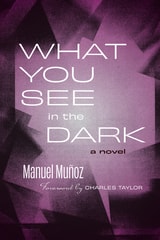
What You See in the Dark
A NovelManuel Muñoz and Charles Taylor
Northwestern University Press, 2025
A doomed love story unfolds alongside the production of Psycho in 1950s Bakersfield, California
Muñoz’s debut novel tells the story of Teresa, an aspiring singer too far away from Los Angeles to share the city’s glamour. In Dan Watson, the most desirable man in town, she believes she has found someone to help her realize those dreams. But when a famous actress arrives from Hollywood with a legendary director in tow, local gossip about Teresa and Dan turns to speculation about the celebrity visitors there to work on what will become an iconic, groundbreaking film of madness and murder at a roadside motel: Alfred Hitchcock’s Psycho. Framed by a foreword from film critic Charles Taylor, Muñoz’s haunting tale reflects “the slow winding down of everything that once seemed certain.”