Results by title
9 books match the query '1852-1936'
The East Florida Expeditions of Clarence Bloomfield Moore
Clarence Bloomfield Moore, edited by Jeffrey M. Mitchem
University of Alabama Press, 1999
A Dan Josselyn Memorial Publication
A foundational archaeological record of the Indigenous cultures and ancient landscapes of Florida's eastern coast.
The East Florida Expeditions of Clarence Bloomfield Moore, edited and introduced by Jeffrey M. Mitchem, is an essential collection of pioneering archaeological research documenting the prehistoric cultures of Florida's eastern coast. Bringing together seventeen of Moore's landmark publications originally issued between 1892 and 1903, this volume preserves the results of extensive explorations conducted along the Atlantic coast of Florida, from the Georgia border southward to Lake Okeechobee, with particular emphasis on the St. Johns River and its tributaries.
Through detailed descriptions, illustrations, and field observations, Moore records the excavation of burial mounds, shell heaps, sand mounds, and Indigenous habitation sites that yielded a wealth of artifacts, including pottery, tools, ornaments, and human remains. His investigations provided some of the earliest systematic archaeological documentation in Florida and helped establish the foundations for understanding regional cultural chronologies and settlement patterns. Many of the sites he examined have since been altered or destroyed, making these reports an irreplaceable record of Florida's archaeological heritage.
Enhanced by Mitchem's scholarly introduction and analysis of subsequent research, this volume connects Moore's groundbreaking work to modern archaeological scholarship. It remains a foundational resource for archaeologists, anthropologists, historians, and anyone interested in the Indigenous history and prehistoric cultures of East Florida.
The Georgia and South Carolina Coastal Expeditions of Clarence Bloomfield Moore
Clarence Bloomfield Moore, edited by Lewis Larson
University of Alabama Press, 1998
A Dan Josselyn Memorial Publication
A foundational record of the archaeological discoveries that revealed the prehistoric cultures of the Georgia and South Carolina coasts.
The Georgia and South Carolina Coastal Expeditions of Clarence Bloomfield Moore, edited and introduced by Lewis Larson, is an essential resource for understanding the archaeology and Indigenous history of the southeastern United States. This comprehensive volume brings together Moore's pioneering investigations of the coastal regions and major river systems of Georgia and South Carolina, preserving detailed records of archaeological sites, burial mounds, artifacts, and Native American communities that shaped the region's prehistory. Many of the sites documented by Moore have since been damaged, altered, or destroyed, making his observations an invaluable record for researchers and historians today.
Originally conducted in the late nineteenth and early twentieth centuries, Moore's expeditions yielded significant discoveries concerning prehistoric mound-building cultures, ceremonial practices, settlement patterns, and burial traditions along the Georgia Coast, South Carolina Coast, Savannah River, and Altamaha River. Although modern archaeological standards have evolved considerably, Moore's careful documentation preserved information that might otherwise have been lost forever. Larson's scholarly introduction places these investigations within the context of contemporary archaeological research and provides readers with updated interpretations of Moore's findings.
Combining historical scholarship, archaeology, and Indigenous studies, this volume remains a foundational reference for anyone seeking to understand the rich cultural heritage and archaeological legacy of the American Southeast.
The Louisiana and Arkansas Expeditions of Clarence Bloomfield Moore
Clarence Bloomfield Moore
University of Alabama Press, 2004
A Dan Josselyn Memorial Publication
The ninth and final volume in the C.B. Moore reprint series that covers archaeological discoveries along North American Waterways.
Clarence B. Moore (1852-1936), a wealthy Philadelphia socialite, paper company heir, and photographer, made the archaeology of the Southeast his passion. Beginning in the 1870s, Moore systematically explored prehistoric sites along the major waterways of the region, from the Ohio River south to Florida and as far west as Texas, publishing his findings, at his own expense, with the Academy of Natural Sciences of Philadelphia.
This volume, the final in a series of nine, includes Moore’s investigations along waterways of Arkansas and Louisiana—the Ouachita, Red, Saline, Black, Tensas, and Atchafalaya Rivers—in three complete field sessions ending in 1909, 1912, and 1913. He located and mapped more than 185 mounds and cemeteries. Artifacts recovered in this territory, such as ceramic effigy pots, earthenware pipes, arrowheads, celts, and projectile points, include some of the most important ones discovered by Moore in his 47 years of excavating. Included in this volume is a CD containing the 69 color illustrations from all the original expedition volumes.
The elaborate earthwork of Poverty Point, located in West Carroll Parish, Louisiana, is perhaps the most remarkable archaeological site presented in the volume. In some cases, Moore documented sites along the tributaries that have since been destroyed by river action or looters. In other cases, the National Register of Historic Sites and concerned landowners in Arkansas and Louisiana have preserved the record of aboriginal peoples and their life ways that was first illuminated by Moore's sophisticated study.
The Lower Mississippi Valley Expeditions of Clarence Bloomfield Moore
Clarence Bloomfield Moore
University of Alabama Press, 1998
A Dan Josselyn Memorial Publication
A foundational record of the archaeological discoveries that revealed the ancient cultures of the Lower Mississippi Valley.
The Lower Mississippi Valley Expeditions of Clarence Bloomfield Moore, edited and introduced by Dan F. Morse and Phyllis A. Morse, is an indispensable resource for the study of the archaeology, prehistory, and Indigenous cultures of the Lower Mississippi Valley. This comprehensive volume gathers in a single facsimile edition the pioneering investigations conducted by Clarence Bloomfield Moore, whose extensive surveys of the Mississippi River and its tributaries helped establish the foundation of archaeological research throughout the American South.
Spanning archaeological sites in present-day Arkansas, Mississippi, and surrounding regions, the book documents mound centers, cemeteries, burial practices, pottery traditions, and settlement patterns associated with the prehistoric peoples of the Mississippi Valley. Moore's meticulous field observations preserved invaluable information about many sites that have since been altered, damaged, or destroyed, making his work an enduring source of archaeological data. The volume includes investigations of significant sites such as Toltec, Parkin, Mound City, and Wickliffe, all of which contributed to a deeper understanding of the region's rich cultural heritage.
Enhanced by scholarly commentary and contextual analysis from the Morses, this edition bridges the history of archaeology and modern research, offering readers a vital reference for exploring the ancient societies, ceremonial landscapes, and Indigenous traditions of the Lower Mississippi Valley.
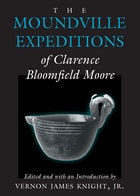
The Moundville Expeditions of Clarence Bloomfield Moore
Clarence Bloomfield MooreClarence Bloomfield Moore, edited and introduced by Vernon James Knight, Jr.
University of Alabama Press, 1996
The Moundville Expeditions of Clarence Bloomfield Moore brings together, in a handsome facsimile edition, two landmark studies documenting the first large-scale archaeological investigations of Alabama's most important prehistoric Native American site. Originally published in 1905 and 1907 and presented here with an introduction by noted archaeologist Vernon James Knight Jr., the volume preserves the pioneering work of Clarence Bloomfield Moore, one of the most influential figures in American archaeology, whose river expeditions helped establish the foundations of Southeastern archaeological research.
Focusing on Moundville, one of the most important ceremonial centers of the Mississippian world, this richly illustrated work offers readers an unparalleled window into the discovery and interpretation of a site that shapes our understanding of Indigenous history in the American South.
Produced in an oversized format that showcases Moore's photographs, maps, plates, and field documentation, this volume is both a vital scholarly resource and an impressive keepsake worthy of any personal or institutional library. Of interest to archaeologists, historians, anthropologists, students of Native American history, Alabama history enthusiasts, museum professionals, collectors of regional history, and readers fascinated by the exploration of America's ancient past.
Other books in this same series include sites in Florida, Georgia, Mississippi, Arkansas, and Louisiana.
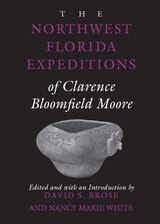
The Northwest Florida Expeditions of Clarence Bloomfield Moore
Clarence Bloomfield Moore
University of Alabama Press, 1999
A Dan Josselyn Memorial Publication
A foundational archaeological record of the Indigenous cultures, mound sites, and ancient landscapes of Northwest Florida and the Gulf Coast.
The Northwest Florida Expeditions of Clarence Bloomfield Moore, edited by David S. Brose and featuring scholarly contributions by Nancy Marie White, is an essential volume for understanding the archaeological heritage of Northwest Florida and the broader southeastern United States. This comprehensive collection brings together Moore's pioneering archaeological reports from expeditions conducted between 1901 and 1918, preserving some of the earliest documented investigations of prehistoric Native American sites in Florida, southern Alabama, and Georgia.
Traveling along rivers, coastal waterways, and estuaries, Moore examined earthen mounds, shell middens, burial sites, and village settlements, uncovering ceramics, tools, skeletal remains, and other artifacts that provided crucial insight into the Indigenous cultures that inhabited the region for thousands of years. Many of the sites he recorded have since been altered or lost, making his detailed observations an invaluable source for modern archaeological research.
The volume is enhanced by an extensive introduction from Brose and White, who place Moore's work within the context of contemporary archaeological theory and Southeastern cultural history while assessing the lasting significance of his discoveries. Combining the history of archaeology with modern interpretation, this book remains a foundational reference for scholars, students, and anyone interested in the Indigenous past of the Gulf Coast and Southeast.
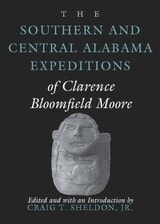
The Southern and Central Alabama Expeditions of Clarence Bloomfield Moore
Clarence Bloomfield Moore, edited and introduced by Craig T. Sheldon Jr.
University of Alabama Press, 2001
Covering 19 years of excavations, this volume provides an invaluable collection of Moore's pioneering archaeological investigations along Alabama's waterways.
In 1996, The University of Alabama Press published The Moundville Expeditions of Clarence Bloomfield Moore, which covered a large part of Moore's early archaeological expeditions to the state of Alabama. This volume collects the balance of Moore's Alabama expeditions, with the exception of those Moore made along the Tennessee River, which will be collected in another, forthcoming volume focusing on the Tennessee basin.
This volume includes:
Certain Aboriginal Remains of the Alabama River (1899);
Certain Aboriginal Remains of the Tombigbee River(1901);
a portion of Certain Aboriginal Remains of the Northwest Florida Coast (1901);
The So-Called "Hoe-Shaped Implement" (1903);
Aboriginal Urn-Burial in the United States (1904);
A Form of Urn-Burial on Mobile Bay (1905);
Certain Aboriginal Remains of the Lower Tombigbee River (1905);
Certain Aboriginal Remains on Mobile Bay and on Mississippi Sound (1905);
a portion of Mounds of the Lower Chattahoochee and Lower Flint Rivers (1907);
a portion of The Northwest Florida Coast Revisited(1918).
Craig Sheldon's comprehensive introduction focuses both on the Moore expeditions and on subsequent archaeological excavations at
sites investigated by Moore. Sheldon places Moore's archaeological work in the context of his times and against the backdrop of similar investigations in the Southeast. Sheldon discusses practical matters, such as the various assistants Moore employed and their roles in these historic expeditions. He provides brief vignettes of daily life on the Gopher and describes Moore's work habits, revealing professional and personal biographical details previously unknown about this enigmatic archaeologist.
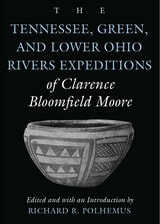
The Tennessee, Green, and Lower Ohio Rivers Expeditions of Clarence Bloomfield Moore
Clarence Bloomfield Moore, edited and introduced by Richard R. Polhemus
University of Alabama Press, 2002
A landmark archaeological record of the ancient peoples, sacred landscapes, and river civilizations of the Tennessee and Ohio Valleys.
The Tennessee, Green, and Lower Ohio Rivers Expeditions of Clarence Bloomfield Moore, edited and introduced by Richard R. Polhemus, is a significant contribution to the study of North American archaeology and the Indigenous cultures of the Tennessee, Kentucky, and Ohio River valleys. This richly illustrated volume brings together the results of Moore's northernmost expeditions, conducted during the early twentieth century, and preserves a remarkable record of archaeological sites, burial grounds, mound complexes, and artifact assemblages discovered along some of the most important waterways in the eastern United States.
Drawing on extensive field investigations, Moore documented numerous prehistoric sites that later became the focus of major archaeological excavations or were ultimately lost to river erosion, reservoir construction, or other forms of development. His reports contain invaluable information about Indigenous lifeways, ceremonial practices, trade networks, and mortuary traditions, including notable discoveries at sites such as Indian Knoll on Kentucky's Green River. These observations continue to provide researchers with important primary-source data for understanding the region's ancient cultures.
Enhanced by Polhemus's scholarly introduction and updated contextual analysis, this volume bridges the history of archaeology with contemporary interpretation. It remains an essential reference for archaeologists, historians, anthropologists, and anyone interested in the rich cultural heritage of the Tennessee, Green, and Lower Ohio River valleys.
The West and Central Florida Expeditions of Clarence Bloomfield Moore
Clarence Bloomfield Moore, edited and with an introduction by Jeffrey M. Mitchem
University of Alabama Press, 1999
This compilation of Moore's publications on western and central Florida provides all of his archaeological data on the region's mounds and prehistoric canals in a single volume.
The name Clarence B. Moore is familiar to every archaeologist interested in the southeastern United States. This amateur archaeologist's
numerous scientific expeditions to the region resulted in dozens of well-illustrated publications, the value of which increases daily as many of the sites he investigated continue to be destroyed by modern development.
Moore invested considerable time and effort exploring Florida's archaeological sites, devoting more pages of published reports and articles to Florida than to any other state. Because of the wealth of material on Florida, Moore's Florida expedition publications have been
collected in three separate volumes, all published within the Classics in Southeastern Archaeology series. The thirteen papers reproduced in this
volume present the results of Moore's research in West and Central Florida.
Moore's first and last expeditions were to Florida and spanned almost fifty years of archaeological investigations. Following the eastern river drainages to central and western Florida, in 1900 Moore concentrated his efforts along the Florida Gulf Coast, spurred by the exciting
discoveries of Frank Hamilton Cushing at Key Marco in 1896. Although this region is rich in mound sites, many sites located by Moore in the early
years of this century had already been destroyed by construction and lime processing. In addition to mound groupings—some containing masses of skeletal remains—Moore found a number of sites connected by a network of prehistoric canals. Several of the sites located by Moore contained European trade goods and have been used to trace the early wanderings of the conquistadores in the New World.
Moore's early work on the Florida Gulf Coast succeeded in preserving much of the archaeological record in this area. He is to be credited with remarkable insights concerning mound and earthwork construction, artifact trade networks, and chronology development.