Results by title

3 books match the query '1857-1919'

cover of Animal Labor and Colonial Warfare

Animal Labor and Colonial Warfare

James L. Hevia

University of Chicago Press, 2018

Until well into the twentieth century, pack animals were the primary mode of transport for supplying armies in the field. The British Indian Army was no exception. In the late nineteenth century, for example, it forcibly pressed into service thousands of camels of the Indus River basin to move supplies into and out of contested areas—a system that wreaked havoc on the delicately balanced multispecies environment of humans, animals, plants, and microbes living in this region of Northwest India.
 
In Animal Labor and Colonial Warfare, James Hevia examines the use of camels, mules, and donkeys in colonial campaigns of conquest and pacification, starting with the Second Afghan War—during which an astonishing 50,000 to 60,000 camels perished—and ending in the early twentieth century. Hevia explains how during the nineteenth and twentieth centuries a new set of human-animal relations were created as European powers and the United States expanded their colonial possessions and attempted to put both local economies and ecologies in the service of resource extraction. The results were devastating to animals and human communities alike, disrupting centuries-old ecological and economic relationships. And those effects were lasting: Hevia shows how a number of the key issues faced by the postcolonial nation-state of Pakistan—such as shortages of clean water for agriculture, humans, and animals, and limited resources for dealing with infectious diseases—can be directly traced to decisions made in the colonial past. An innovative study of an underexplored historical moment, Animal Labor and Colonial Warfare opens up the animal studies to non-Western contexts and provides an empirically rich contribution to the emerging field of multispecies historical ecology.
 
[more]
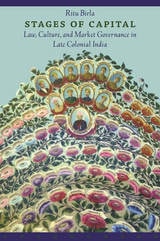
cover of Stages of Capital: Law, Culture, and Market Governance in Late Colonial India

Stages of Capital

Law, Culture, and Market Governance in Late Colonial India

Ritu Birla

Duke University Press, 2009

In Stages of Capital, Ritu Birla brings research on nonwestern capitalisms into conversation with postcolonial studies to illuminate the historical roots of India’s market society. Between 1870 and 1930, the British regime in India implemented a barrage of commercial and contract laws directed at the “free” circulation of capital, including measures regulating companies, income tax, charitable gifting, and pension funds, and procedures distinguishing gambling from speculation and futures trading. Birla argues that this understudied legal infrastructure institutionalized a new object of sovereign management, the market, and along with it, a colonial concept of the public. In jurisprudence, case law, and statutes, colonial market governance enforced an abstract vision of modern society as a public of exchanging, contracting actors free from the anachronistic constraints of indigenous culture.

Birla reveals how the categories of public and private infiltrated colonial commercial law, establishing distinct worlds for economic and cultural practice. This bifurcation was especially apparent in legal dilemmas concerning indigenous or “vernacular” capitalists, crucial engines of credit and production that operated through networks of extended kinship. Focusing on the story of the Marwaris, a powerful business group renowned as a key sector of India’s capitalist class, Birla demonstrates how colonial law governed vernacular capitalists as rarefied cultural actors, so rendering them illegitimate as economic agents. Birla’s innovative attention to the negotiations between vernacular and colonial systems of valuation illustrates how kinship-based commercial groups asserted their legitimacy by challenging and inhabiting the public/private mapping. Highlighting the cultural politics of market governance, Stages of Capital is an unprecedented history of colonial commercial law, its legal fictions, and the formation of the modern economic subject in India.
[more]
cover of The Politics of Preference: Democratic Institutions and Affirmative Action in the United States and India

The Politics of Preference

Democratic Institutions and Affirmative Action in the United States and India

Sunita Parikh

University of Michigan Press, 1997

Sunita Parikh examines the history and fate of affirmative action programs in two ethnically heterogeneous democracies, the United States and India. Affirmative action programs in the United States represent a controversial policy about which the American public feel at best ambivalence and at worst hostility, while in India the expansion of reservation policies in recent years has led to riots and contributed to the fall of governments. And yet these policies were not particularly controversial when they were introduced. How the policy traveled from these auspicious beginnings to its current predicament can best be understood, according to Parikh, by exploring the changing political conditions under which it was introduced, expanded, and then challenged.
Although they are in many respects very different countries, India and the United States are important countries in which to study the implementation of ascriptive policies like affirmative action, according to Parikh. They are both large, heterogeneous societies with democratic political systems in which previously excluded groups were granted benefits by the majorities that had historically oppressed them. Parikh argues that these policies were the product of democratic politics--which required political parties to mobilize existing groups as voters--and the ethnically heterogeneous nature of Indian and U.S. society--where ethnic markers are particularly salient sources of identification as groups. Affirmative action in both countries was introduced because it could be used to solidify and expand electoral coalitions by giving benefits to defined minority groups, according to Parikh. As the policy became better known, it became more disliked by non-targeted groups, and it was no longer an appeal which was cost free for politicians.
This book will be of interest to social scientists concerned with race and ethnic relations and with the comparative study of political and social systems.
Sunita Parikh is Assistant Professor of Political Science, Columbia University.
[more]