Results by title
6 books match the query '1858-1932'
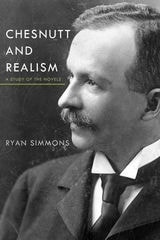
Chesnutt and Realism
A Study of the NovelsRyan Simmons
University of Alabama Press, 2006
Provides an important examination of Charles Chesnutt as a practitioner of realism
Although Chesnutt is typically acknowledged as the most prominent African American writer of the realist period, scholars have paid little attention to the central question of this study: what does it mean to call Chesnutt a realist? As a writer whose career was restricted by the dismal racial politics of his era, Chesnutt refused to conform to literary conventions for depicting race. Nor did he use his imaginative skills to evade the realities he and other African Americans faced. Rather, he experimented with ways of portraying reality that could elicit an appropriate, proportionate response to it, as Ryan Simmons demonstrates in extended readings of each of Chesnutt’s novels, including important unpublished works overlooked by previous critics.
In addition, Chesnutt and Realism addresses a curiously neglected subject in American literary studies—the relationship between American literary realism and race. By taking Chesnutt seriously as a contributor to realism, this book articulates the strategies by which one African American intellectual helped to define the discourses that influenced his fate.

My Friend, Julia Lathrop
Jane Addams
University of Illinois Press, 1935
The memoir reveals a great deal about the influence of Hull-House on the social and political history of the early twentieth century. An introduction by long-time Addams scholar Anne Firor Scott provides a broader account of women's work in voluntary associations.

The Absent Man
The Narrative Craft of Charles W. ChesnuttCharles Duncan
Ohio University Press, 1998
As the first African-American fiction writer to achieve a national reputation, Ohio native Charles W. Chesnutt (1858–1932) in many ways established the terms of the black literary tradition now exemplified by such writers as Toni Morrison, Alice Walker, and Charles Johnson.
Following the highly autobiographical nonfiction produced by Frederick Douglass, Harriet Jacobs, and other slave narrative writers, Chesnutt’s complex, multi-layered short fiction transformed the relationship between African-American writers and their readers. But despite generous praise from W. D. Howells and other important critics of his day, and from such prominent readers as William L. Andrews, Henry Louis Gates, Jr., and Eric Sundquist in ours, Chesnutt occupies a curiously ambiguous place in American literary history.
In The Absent Man, Charles Duncan demonstrates that Chesnutt’s uneasy position in the American literary tradition can be traced to his remarkable narrative subtlety. Profoundly aware of the delicacy of his situation as a black intellectual at the turn of the century, Chesnutt infused his work with an intricate, enigmatic artistic vision that defies monolithic or unambiguously political interpretation, especially with regard to issues of race and identity that preoccupied him throughout his career.
In this first book-length study of the innovative short fiction, Duncan devotes particular attention to elucidating these sophisticated narrative strategies as the grounding for Chesnutt’s inauguration of a tradition of African-American fiction.
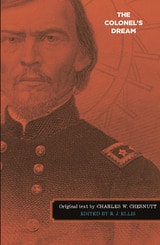
The Colonel's Dream
Charles W. Chesnutt
West Virginia University Press, 2014
Charles Waddell Chesnutt (1858-1932) was an African American writer, essayist, Civil Rights activist, legal-stenography businessman, and lawyer whose novels and short stories explore race, racism, and the problematic contours of African Americans’ social and cultural identities in post-Civil War South. He was the first African American to be published by a major American publishing house and served as a beacon-point for future African American writers.
The Colonel’s Dream, written in 1905, is a compelling tale of the post-Civil War South’s degeneration into a region awash with virulent racist practices against African Americans: segregation, lynchings, disenfranchisement, convict-labor exploitation, and endemic violent repression. The events in this novel are powerfully depicted from the point of view of a philanthropic but unreliable southern white colonel. Upon his return to the South, the colonel learns to abhor this southern world, as a tale of vicious racism unfolds. Throughout this narrative, Chesnutt confronts the deteriorating position of African Americans in an increasingly hostile South. Upon its publication The Colonel’s Dream was considered too controversial and unpalatable because of its bitter criticisms of southern white prejudice and northern indifference, and so this groundbreaking story failed to gain public attention and acclaim.
This is the first scholarly edition of The Colonel’s Dream. It includes an introduction and notes by R. J. Ellis and works to reestablish this great novel’s reputation.
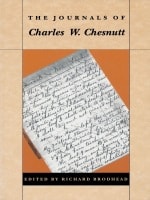
The Journals of Charles W. Chesnutt
Charles W. Chesnutt
Duke University Press, 1993
Though he achieved literary success in his time, Chesnutt has only recently been rediscovered and his contribution to American literature given its due. The only known private diary from a nineteenth-century African American author, these pages offer a fascinating glimpse into Chesnutt's everyday experience as he struggled to win the goods of education in the world of the post-Civil War South. An extraordinary portrait of the self-made man beset by the urgencies and difficulties of self-improvement in a racially discriminatory society, Chesnutt's journals unfold a richly detailed local history of postwar North Carolina. They also show with great force how the world of the postwar South obstructed--and, unexpectedly, assisted--a black man of driving intellectual ambitions.
Universes without Us
Posthuman Cosmologies in American LiteratureMatthew A. Taylor
University of Minnesota Press, 2013
During the nineteenth and early twentieth centuries, a wide variety of American writers proposed the existence of energies connecting human beings to cosmic processes. From varying points of view—scientific, philosophical, religious, and literary—they suggested that such energies would eventually result in the perfection of individual and collective bodies, assuming that assimilation into larger networks of being meant the expansion of humanity’s powers and potentialities—a belief that continues to inform much posthumanist theory today.
Universes without Us explores a lesser-known countertradition in American literature. As Matthew A. Taylor’s incisive readings reveal, the heterodox cosmologies of Edgar Allan Poe, Henry Adams, Charles Chesnutt, and Zora Neale Hurston reject the anthropocentric fantasy that sees the universe as a kind of reservoir of self-realization. For these authors, the world can be made neither “other” nor “mirror.” Instead, humans are enmeshed with “alien” processes that are both constitutive and destructive of “us.” By envisioning universes no longer our own, these cosmologies picture a form of interconnectedness that denies any human ability to master it.
Universes without Us demonstrates how the questions, possibilities, and dangers raised by the posthuman appeared nearly two centuries ago. Taylor finds in these works an untimely engagement with posthumanism, particularly in their imagining of universes in which humans are only one category of heterogeneous thing in a vast array of species, objects, and forces. He shows how posthumanist theory can illuminate American literary texts and how those texts might, in turn, prompt a reassessment of posthumanist theory. By understanding the posthuman as a materialist cosmology rather than a technological innovation, Taylor extends the range of thinkers who can be included in contemporary conversations about the posthuman.