Results by title
4 books match the query '1863-1933'
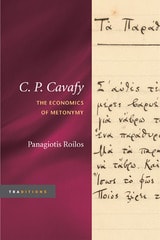
C. P. Cavafy
The Economics of MetonymyPanagiotis Roilos
University of Illinois Press, 2009
Konstantinos P. Kavafis--known to the English-reading world as C. P. Cavafy--has been internationally recognized as an important poet and attracted the admiration of eminent literary figures such as E. M. Forster, F. T. Marinetti, W. H. Auden, George Seferis, and James Merrill. Cavafy's idiosyncratic poetry remains one of the most influential and perplexing voices of European modernism.
Focusing on Cavafy's intriguing work, this book navigates new territories in critical theory and offers an interdisciplinary study of the construction of (homo)erotic desire in poetry in terms of metonymic discourse and anti-economic libidinal modalities. Panagiotis Roilos shows that problematizations of art production, market economy, and trafficability of erôs in diverse late-nineteenth and early twentieth-century European sociocultural and political contexts were re-articulated in Cavafy's poetry in new subversive ways that promoted an "unorthodox" discursive and libidinal anti-economy of jouissance.
Modern Odysseys
Cavafy, Woolf, Césaire, and a Poetics of IndirectionMichelle Zerba
The Ohio State University Press, 2021
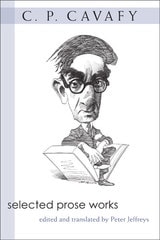
Selected Prose Works
C. P. Cavafy
University of Michigan Press, 2010
"A timely and significant supplement to C. P. Cavafy's poetic canon, the Selected Prose Works, eloquently translated and meticulously annotated by Peter Jeffreys, allows readers yet another creative engagement with the greatest Greek writer since antiquity. Marked by a wide and intriguing range of interests, these writings offer a rich trove for general readers and scholars alike, who from now on will find it difficult to discuss Cavafy's poetry without reference to his prose."
---Vassilis Lambropoulos, C. P. Cavafy Professor of Modern Greek, University of Michigan
"Peter Jeffreys gives us a rare gift---access to Constantine Cavafy's prose work. Through his intelligent translation, these texts, which range from literary criticism to personal notes, from essays on the Greek language to the Parthenon marbles, offer unexpected entry into the mind of one of the twentieth century's greatest literary figures. They suggest new ways to think about not only Cavafy's remarkable poetry but also the man himself. An indispensable companion for all who love Cavafy's work."
---Gregory Jusdanis, The Ohio State University
"Once you've felt his influence, you won't need telling that Cavafy is unique in his distinctive voice, his quiet humor, and his unassertive culture."
---Frank Kermode, Formerly Lord Northcliffe Professor of Modern English Literature at University College, London, and King Edward VII Professor of English Literature, University of Cambridge
Constantine Cavafy (1863–1933) is arguably the most important modern poet of Greece and Greek culture. Long a resident of Egypt and then Constantinople, Cavafy in his poems and prose works tended to focus on Greco-Roman antiquity, on Greece's national identity, and on personal and mythological images and themes including his ethnicity and sexual identity. He wrote some 150 poems, plus a few works in collaboration with his brother John.
His poetical works have been much translated and discussed, but until now, very little consideration has been given to his prose works, in part because many remained untranslated from the original Greek. This book collects Cavafy's more interesting prose pieces and translates those that originally appeared in Greek.
Of the forty pieces included, only thirteen have previously appeared in print, and of those thirteen only a few were in English. The pieces include essays, "prose poems," short stories, self-assessments, and considerations of other poets, including John Keats. This significant new collection offers a different perspective on the well-known Cavafy.
Peter Jeffreys, Assistant Professor of English at Suffolk University in Boston, received a Doctorate in English Literature from the University of Toronto. He is the author of Eastern Questions: Hellenism and Orientalism in the Writings of E.M. Forster and C.P. Cavafy and the editor of The Forster-Cavafy Letters: Friends at a Slight Angle. He is currently working on a bio-critical study of C. P. Cavafy and the decadent tradition.
Cover image copyright © David Levine
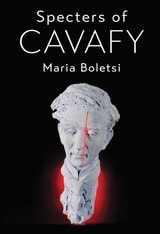
Specters of Cavafy
Maria Boletsi
University of Michigan Press, 2024
Winner of the European Society of Modern Greek Studies Best Monograph Award
The Greek Alexandrian poet C. P. Cavafy (1863–1933) has been recognized as a central figure in European modernism and world literature. His poetry explored the conditions for animating the past and making lost worlds or people haunt the present. Yet he also described himself as “a poet of the future generations.” Indeed, his writings address concerns and desires that permeate the twentieth and twenty-first centuries. How does poetry concerned with the past, memory, loss, and death, carry futurity? How does it haunt, and how is it haunted by, future presents?
Specters of Cavafy broaches these questions by proposing spectral poetics as a novel approach to Cavafy’s work. Drawing from theorizations of specters and haunting, it develops spectrality as a lens for revisiting Cavafy’s poetry and prose, fiction and nonfiction, as well as his poetry’s bearing on our present. By examining Cavafy’s spectral poetics, the book’s first part shows how conjurations work in his writings, and how the spectral permeates the entanglement of modernity and haunting, and of irony and affect. The second part traces the afterlives of specific poems in the Western imagination since the 1990s, in Egypt’s history of debt and colonization, and in Greece during the country’s recent debt crisis. Beyond its original contribution to Cavafy studies, the book proposes tools and modes of reading that are broadly applicable in literary and cultural studies.