Results by title
4 books match the query '1863-1947'

"History Is Bunk"
Assembling the Past at Henry Ford's Greenfield VillageJessie Swigger
University of Massachusetts Press, 2014
In 1916 a clearly agitated Henry Ford famously proclaimed that “history is more or less bunk.” Thirteen years later, however, he opened the outdoor history museum Greenfield Village in Dearborn, Michigan. It was written history's focus on politicians and military heroes that was bunk, he explained. Greenfield Village would correct this error by celebrating farmers and inventors.
The village eventually included a replica of Thomas Edison's Menlo Park, New Jersey, laboratory, the Wright brothers' cycle shop and home from Dayton, Ohio, and Ford's own Michigan birthplace. But not all of the structures were associated with famous men. Craft and artisan shops, a Cotswold cottage from England, and two brick slave cabins also populated the village landscape. Ford mixed replicas, preserved buildings, and whole-cloth constructions that together celebrated his personal worldview.
Greenfield Village was immediately popular. But that only ensured that the history it portrayed would be interpreted not only by Ford but also by throngs of visitors and the guides and publicity materials they encountered. After Ford's death in 1947, administrators altered the village in response to shifts in the museum profession at large, demographic changes in the Detroit metropolitan area, and the demands of their customers.
Jessie Swigger analyzes the dialogue between museum administrators and their audiences by considering the many contexts that have shaped Greenfield Village. The result is a book that simultaneously provides the most complete extant history of the site and an intimate look at how the past is assembled and constructed at history museums.
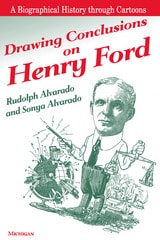
Drawing Conclusions on Henry Ford
Rudolph Alvarado and Sonya Alvarado
University of Michigan Press, 2001
For years political cartoons have shaped the often unflattering popular view of public figures. One of the most-often-portrayed figures of the twentieth century was the automobile manufacturer Henry Ford. Through editorial drawings, a vivid picture of Ford was presented that became the source of myths that surrounded him and continue even to this day.
Drawing Conclusions on Henry Ford is the first and only collection that brings together in one volume these editorial cartoons. They date back as far as the time Ford introduced the Model T in 1908 and extend forward to the introduction of the Model A and subsequent V8 engines in the 1930s. They illustrate the emergence of many of the popular myths surrounding Henry Ford, as seen and understood by the average citizen during the opening decades of the twentieth century. With 150 illustrations, the reader is able to trace the evolving images of Ford from a time period when caricature images of public figures were a primary source of information about those persons. Sometimes funny, sometimes sharp and critical, these cartoons are entertaining in themselves. Viewed as a whole, they create anew view of the Henry Ford story.
Rudolph V. Alvarado is a freelance writer and museum consultant, as well as the former programs leader for the Henry Ford Museum and Greenfield Village. Sonya Y. Alvarado is an instructor of English, at Eastern Michigan University and a former adjunct faculty member, Wayne State University.

History Is Bunk
Assembling the Past at Henry Ford's Greenfield VillageSwigger Jessie
University of Massachusetts Press, 0

Life in the Shadows of the Crystal Palace, 1910–1927
Ford Workers in the Model T EraClarence Hooker
University of Wisconsin Press, 1997