Results by title
3 books match the query '1864-1937'
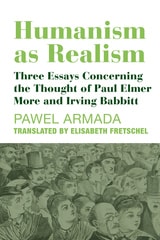
Humanism as Realism
Three Essays Concerning the Thought of Paul Elmer More and Irving BabbittLisa Fretschel
St. Augustine's Press, 2023
"This is a protreptic book. Its main goal is to encourage people to undertake independent studies or more generally, simply to think independently. If we want to think for ourselves, and not like preprogrammed humanoids, we can’t do so in a vacuum. We have to lean on something. In the Author’s view, the more than century-old writings of Paul Elmer More and Irving Babbitt are perfectly suited to the role of such a support for us, living in the here and now. They make it possible for us to dig ourselves out from underneath the heaps of opinions, “principles” or “theories” that allegedly can’t be rejected, that we’re obliged to follow, but that have a paralyzing and dumbing-down effect on us, making our lives from the
outset seems like the dream of a childish old man."
––Taken from the Preface by Pawel Armada
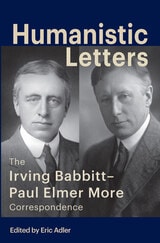
Humanistic Letters
The Irving Babbitt-Paul Elmer More CorrespondenceEric Adler
University of Missouri Press, 2023

The Philosophy of Paul Elmer More
The Ethical Basis of Life and LettersFolke Leander
University of Missouri Press, 2026
Folke Leander (1910-1981) was a prolific and internationally known Swedish philosopher. He is best known in the United States as an explicator of the New Humanism, an informal movement of literary and cultural criticism founded by Paul Elmer More (1864-1937) and Irving Babbitt (1865-1933).
Leander’s manuscript for The Philosophy of Paul Elmer More was completed in the early 1970s, but because of the academic environment at the time and the book’s special philosophical focus, Leander was unable to find a publisher. Since then, the work existed only as a typescript, a copy of which he left with Claes G. Ryn, his former student and collaborator, in the hope that one day in more favorable intellectual circumstances it might be published.
Leander is rare among the scholars of the New Humanism for his first-rate philosophical training, depth of insight, and clarity of expression. In The Philosophy of Paul Elmer More he grapples carefully and precisely with the most fundamental tenets of the New Humanism. Although very supportive of the movement, Leander provides essential critiques of its contentions—and even improves upon some of them in crucial respects. In a series of concise, limpid chapters, he explains and assesses such fundamental—but often hazily understood—Humanist concepts as the “inner check,” “naturalism,” and “the higher will.” The result is a book essential for anyone who wants to understand the New Humanism.